Friday, March 31, 2006
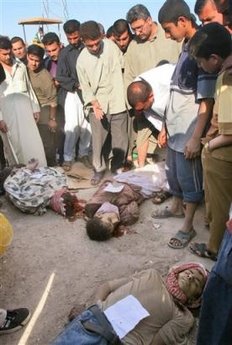
DAILY WAR NEWS FOR FRIDAY, MARCH 31, 2006 PHOTO: Iraqis look at the bodies of three men who were found dead Thursday March 30, 2006 in Ramadi, Iraq. Unknown gunmen killed 3 people, two Egyptians and one Iraqi, and left notes on their bodies claiming that they were homosexuals and agents, police said. (AP Photo Bilal Hussein) Bring ‘em on: Britain’s casualties of Iraq war total 6,700 said MoD. Bring ‘em on: Mortar shell fell on the headquarters of multi-national forces in Kirkuk. No casualties reported. Security Incident: Update to yesterday: At least 27 people died in violence on Thursday, including a 4-year-old girl who was killed when a car bomb exploded near the Shiite Ali Basha mosque in Baghdad's eastern Kryaat neighborhood. Security Incident: Three civilians killed and three wounded by mortar round in northeast Baghdad. Soldiers discovered six bullet-riddled bodies wearing handcuffs in western Baghdad. There were male and between the ages of 25 and 30. Security Incident: FALLUJA - A policeman was killed when gunmen fired on his patrol in Falluja 50 km (30 miles) west of Baghdad, police said. BAGHDAD - A 62-year-old male prisoner died on Thursday of an apparent heart attack at Abu-Ghraib jail, a U.S. military statement said. Security Incident: At least four civilians killed by car bomb in al-Aathamiah district of Baghdad. Salem Hameed, member of the al-Daawa Party, gunned down in western Baghdad. Majed Hameed, also a member of that political party, also shot dead in al-Adel district in Baghdad. Two more civilians killed by a mortar shell that hit their car in al-Ghazaliah district of Baghdad. Four Iraqis killed and 22 others injured by IED and car bombs in Baghdad (some of these may have been mentioned yesterday). Security Incident: Two civilians killed by unknown gunmen in two separate shooting incidents in Kirkuk. Security Incident: Eight oil workers killed in Baiji. They were taken off the bus they were on and accused of being “agents of the occupation”. One person killed in Baghdad and 11 injured by two roadside bombings. Two killed and seven injured in a car bombing in Baghdad. Five injured in a suicide car bombing near a police convoy. Three workers from Ramadi General Hospital were found blindfolded and shot in the head, with notes that said al Qaeda in Iraq did the killings, and the men were killed for being homosexuals (story of the picture above). Security Incidents: Gunmen target Baghdad firm, killing eight workers. The officials said the assailants were wearing the familiar green camouflage uniforms of the Interior Ministry's Majhaweer, an elite force that has taken the lead in a number of operations against insurgents in and around Baghdad. Security Incidents: BAGHDAD - The bodies of two people were found in two different districts in the capital, police said. BAGHDAD - Three civilians were wounded when a roadside bomb hit a police patrol in central Baghdad, police said. KIDNAPPING REPORTS
Iraqis Are Most Likely Kidnap Victims The most likely kidnap victims in Iraq increasingly are Iraqis, with an average of 10 to 20 taken hostage every day for nearly three years, a U.S. official in Baghdad said Thursday. U.S. Embassy spokeswoman Elizabeth Colton said freedom comes at a heavy price, with ransoms averaging between $20,000 and $30,000. "It's huge," she said. "There are a lot more Iraqis being held hostage in Iraq now than most people are aware of." The puzzle is how Iraqis come up with such large ransom payments in a country where unemployment is estimated between 28 and 40 percent and the average monthly wage is about $100. Equally unclear is who the kidnappers are — they have grown increasingly bold and now are striking in broad daylight. Carloads of masked gunmen have driven up to several Baghdad businesses this month, charging through the doors and seizing employees inside. At least 90 Iraqis have been picked up in such mass kidnappings in March; there has been no word on any of the captives. Police say they are investigating who is behind the attacks, and whether they are linked. Some officials speculate that the assailants are insurgents running out of money.
RAMADI - A Syrian journalist and an Iraqi political analyst were released by kidnappers after being held for three days
Iraqi Shopkeeper Still Haunted by Hostage Ordeal Uncertainty ate away at him. Some days he was beaten, at other times the gunmen reminded him of the sectarian violence that has pushed his country close to civil war. "Are you Sunni or Shi'ite?," he was constantly asked. The answer was always one given by Iraqis who refuse to accept they have been torn apart by communal strife. "I told them I am a Muslim," he said proudly. That earned him more whippings, until he finally said he was a Sunni, the minority sect once dominant under Saddam. But his hopes began fading: "I felt like I was already dead." Back at his home, his family was frantically borrowing money to pay the $20,000 ransom demanded by his captors. After two weeks of being kept underground and blindfolded, Ahmed was released. "They let me go. But they warned me not to say anything about them or they would kill me," he said. Still gripped by fear, he imagines gunmen will suddenly turn up again, as they do across Iraq. "I am afraid of my own shadow," he said. "Whenever I walk down the street I look behind me." (The original ‘deck of cards’ issued by US authorities just after the war started contained 40% Shi’ites. – Susan)
Elated Carroll Family Plead for Iraq Hostages "My wish is that this joyous occasion will offer hope to all the mothers of Iraq whose children have been kidnapped. May they all be returned safely and swiftly to their mothers' arms," she said in a statement from her Illinois home. Thousands of Iraqis have been kidnapped in the past three years, many for ransom. More than 200 foreigners have also been taken prisoner. Many have been freed but others have been killed by militant groups making political demands. Earlier, outside the Boston offices of The Christian Science Monitor, Carroll's editor Richard Bergenheim read statement from her family. "Our hearts are full. We are elated by Jill's safe release," it said. "Our thoughts are with the families of others still being held hostage in Iraq and we hope that their loved ones will return safely to them soon."
Iraq Hostage Believes Ransom Paid A peace activist held hostage in Iraq for nearly four months says he believes a ransom was paid for his freedom. Harmeet Singh Sooden said he had no evidence but "instinct" told him money had been exchanged for his release and that of his two fellow hostages. Mr Sooden, 33, a Canadian who lives in New Zealand, was freed last week after being held by militants in Baghdad. New Zealand Prime Minister Helen Clark said her government had not paid a ransom for Mr Sooden. The activist for the Christian Peacemaker Teams (CPT) group was released unhurt along with fellow Canadian James Loney and Briton Norman Kember. A fourth hostage captured at the same time in Baghdad, US citizen Tom Fox, was found shot dead earlier this month. Speaking publicly for the first time since his release, Mr Sooden said he believed he and his colleagues had been captured "to fund the insurgency". "They kept telling us that 'if we wanted to kill you, you wouldn't have been given the treatment you have been given'," Reuters news agency reported. He said it was highly unusual his captors had been absent when the three men were freed from a house west of Baghdad by multinational forces, adding that he disapproved of the payment of ransom to secure the release of hostages. "I wanted to be released. I didn't want money to be paid for me to be released because I know where that money is going to go," he said. "I'd rather it went on social work or feeding people who need food, not on killing people." Report: Carroll Threatened Before Release Jill Carroll's kidnappers reportedly warned her before her release that she might be killed if she cooperated with the Americans or went to the Green Zone, saying it was infiltrated by insurgents. The freelance writer for The Christian Science Monitor, who was freed by her captors Thursday and dropped off at a branch office of the Iraqi Islamic Party, was later escorted to the Green Zone by the U.S. military, the newspaper said Friday. OTHER REPORTS Garbage Dump Second Home for Iraqi Children Every day before school, seven year old Mohammed Fariq Rostam goes with his father on their donkeys to scrounge through Sulaimaniyah's garbage dump. Mohammed's eyes often burn from the smoke that rises from the rubbish, and his forehead bears a scar from when he slipped on trash and sliced it on a piece of glass. But he is proud when he helps his father find a source of income for their five member family. That could be aluminium cans that they can resell in the market, or a piece of electrical equipment that has been thrown away but can be repaired. Shoes and clothes, though torn or stained, are also prized. "This isn't a place for him," said Mohammed’s father Fariq, 31, who is illiterate and unemployed. "I want him to have a better future." The dump lies in an industrial area 11 kilometers southwest of Sulaimaniyah city, near seven villages that are home to more than 100 families. It has become a source of income for many like the Rostams who are out of work and looking for anything that can be resold or reused. Zereen Abdullah, 12, sloshes through garbage with a pair of muddy boots - one of her many finds. She has rashes all over her body from the trash that itches her skin, but triumphantly announces, "I have found three dolls, and whenever I go home I play with them." Parents in the area close to the dump criticize the government for not providing basic services for their children such as kindergartens, parks or a playground. Their relatives do not visit, they say, because of the stench of the rubbish heap, which clings to their clothes even when they return. For local children, though, the dump is an a big attraction, so much so that some say they dream of becoming garbage workers when they grow up - much to the consternation of parents, who they want more for their families. "Our children have nowhere to go during vacations except this garbage dump," said Parween Muhammed, 48. Iraq Politician Says 1,700 Sunnis Killed in Unrest A Sunni Arab leader said on Thursday more than 1,700 Sunnis had been killed in Iraq's sectarian bloodshed since a major Shi'ite mosque was bombed a month ago, but it was unclear how he arrived at the figure. The spiralling violence between Shi'ites and minority Sunnis, with death squads and militias leaving scores of horribly mutilated corpses in the streets every day, has stoked fears of an all-out sectarian civil war. "Up to now, more than 1,700 bodies of Sunnis have been delivered to the morgue," Adnan al-Dulaimi, who heads the largest Sunni bloc in the newly elected parliament, told Reuters. "The killing is continuing and every day nearly 50 Sunnis get killed and we expect this number will rise in the coming days." Dulaimi said the 1,700 was for the main central morgue alone and did not include smaller morgues in smaller hospitals. But he did not say how he had determined the figure amid the confusion and uncertainty that shrouds everything in postwar Iraq. Morgue officials do not have comprehensive records but they estimate 1,100-1,500 victims of sectarian violence, from all sides, have been brought to the central morgue over that time. Iraq Accuses US of Damaging Ancient City American forces are damaging the ancient city of Kish and must withdraw from the 5,000-year-old archaeological site, an Iraqi ministry said Thursday. The Ministry of State for Tourism and Antiquities Affairs said U.S. forces had set up a camp in Kish, near Hillah, about 60 miles south of Baghdad. In a statement, the ministry said the U.S. military was preventing anyone from entering this important archaeological site to assess the damage, which was not specified. The U.S. military had no immediate comment. Last year, the British Museum said that U.S.-led troops using the ancient Iraqi city of Babylon as a base had damaged and contaminated artifacts dating back thousands of years in one of the world's most important ancient sites. The U.S. military then said all earth moving had been halted and that all engineering work were discussed with the head of the Babylon museum. Mosul Slips Out of Control As the Bombers Move In When the 3,000 men of the mainly Kurdish 3rd Brigade of the 2nd Division of the Iraqi Army go on patrol it is at night, after the rigorously enforced curfew starts at 8pm. Their vehicles, bristling with heavy machine guns, race through the empty streets of the city, splashing through pools of sewage, always trying to take different routes to avoid roadside bombs. "The government cannot control the city," said Hamid Effendi, an experienced ex-soldier who is Minister for Peshmerga Affairs in the Kurdistan Regional Government. He is influential in the military affairs of Mosul province with its large Kurdish minority, although it is outside the Kurdish region. He believes: "The Iraqi Army is only a small force in Mosul, the Americans do not leave their bases much and some of the police are connected to the terrorists." In the days since a suicide bomber killed 43 young men waiting to join the Iraqi army at a recruitment centre near Mosul last week soldiers in the city have been expecting a second attack. He claims that the situation is very different today when the people of Mosul "welcome us, hate the terrorists and give us information about them". But the general's own account of recent events in the city show the depth of the divisions between Arabs and Kurds as well the Arab hostility to the occupation. For instance at the end of last year the Arab chief of police Ahmed al-Jibouri, appointed after the uprising, was dismissed with 40 of his officers for aiding the insurgents. "He was telling people that every family should have one of its members in the resistance," recalled the general. In reality, Mosul city, like so many places in Iraq, is an ethnic minefield which the US has sought to negotiate with varying success since the overthrow of Saddamin 2003. At first US commanders did not want Kurdish forces in the city fearing the reaction of the Arabs. General David Petraeus of the 101st Airborne tried to bring on board the Sunni Arabs but when he left this policy languished. Since November 2004 Arabs in the province claim that the US has simply joined forces with the Kurds after the mass desertion of the Arab police and army. "The Americans are now just one more of the tribes of Mosul," said one Arab source alleging that the CIA got all its information from Kurdish intelligence. Most soldiers have an ethnic map of Mosul imprinted on their brain. "I feel safer now because there is nothing but Kurdish villages from now on," said a driver, with a sign of a relief, as we drove away from the city. For the moment nobody is wholly in control and most expect more fighting. Saddam Better for Women Women were far better off under former Iraq dictator Saddam Hussein, a women's group has found after an extensive survey in Iraq. ''Under the previous dictator regime, the basic rights for women were enshrined in the constitution,'' Houzan Mahmoud from the Organisation of Women's Freedom in Iraq told IPS in an interview. The group is a sister organization of MADRE, an international women's rights group. Under Saddam, she said, ''women could go out to work, university and get married or divorced in civil courts. But at the moment women have lost almost all their rights and are being pushed back into the corner of their house.''
The recent constitution which was written under the U.S. government's supervision is ''very backward and anti-women,'' Mahmoud said. ''They make Islam the source for law making, and the main official religion of the country. This in itself means Islamic Sharia law and according to this women will be considered second-class citizens and will have no power in deciding over their lives.'' The whole of Iraqi society has been subjected to ''chaos and brutalisation,'' she said. ''Security is absent, all basic services, and above all the protection for women's rights is in no way on the agenda of any of the political parties who have been hand-picked by the U.S. administration in the installed so-called parliament.'' MADRE is calling for the deployment of a United Nations-led peacekeeping force and an immediate end to the U.S. occupation. As the crisis in Iraq intensifies, the group says women and their families in Iraq face an urgent need for security, functional government, and the provision of basic services within a human rights framework. An Intimate Story of Marines in Iraq (A PBS program on US TV.) What's working and what's failing in the US-led effort to battle the Iraqi insurgents? On Friday, video journalist Brian Palmer, who was embedded with US Marines in Iraq's volatile Anbar province, gives us an uncensored, inside look at the extremely dangerous and often overwhelming job of fighting the committed insurgency. "I don't see any more good coming out of being here," Lance Corporal Damon Broussard told Palmer. "You can only make so much progress and then you have the guys hiding behind the scenes planting IEDs and stuff ... You can only do so much until you friggin' slam your face into the wall so many times." What's it really like going door-to-door on the front lines of the War on Terror? Iranian Infiltrators Captured Interior Ministry forces have seized 17 Iranians after entering the country illegally. In a statement, the ministry said the infiltrators were on their way to the southern city of Kut. It did not say when these infiltrators were captured or what they intended to do in Iraq. Several provinces in southern Iraq have struck their own agreements with the Iranian government on the flow of goods and travellers. Trade between the countries is booming and Iran is now Iraq’s largest trade partner and exporter. The U.S. has repeatedly said that Iran was interfering in Iraqi affairs, a claim the country’s Shiite-dominated government denies. But undoubtedly, Iran now exercises tremendous influence in the central and southern parts of the country. The U.S. has only recently come to acknowledge the immense power Iran has in Iraq and the countries have agreed to negotiate the Iraqi issue. MEDIA ISSUES, YET AGAIN…. OR STILL….. All the ‘Good News’ From Iraq I bet you guys didn't really listen to President Bush this week. Too bad, because for once he told the truth. I listened, heard the truth and checked it out. And, as he promised, it was a real eye-opener. It happened at one of Bush's fake "town hall meetings" this week. An Army wife asked Bush why the mainstream media only focuses on "the bad news" from Iraq and never reports "the good news." Bush furrowed his brow and nodded in agreement. Earlier in the week the administration launched a Vietnam-era-style "blame the media" campaign to explain plummeting public support for both the war and Bush himself.
The woman's question offered Bush an opportunity for another anti-media riff on that theme. He sympathized with her distress and suggested (pay attention -- here comes the truth part) that she should turn to alternative sources for news, "like the internet." (He used to call it the "internets" until his handlers informed him that, like God, the internet is not plural.) Whoa! When I heard Bush say that, it struck me. Of course! The internet! Why have I been relying on the New York Times and Washington Post and CBS, NBC, CNN to tell me what's really going on in Iraq. Hell, they don't even speak the language. And, of course, we learned four years ago we can't believe anything the U.S. government says about the war. So I checked with Iraqis to see how much "good news" I could find. I read dozens of March postings by folks living in U.S.-'liberated' Iraq. Bush was right. It was time well spent. CNN, MSNBC, FOX, eat your hearts out. These postings are a revelation. And, hey, big dude -- thanks for the tip, George. Now I suggest you take your own advice and do the same. Here's a sampler and some links to get you started on your search for all the "good news" from Iraq that the scheming evil U.S. media is hiding from you. From A Star from Mosul: March 9: It was about 6 p.m. last night when dad's mobile rang, dad was in the mosque, my aunt was calling him and so mom picked up the mobile instead. Mom's emotions on the phone only led to one conclusion: Someone is dead. … Mom put the mobile aside and said: "Uncle S is dead." … Yesterday he was shot by Americans on his way back home, and he died. Like many others, he died, left us clueless about the reason and saddened with this sudden loss. He was shot many times, only three reached him: One in his arm, one in his neck and one in his chest. But they said they're sorry. They always are. From Healing Iraq: March 16: Black-clad Mahdi army militiamen drag the body of Sheikh Ghazi Al-Zoba'i, the imam and preacher of the Al-Sabbar mosque around a street in Husseiniya, a mixed suburb north of Baghdad. … Someone shouts: "Drag the Wahhabi," while another describes him as a "bastard." … Then they dump him on the side of the road. Another militiaman suggests they bury him. "What do you mean bury him?" the gang leader snaps back with indignation. "Leave him here to the dogs." Then they joke about his underwear and cover the corpse with a cardboard that life looks absolutely normal in the surroundings. You can see children running about, stores open, religious holiday flags and even a traffic jam. Perhaps Ralph Peters will happen to drive by with an American army patrol and enjoy the scene of children cheering for the troops, while wondering where his civil war is, dude. I see people blown up to smithereens because a brainwashed virgin seeker targeted a crowded market or cafe. I see all that and more. … Don't you dare chastise me for writing about what I see in my country. From Hammorabi: March 20: Death and killing in Iraq become a daily event and apprehension of death is a concomitant issue with every person. The Iraqi politicians who fight for the power, their hands are stained with the blood of the innocent Iraqis … Iraq, as the rest of the world, is much better without Saddam but much worse in every other aspect, especially the security. Why The Media Get The War Wrong To a question from CBS's Bob Schieffer on Face the Nation – had his "over optimistic" statements had led Americans "to be more skeptical in this country about whether we ought to be in Iraq?" – Vice President Dick ("in the last throes") Cheney replied: "No. I think it has less to do with the statements we've made, which I think were basically accurate and reflect reality, than it does with the fact that there's a constant sort of perception, if you will, that's created because what's newsworthy is the car bomb in Baghdad. It's not all the work that went on that day in 15 other provinces in terms of making progress towards rebuilding Iraq." This was Cheney's version of an ongoing litany of not-enough-good-news complaints from officials of the Bush administration who are already preparing their (media) stab-in-the-back/we-lost-the-war-at-home arguments to cover their Iraqi disaster. ("A few violent people can always grab headlines and can always kill innocent people" was the way Condoleezza Rice put it on Meet the Press Sunday.) Missing, they regularly claim, are those quiet, behind-the-scenes stories of what's really happening in Iraqi life. They imagine such missing "good news" reports as like those the U.S. Central Command regularly sends out in its weekly electronic newsletter with headlines like "Darkhorse Marines Deliver Wheelchair to Iraqi Girl" and "Bridge Reopens over Euphrates River." (snip) The invasion was initially successful, but the plan for the peace was faulty. Bush administration officials misestimated the amount of resistance they would find in the wake of Baghdad's fall. Donald Rumsfeld and his civilian officials in the Pentagon ignored military warnings and did not deploy sufficient soldiers to handle this initial resistance. As a result, the occupation was unable to quell the rebellion when it was small. This first blunder allowed what was at best a modest insurgency to grow to formidable proportions, at which point occupation officials committed a second disastrous blunder, dismantling the Iraqi army which otherwise could have been deployed to smash the rebellion. Bottom line: General Eric Shinseki was right. If the U.S. had deployed the several hundred thousand troops that he insisted were needed to lock down the country (instead of hustling him into retirement), then the war would have been short and sweet, and the U.S. would now be well on its way both to victory and withdrawal.
This, I think, is a fair summary of the thinking on Iraq currently dominant in the mainstream media and, because it ignores the fundamental cause of the war-after-the-war – the American attempt to neo-liberalize Iraq – it is also profoundly wrong. The claim that the war has an economic foundation may sound strange in the context of American media coverage, because it is so unfamiliar. So let me begin by agreeing with two key points in the currently fashionable media analysis: The initial attack on Saddam Hussein's regime was a success and there was a moment – just after the fall of Baghdad – when the Bush administration might have avoided triggering a formidable armed resistance. The war and proto-civil war of the present moment were not the inevitable result of the invasion, but of Bush administration actions taken afterwards. The War Reporter Who Turned Prophet on Iraq Looking back at E&P’s extensive, and often critical, commentary on media coverage of the Iraq war three years ago, I was struck again by how Chris Hedges stands out as a kind of prophet. The longtime war reporter, who decided to sit this one out, was among the few who recognized that taking Baghdad would be the easy part. Let's contrast it with the criminal incompetence of the U.S. war planners. That British memo recording President Bush's meeting with Prime Minister Blair two months before the war, in contrast, reveals that the two leaders expected an easy ride during the occupation with little sectarian violence. One thing Hedges said back then, in early April 2003, has stuck with me. I think it could go down, unfortunately, as the most prescient quote of the entire war. Speaking of what the U.S. was facing in an Iraq occupation, he said: “It reminds me of what happened to the Israelis after taking over Gaza, moving among hostile populations. It's 1967, and we've just become Israel.”
E&P contributor Barbara Bedway interviewed Hedges during the run-up to the war in early 2003, and then during and just after the invasion. He was a logical source. Hedges had covered 12 wars, most recently for The New York Times, and was held for a week by the Iraqi Republican Guard during the Shiite uprising following the Gulf War. He also wrote the influential book, "War Is a Force That Gives Us Meaning." Even before the attack on Iraq, he warned of the limits of the embedding program, which discouraged independent reporting on the “other side,” the civilian toll, and the long-term obstacles to the success of any occupation. "Most reporters in war are part of the problem," he cautioned. "You always go out and look for that narrative, like the hometown hero, to give the war a kind of coherency that it doesn't have.” He also warned: “When the military has a war to win, everything gets sacrificed before that objective, including the truth." The US Propaganda Machine: Oh, What A Lovely War The Lincoln Group was tasked with presenting the US version of events in Iraq to counter adverse media coverage. Here we present examples of its work, and the reality behind its headlines. A week after the US Defence Secretary criticised the media for " exaggerating" reports of violence in Iraq, The Independent has obtained examples of newspaper reports the Bush administration want Iraqis to read. They were prepared by specially trained American "psy-ops" troops who paid thousands of dollars to Iraqi newspaper editors to run these unattributed reports in their publications. In order to hide its involvement, the Pentagon hired the Lincoln Group to act as a liaison between troops and journalists. The Lincoln Group was at the centre of controversy last year when it was revealed the company was being paid more than $100m (£58m) for various contracts, including the planting of such stories. The Pentagon - which recently announced that an internal investigation had cleared the Lincoln Group of breaching military rules by planting these stories - has claimed these new reports did not constitute propaganda because they were factually correct. But a military specialist has questioned some of the information contained within their reports while describing their rhetorical style as "comical". Furthermore, it has been alleged that quotations contained within these reports and others - attributed to anonymous Iraqi officials or citizens - were routinely made up by US troops who never went beyond the perimeter of the Green Zone. What seems clear is that, taken by themselves, these reports would provide an unbalanced picture of the situation inside Iraq where ongoing violence wreaks daily chaos and horror. Three years since US and UK troops invaded, more than 2,500 coalition troops have been killed. How many Iraqi civilians have died is unclear. The Iraqi Body Count puts the minimum at 33,773, but this figure is based on media reports and the group admits "it is likely that many if not most civilian casualties will go unreported by the media". An extrapolation published in The Lancet 18 months ago said more than 100,000 had been killed. (example follows) 'IRAQI ARMY DEFEATS TERRORISM' 26 October 2005 The Lincoln version With the people's approval of the constitution, Iraq is well on its way to forming a permanent government. Meanwhile, the underhanded forces of al-Qa'ida remain bent on halting progress and inciting civil war. The honest citizens of Iraq, however, need not fear these criminals and terrorists. The brave warriors of the Iraqi Security Forces (ISF) are hard at work stopping al-Qa'ida's attacks before they occur. On 24 October, soldiers near Taji received a report that terrorists were stockpiling dangerous weapons. The soldiers found over 150 tank and artillery rounds. These munitions are similar to the ones that al-Qa'ida bomb-makers often use to construct their deadly bombs. The troops destroyed every last round, ensuring they will never be used against the Iraqi people. Three al-Qa'ida mercenaries in Baqubah were planning to conduct a suicide vest attack. Officers of the Iraqi Police Service (IPS) spotted them as they drove towards their target. But then something happened. The would-be murderer lost his faith and leapt from the moving vehicle. One of the other suicide bombers panicked and detonated his vest while still inside the car, instantly killing himself and another accomplice. The reality check At least five Iraqis killed by suicide bomber on bus in Baqubah, north-east of Baghdad. Bodies of nine Iraqi border guards, who were shot dead, found previous day. Joint US-Iraqi convoy targeted by car bomb in al-Ma'mun area of Baghdad. The “Salman Rushdie of Iraqi-Kurdistan” Forced to Flee to Sweden As first reported by the Kurdish language weekly Hawlati on March 27, 2006, and later reported by the Peyamner News Agency and The Hewler Globe on March 28, Mariwan Halabjayee, "the Salman Rushdie of Iraqi-Kurdistan” has been forced to flee to Sweden. Halabjayee departed from Suleimaniya International Airport. Mala Bakhtiar, a political bureau member of the Patriotic Union of Kurdistan, was responsible for facilitating Halabjayee’s escape. The PUK effectively controls the Eastern half of Iraqi-Kurdistan, including Suleimaniya. Halabjayee is in possession of a warrant for his arrest issued by the Suleimaniya police department. Halabjayee reportedly intends to use the warrant in an attempt to secure political asylum in Sweden. Halabjaee is the author of the book ‘Sex, Sharia and Women in the History of Islam. The book is about how Islam is allegedly used to oppress women. "I wanted to prove how oppressed women are in Islam and that they have no rights," said Halabjayee. The Islamic League of Kurdistan has issued a “conditional” fatwa to kill Halabjayee if he does not repent and apologize for writing his book. The "conditional" nature of the fatal fatwa is uncertain. Halabjayee reported that "a couple of weeks ago in Halabja, the mullahs and scholars said if I go to them and apologize they will give me 80 lashes and then refer me to the fatwa committee to decide if I am to be beheaded. They might forgive me, they might not." As a result, Halabjaye went into hiding with his pregnant wife and three children. Courage in Coverage Yesterday's release of American journalist Jill Carroll makes this a good moment to celebrate the work that reporters are doing every day in Iraq. They are taking huge personal risks to bring back the news -- not "good news," as some supporters of the administration often seem to want, but the news. Anyone taking potshots at the "mainstream media" should read the description of what it's like to cover Baghdad that appears in the April/May issue of the American Journalism Review. The story opens with a description of NPR's Deborah Amos, dressed in Arab clothes, anxiously scanning the street for bombers and kidnappers as she heads for an interview in the protected Green Zone. And that's an easy assignment. Like most resident correspondents, National Public Radio reporters such as Amos live and work in the "Red Zone" -- meaning the real Iraq. These reporters are in daily contact, through their Iraqi staffs, with the nightmare the Iraqi people are experiencing. When their reporting contrasts with the more upbeat accounts coming out of the Green Zone, the reporters in the Red Zone generally have been right, for a simple reason: They are closer to the story. (This commentary goes on to state): “Fortunately that point wasn't lost on U.S. Ambassador Zalmay Khalilzad, who has warned in recent days that America will not support an Iraqi government that doesn't crack down on the Shiite militias.” (Too late for that, but this comment does illustrate how the corporate US media totally supports the “right” of the US government and military to go and interfere and even run foreign countries as they see fit. In this case, that may mean stopping a human rights abuse, but in other cases it is exactly the opposite. This war in the Middle East has been a real boon for Latin America countries – since the USA is too busy to mess with them and has mainly left them alone. And, no surprise, they are doing much better. This attitude that this columnist supports underscores the real problem we are up against. The underlying reason they support this type of attitude is because that is what keeps THE CORPORATIONS going. No morality to be found here. – Susan) “But there are also some horrific stories: Time magazine published a disturbing account in its March 27 issue about how U.S. Marines are believed to have killed 15 Iraqi civilians in their homes in Haditha last November after a roadside bomb attack. This may prove a shocking tale when more details emerge about what happened, but it's a story that journalists must report.” (I suppose such an incident would be “shocking” if one is totally ignorant of war and how things go in war. I wish I suffered from such naiveté, to think that ‘my’ people have an “anti-revenge” gene or something. – Susan)
POLITICS IRAQ AND VIETNAM DEJA VU President George W. Bush, March 21, 2006: "We're making progress because we've got a strategy for victory." President Lyndon Johnson, November 17, 1967: "We are inflicting greater losses than we're taking... We are making progress." Secretary of Defense Donald Rumsfeld, March 19, 2006: "The terrorists seem to recognize that they are losing in Iraq. I believe that history will show that to be the case." President Richard Nixon, March 28, 1985: "No event in American history is more misunderstood than the Vietnam War. It was misreported then, and it is misremembered now." President George W. Bush, March 19, 2006: "We are implementing a strategy that will lead to victory in Iraq." President Richard Nixon, January 4, 1971: "The end is in sight." Vice President Dick Cheney, March 19, 2006: "And I think we are going to succeed in Iraq. I think the evidence is overwhelming." Secretary of State Henry Kissinger, October 1972: "We believe that peace is at hand.” Gen. George Casey, March 19, 2006: “So, yes we’re making good political progress and yes, we continue to make good progress with the Iraqi security forces.” Defense Secretary Robert McNamara, May 1962: "We are winning the war.” Shiite Ayatollah Ignores Letter From Bush A letter from Bush is Iraq’ supreme Shiite spiritual leader, Ayatollah Ali al-Sistani, was hand-delivered earlier this week but sits unread and untranslated in the top religious figure’s office, a key al-Sistani aide told the Associated Press on Thursday. The aide — who has never allowed use of his name in news reports, citing al-Sistani's refusal to make any public statements himself — said the ayatollah had laid the letter aside and did not ask for a translation because of increasing "unhappiness" over what senior Shiite leaders see as American meddling in Iraqi attempts to form their first, permanent post-invasion government. The aide said the person who delivered the Bush letter — he would not identify the messenger by name or nationality — said it carried Bush's thanks to al-Sistani for calling for calm among his followers in preventing the outbreak of civil war after a Shiite shrine was bombed late last month. The messenger also was said to have explained that the letter reinforced the American position that Prime Minister Ibrahim al-Jaafari should not be given a second term. Al-Sistani has not publicly taken sides in the dispute, but rather has called for Shiite unity. Iraq Shi’ite Ayatollah Demands US Fire Envoy A leading Iraqi Shi'ite cleric demanded on Friday that the United States sack its ambassador, accusing Zalmay Khalilzad of siding with his fellow Sunni Muslims in the sectarian conflict gripping the country. In a sermon read out at mosques for Friday prayers, Ayatollah Mohammed al-Yacoubi said Washington had underestimated the bloody conflict between Shi'ites and the once dominant Sunni Arab minority, which many fear threatens to trigger a civil war. "By this, they are either misled by reports, which lack objectivity and credibility, submitted to the United States by their sectarian ambassador to Iraq ... or they are denying this fact," Yacoubi said in the message, later issued as a statement. (Or, it has been part of the plan all along – how many times do bad things have to happen under this administration before we conclude they are doing it on purpose? – Susan) "It (the United States) should not yield to terrorist blackmail and should not be deluded or misled by spiteful sectarians. It should replace its ambassador to Iraq if it wants to protect itself from further failures." After the imam of Baghdad's Rahman mosque read that line, worshippers chanted "Allahu Akbar" -- God is Greatest. Afghan-born Khalilzad, former envoy to Kabul and the most senior Muslim in the U.S. administration, has been in Iraq for 10 months and is spearheading Washington's increasingly urgent efforts to pressure Iraq's leaders into a unity government. Yacoubi is the spiritual guide for the Fadhila party, one of the smaller but still influential components of the dominant Islamist Alliance bloc. He is not part of the senior clerical council around Grand Ayatollah Ali al-Sistani in Najaf. Nonetheless, Shi'ite politicians said his comments reflected widespread disenchantment among them with the ambassador. Soldiers Flee to Canada to Avoid Iraq Duty Hundreds of deserters from the US armed forces have crossed into Canada and are now seeking political refugee status there, arguing that violations of the rules of war in Iraq by the US entitle them to asylum. A decision on a test case involving two US servicemen is due shortly and is being watched with interest by fellow servicemen on both sides of the border. At least 20 others have already applied for asylum and there are an estimated 400 in Canada out of more than 9,000 who have deserted since the conflict started in 2003. Ryan Johnson, 22, from near Fresno in California, was due to be deployed with his unit to Iraq in January last year but crossed the Canadian border in June and is seeking asylum. "I had spoken to many soldiers who had been in Iraq and who told me about innocent civilians being killed and about bombing civilian neighbourhoods," he told the Guardian. "It's been really great since I've been here. Generally, people have been really hospitable and understanding, although there have been a few who have been for the war." He is now unable to return to the US. "I don't have a problem with that. I'm in Canada and that's that." Blair Leaves NZ Saying Focus Should Not Be On Iraq British Prime Minister Tony Blair has ended his 24-hour visit to New Zealand agreeing to closer ties between the two countries and calling for those angry about the invasion of Iraq to focus on other issues instead. During the 24 hours Mr Blair was questioned numerous times about Iraq and his role in the decision to topple Saddam Hussein. Repeatedly Mr Blair said even those who disagreed with the decision should recognise the occupation was now mandated by the United Nations and welcomed by the Iraqi Government. He argued that the whole world would now benefit from a stable, democratic Iraq. (I can only surmise that he is not current on what is happening in Iraq. But, what I want to know is: how dare that little punk tell us what we should or should not focus on? – Susan) Rice Admits “thousands” of Errors in Iraq Rice accepted on Friday the United States had probably made thousands of errors in Iraq but defended the overall strategy of removing Saddam Hussein. Local Muslims and anti-war activists told Rice to "Go Home" when British counterpart Jack Straw earlier led her on a tour of his home town of Blackburn in the industrial northwest, an area which rarely plays host to overseas politicians. "Yes, I know we have made tactical errors, thousands of them," she said in answer to a question over whether lessons had been learned since the U.S.-led invasion of Iraq in 2003. "I believe strongly that it was the right strategic decision, that Saddam had been a threat to the international community long enough," she added. COMMENTARY OPINION: May God Rest Our Souls! Every Baghdad neighbourhood must have a wall or a corner for black banners announcing recent deaths in the area so that people who recognize the names can attend the funerals and express their condolences to the bereaved families, if there were any family members left. On the other hand, white banners indicate that the victim was killed by the Americans. Throughout the past three years, the number of banners was mounting. Calligraphy and coffin-making have become booming industries. I once read an interview with a coffin-maker, who said that his workshop was in full swing that he had to hire a large number of skillful carpenters to keep up with the increasing demand on his products. Families started to refer to reasons for death, about which nobody gave a damn ten or fifteen years ago, when most people died of cancer thanks to the depleted uranium the US Administration have wholeheartedly bestowed upon us. Not surprisingly, the majority of banners these days read "Due to a Cowardly Accident". When there's no mention of any causes, people tend to raise their eyebrows and say, "oh! Natural causes, that's weird!", "he or she must be old!" OPINION: ‘If You Start Looking At Them As Humans, Then How Are You Gonna Kill Them?’ They are a publicity nightmare for the US military: an ever-growing number of veterans of the Iraq conflict who are campaigning against the war. To mark the third anniversary of the invasion this month, a group of them marched on Katrina-ravaged New Orleans. At a press conference in a cavernous Alabama warehouse, banners and posters are rolled out: "Abandon Iraq, not the Gulf coast!" A tall, white soldier steps forward in desert fatigues. "I was in Iraq when Katrina happened and I watched US citizens being washed ashore in New Orleans," he says. "War is oppression: we could be setting up hospitals right here. America is war-addicted. America is neglecting its poor." A black reporter from a Fox TV news affiliate, visibly stunned, whispers: "Wow! That guy's pretty opinionated." Clearly such talk, even three years after the Iraq invasion, is still rare. This, after all, is the Deep South and this soldier less than a year ago was proudly serving his nation in Iraq. The soldier was engaged in no ordinary protest. Over five days earlier this month, around 200 veterans, military families and survivors of hurricane Katrina walked 130 miles from Mobile, Alabama, to New Orleans to mark the third anniversary of the Iraq war. At its vanguard, Iraq Veterans Against the War, a group formed less than two years ago, whose very name has aroused intense hostility at the highest levels of the US military. OPINION: Bombing Civilians Is Not Only Immoral, It’s Ineffective No one knows how many civilians have died violently in Iraq since the US-led invasion in 2003. The most careful assessment, by the website Iraq Body Count, estimates at least 36,000. The true figure could be three times higher. The uncertainty is explained by General Tommy Franks' now-notorious remark, "We don't do body counts." Three interesting facts nevertheless help shape a sense of the possibilities. One is that the US forces insist that they use precision techniques to minimise "collateral damage". The second is that the coalition recently and controversially admitted using phosphorus weapons in its attack on Falluja. The third is that one of the US marine air wings operating in Iraq announced in a press release in November 2005 that since the invasion began it had dropped more than half a million tons of explosives on Iraq. The felt inconsistency between the first fact and the other two reminds one that ever since the deliberate mass bombing of civilians in the second world war, and as a direct response to it, the international community has outlawed the practice. It has been hypothesised that if allied bombing had been relentlessly focused on fuel and transport in Nazi-controlled Europe, the war would have been shorter by two years. To their credit, the Americans understood this and in Europe did not join the RAF in indiscriminate area bombing, but concentrated on these crucial assets. As a result they share with the Russian army the largest single credit for victory over nazism. But when the US got within bombing range of Japan it adopted the RAF tactic with a vengeance, and in less than a year killed as many Japanese civilians as were killed in Germany in the entire war. OPINION: Cheney's dysfunction Sunday morning (March 19), I listened to Bob Schieffer's interview with Dick Cheney on CBS's "Face the Nation." My diagnosis of Cheney's comments: The VP has "Iraqtile dysfunction." Bill Burnett, Greensboro, NC OPINION: Truth in Short Supply Truth in Iraq is in short supply. The raid on a Shiite mosque complex by Iraqi security forces and US special forces illustrates this. According to the Iraqi authorities, the operation against a terror cell of Moqtada Sadr’s Mehdi Army left 22 dead. The Americans said there had been 16 fatalities. A large hoard of weapons was seized and a kidnapped and tortured government employee was freed. Both denied the mosque itself had been entered, insisting the raid had focused on a nearby building. Worshippers claimed this was untrue. Video footage taken afterward appears to show bloodstains and bullet holes in the mosque itself. A fireman called to the site said he saw a US soldier leaving the mosque. The same day US forces said they raided an Interior Ministry building and arrested 41 staff guarding a secret prison and seized 17 Sudanese nationals held there. Government sources claimed only ten policemen had been detained and then released when it was realized that the Sudanese were being legitimately held. The Americans have yet to respond and there is no word on the fate of the Sudanese nor what precisely they were doing in Iraq. Even if there is not yet a civil war in Iraq, this is a looking-glass conflict in which nothing is ever quite what it seems and rarely what those involved claim it to be. The only things that seem apparent from these actions is that the US military, increasingly concerned at the growth of Shiite militias and their influence within the Iraqi police and armed forces, are belatedly trying to clip their wings. OPINION: War Hawks Show Callous Disregard for Working Class Troops Ah, but they volunteered, you say. Yes, they did. All the more reason to honor their commitment by making sure they aren't cannon fodder in a dubious cause. They took to heart the common platitudes and easy slogans about duty and honor and service while many who are wealthier did not. Soldiers shouldn't be ill-used simply because they believed in their country and its leaders. And they have been ill-used. They were sent to fight on a false pretext -- that Saddam was linked to Sept. 11 -- by civilian leaders who refused to plan for anything but quick and certain victory. Of course, combat veterans were rare among the armchair hawks in Congress and the White House who rallied the nation for war. Vice President Dick Cheney has said he had "other priorities" during the war in Vietnam. And President Bush ... well, that story is well-known. Even if you credit him with conscientiousness and brilliance as a National Guard pilot, he never left the United States. Their callousness about other people's children aside, it's not just Cheney and Bush whom I hold responsible for the deaths of more than 2,300 hundred Americans and tens of thousands of Iraqis. It's also men like Sen. John Kerry and former Secretary of State Colin Powell, Vietnam veterans who had seen young men die in combat. They knew better than to take the nation to war on the wings of a lie. That they did was not only unjust; it was immoral. OPINION: Iraqi Blogger Thursday, March 23rd, 2006Good morning…….The situation in Iraq is very dangerous currently; there are street fights in Baghdad and other cities, the connections are cut-off, the occupation forces closed the Internet Cafés in the hot towns, like Sammara'a, Al-Qaim, and Al-Ramadi, cutting off their communications with the Iraqi and international cities, meaning- even someone living in Iraq wouldn't know what is happening there…I try to call by Mobile phone, and written messages, some of them get through, and a lot don't…I called my sister in Jordan, and she says the boarders with Iraq are also closed, and every connection with the people there by Internet was cut off…. Our people there are besieged; by an occupation force which commits crimes against civilians and children, by mercenaries who kill, kidnap, and ravage, corrupting the country, by criminal militias who perform eliminations and sectarian revenges, while people are hiding in their houses, aiming to protect their children and families from violence and killings. The Iraqis say: Someone out there is destroying our country, and we are hiding in our houses, without any power or might, without being able to do anything? We cannot defend our country?A friend of mine there told me yesterday, by Phone message: Each of us is holding his shroud by his hands, awaiting death…Her words struck me, leaving me stunned and sad all day, and all night, imagining their life, feeling panic, awaiting death each second….People are in grave pain and sadness, saying that these are the worst days since Baghdad fell, these are the most dangerous stages, and the darkest for us… Story about the same blogger as above: Iraqi Woman Tours U.S. to Tell True Story of Iraq War Faiza Al-Araji, a middle-class Iraqi woman, was able to pay her innocent son’s way out of jail last summer. That’s when she understood that she had to leave. With her husband and three sons, she went to Jordan, leaving behind the chaos and misery of the country of her birth. “I was lucky. I had money to pay for the release of my son,” Al-Araji said, speaking to a small home gathering in Berkeley on Wednesday evening. Al-Araji’s talk was part of a tour by six Iraqi women organized by San Francisco-based Global Exchange to promote a better understanding of the effects of war on the Iraqi people. It took place in a house owned by Becky and Mike O’Malley, also owners of the Daily Planet. She will speak at three large public events in Oakland, Palo Alto and Santa Cruz this weekend. “I have come here to talk about the truth. It’s been three years of pain and suffering,” Al-Araji said. “I hope we can open people’s eyes.” An engineer since 1976—taught in part by women professors, she said proudly—the family’s exit follows on the heels of countless Iraqi professionals who have fled. Al-Araji and her husband, who still own a water treatment company in Iraq, have the means to live in Jordan, where life is very expensive. A Summary of Remarks By George W. Bush and Dick Cheney on the Third Anniversary of the Invasion of Iraq: Our strategy for peace there Is really working well. It's just that all the killing Can make it hard to tell. Iraq Unbreakable Three years have passed and the world continues diving into ever obscurantist times. On 15 February 2003, collective humanity felt it so deeply that it used every available tool to get organised against power, taking to streets simultaneously across the planet to oppose this terrifying war. Three years have passed and as we sensed pre-emptively, it's a massacre; a bloodshed of unspeakable brutality. Three years have passed and Iraq has been destroyed as a state and as a nation. Its natural resources have been plundered, its civilisational and cultural heritage looted, its religious heritage desecrated, its people raped, tortured, drilled, murdered and even melted. Cynicism nowadays refuses the call for an immediate and complete withdrawal of occupation forces for fear of civil war. Since the very first day of this occupation we have witnessed the development of a two-sided power system. One side is the occupation and its stooges; the second is the Iraqi people and its various forms of resistance. Even if some part of the population might have been inclined to welcome an occupier, temporarily, the methods used by the occupation, along with its ultimate end, are contrary to the interest of the Iraqi people, therefore challenged and blunted by an ever- increasing number. OPINION: Not A Country Anymore Think about contractors in Iraq, and what's the first thing that comes to mind? Halliburton, raking in billions and overcharging taxpayers by billing the government for stuff it never delivered, and then getting bonuses for almost all its questionable charges? The Lincoln Group, paying Iraqi journalists to plant "good news" stories in the press? The Pentagon's private army of outsourced "security specialists," like Blackwater and Custer Battles, the mercenaries whose greed and shameful tactics make the CIA look like choirboys? You'd be right. And wrong. Wrong because what you probably don't know is that these miscreants are not the only contractors there. There is also a not-nearly-large-enough cadre of contractors who don't make millions. Most of them work for USAID - the much-maligned US Agency for International Development. They are both Americans and Iraqis - Shia, Sunni, Kurd. And they work side by side every day, in an environment of chaos, fear and violence, risking their lives trying to improve the lives of ordinary Iraqis. That they make any progress at all in that kind of environment is truly remarkable. But they do make progress. And that may be the only piece of legitimate "good news" coming out of what can now only be described as "not a country anymore." I get a near-free pass today, because the rest of this column has been written by one of those unsung heroes - a dear friend who heads a sizable economic development team. But I cop out with sadness. Here's the email he sent me this morning (slightly edited to protect identities): "I just now talked to my security manager in Baghdad, and am left speechless. He describes a complete breakdown of law and order. We reviewed our staff list to determine each individual's circumstances. One guy, Ahmed, has his brothers stay with him at night. They take turns sleeping in case someone attempts to break into his home. Abdullah is the same. He and his father alternate sleeping at night, three hours on and three hours off. Walid and his family live in Sadr City where violence has once again brought tragedy to large numbers of families. "On and on, one by one, we discussed all of our people. All are scared. None of these friends is specifically targeted, so there is nothing for us to do except hope that they do not become victims of random and senseless violence. The most common words are death, kidnapping, injury and danger. Iraq, especially Baghdad, is not a country any more. It is hell. "I am beyond angry, and only feel a deep sadness. The optimism we felt in 2003 and early 2004 has been replaced by despair and wretchedness - there is no longer even a thread of hope to hang onto. How to Lose the ‘War on Terror’ We have been accused of "giving legitimacy to terrorist organizations", of "suffering from the Stockholm syndrome", of being "naive and soft", of treading on ground where only "more realistic, experienced and trained diplomats" have a right to go, and of being "apologists for violence". The US administration has insisted that we make it clear that our program does not have its approval or even tacit endorsement. We repeatedly sought a meeting with US officials to brief them on our work, but were told that such a meeting "would be seen as a confirmation that you are acting on our behalf as some kind of back channel - which you are not". The message to us was repeated several times by a number of officials: "The United States is not talking with terrorists, we will not talk to terrorists and we do not endorse or in any way support those who do." We have agreed that we would make it clear: we do not represent anyone but ourselves. This has been plain to all our interlocutors from the outset. But we adamantly reject the view that our willingness to engage in "an exercise in mutual listening" with Islamist organizations gives them legitimacy. They already have legitimacy. The Muslim Brotherhood (the most recognizable as well as the oldest pan-Islamic party in the region) is the most widely respected Islamist organization in the Middle East and the second-largest party in the Egyptian legislature, Jamaat e-Islami is the most powerful and respected elected opposition to the Pervez Musharraf government in Pakistan, Hezbollah forms the second-largest bloc in the Lebanese parliament, and Hamas is now the majority party in the Palestinian Authority. In southern Lebanon and in the West Bank and Gaza, the largest proportion of constituent services - in health care, child care, education and employment - is conducted under the auspices of Hezbollah and Hamas, respectively. The question of legitimacy is important because for democracies, legitimacy is not conferred, but earned at the ballot box. Hamas and Hezbollah would welcome a dialogue with the West not because it would confer "legitimacy" - they already have that - but because such a dialogue would acknowledge the differences between Islamist movements that represent actual constituencies from those (such as al-Qaeda and its allied movements) that represent no one. The West's insistence that opening a political dialogue [with organizations such as Hamas and Hezbollah] be preceded by and conditioned on disarmament is simply unrealistic: it suggests that we believe that "our" violence is benevolent while "theirs" is unreasoning and random - that a 19-year-old rifle-toting American in Fallujah is somehow less dangerous than a 19-year-old Shi'ite in southern Lebanon. In fact, political agreements have rarely been preceded by disarmament. United Nations demands for the disarmament of the South West Africa People's Organization (SWAPO) in 1978 unraveled a conflict-ending political agreement (a situation put right when the rebels were allowed to keep their weapons), and Northern Ireland's "Good Friday Agreement" allowed the IRA to keep its weapons until a political process (leading to "decommissioning") reflecting their concerns was put in place. The West often views Islamic violence as random and unreasoning, but Hamas and Hezbollah believe that violence can shift practical political considerations to create a psychology in which armed groups can use the tool of de-escalation as a way of forwarding a political process. That is to say, absent a political agreement, Hamas and Hezbollah will not voluntarily abandon what they view as their only defense against the overwhelming weight of Israeli military power. Disarmament (or "demilitarization") is possible: it worked in Northern Ireland and South Africa. When coupled with substantive political talks, the unification of armed elements into a single security or military force - demilitarization - provides the best hope for increased stability and security in Lebanon, the West Bank and Gaza. As a part of our program with Hamas and Hezbollah, we invited John Lord Alderdice to Beirut to brief the groups on how demilitarization might work in their societies. Lord Alderdice helped to negotiate the "Good Friday Agreements" in Northern Ireland that "decommissioned" the IRA and allowed, among other things, for Catholic policing of Catholic neighborhoods and the recomposition of a more representative Ulster Constabulary. Hezbollah leaders have acknowledged that they would be willing to undertake a process of demilitarization that would allow Shi'ite officers to hold more senior level officer positions in the Lebanese army, while Hamas leaders have openly talked of creating a national army - thereby acknowledging the importance of the "one commander, one security service, one gun" solution promoted by the Bush administration. Demilitarization is not a panacea, it does not work always and in every case, but it holds out greater hope for long-term stability and security than conditioning peace on requirements that cannot be met. CASUALTY REPORTS (or, ‘WAR IS DEATH’ REPORTS) Local Story: Lemay Women Killed in Iraq. Local Story: Engineering college dean killed in Baghdad. Local Story: U.S. solider had shot and killed Fadhil’s 81-year-old uncle, Saadi Al-Tahi, as he drove through an intersection in Mosul, Iraq. Local Story: Principal fondly recalls fallen GI. Local Story: Tom Fox commemorated in Baghdad. Local Story: Local serviceman from Shafter dies in Iraq. Local Story: Residents say US Marines killed 15 members of two innocent families. Local Story: Two soldiers with 101st Airborne killed in Iraq. Local Story: Family remembers son killed in Iraq. Local Story: Local soldier killed in Iraq. Local Story: Kentucky guardsman killed in Iraq to be buried in Bowling Green. Local Story: Two Fort Lewis soldiers killed in Iraq. Local Story: Indianapolis soldier killed in Baghdad. Local Story: Fort Hood soldier dies of non-combat injuries in Iraq. Local Story: Two Army Rangers are killed in Iraq. Local Story: Memorial service held for Marine. (Hawaii) Local Story: Kentucky National Guardsman dies in Iraq. Local Story: Soldier from Aberdeen dies in Iraq. Local Story: White House, Tennessee soldier killed in Iraq. Local Story: 200 gather to mourn fallen soldier. Local Story: Green Beret killed in Iraq. Local Story: Allan Enwiya, fatally shot during Jill Carroll’s capture, is one of 26 media assistants killed since the war began. Local Story: Indiana county soldier killed in Iraq. (Pennsylvania) Local Story: Four Iraqis hanged from lampposts in Baghdad. Iraq violence turns inward. Local Story: Romanian soldier dies in Kuwait hospital from suicide attempt in Iraq. Local Story: Schoolboy dies in bomb blast. Local Story: Prince George’s police officer killed in Iraq. Local Story: Iraqi woman, child killed in Iraq violence. Local Story: Native Hoosier killed in Iraq. Local Story: Iraq detainee beaten to death by fellow inmate. Local Story: Soldier from Bethlehem killed in Iraq. Local Story: (same individual as above story) PA soldier dies in Iraq, autopsy pending. Local Story: Remembering Professor Salah Jmor of uncommon grace, dignity and style. “On the day he turned 49, he arrived in Baghdad for a family visit. One day later on the 28th of June 2005 he was killed by the invading American troops in Baghdad.” Local Story: Oxford Hills honor fallen soldier. (Maine) Local Story: Funeral for fallen Kentucky soldier. Local Story: Iraqi girl tells how seven members of her family were killed. PEACE ACTION: No More Victims was founded in September 2002. We work to find medical sponsorships for war-injured Iraqi children and to forge ties between the children, their families and communities in the United States. We believe one of the most effective means of combating militarism is to focus on direct relief to its victims. We are committed to developing information and strategies that empower local communities to engage in direct aid and advocacy. QUOTE OF THE DAY: The Dixie Chicks talk back….and say they are “Not Ready to Make Nice” (Click link to hear the song.) “I know you said Can’t you just get over it It turned my whole world around And I kind of like it I made my bed and I sleep like a baby With no regrets and I don’t mind sayin’ It’s a sad sad story when a mother will teach her Daughter that she ought to hate a perfect stranger And how in the world can the words that I said Send somebody so over the edge That they’d write me a letter Sayin’ that I better shut up and sing Or my life will be over I’m not ready to make nice I’m not ready to back down I’m still mad as hell and I don’t have time to go round and round and round It’s too late to make it right I probably wouldn’t if I could ‘Cause I’m mad as hell Can’t bring myself to do what it is you think I should” I want to personally thank the Dixie Chicks for speaking up when it counted – before the war. -Susan

|

Thursday, March 30, 2006

DAILY WAR NEWS FOR THURSDAY, March 30, 2006 Photo: Workers remove from a balcony in Rome's City Hall the poster of American reporter Jill Carroll - who was kidnapped three months ago in a bloody ambush that killed her translator -, and who was released from captivity Thursday March 30, 2006. Like other colleagues in Iraq, Carrol's poster was hung in Rome's City Hall after her kidnapping. (AP Photo/Pier Paolo Cito) Bring 'em on: U.S. airman killed and another wounded by roadside bomb while conducting operation near Baghdad. Bring 'em on: U.S. soldier dies from wounds received in clashes in Fallujah on March 28. Bring 'em on: U.S. soldier dies in Rutbah on March 28, after improvised explosive device detonates near his Humvee. OTHER SECURITY INCIDENTS Baghdad: Suicide car bomb goes off at entrance of a police commando headquarters near Green Zone. The blast was powerful but the cement barriers protected the guards, minimizing the casualties to two wounded along with killing of the suicide bomber. Assailants in speeding cars gun down police commando as he was leaving his house in south Baghdad. Police discover body of strangled man in a northern Baghdad neighborhood. Suicide car bomber rams police convoy in west Baghdad's Yarmouk neighborhood, killing one police commando and wounding three others. Two civilians also were hurt. Roadside bombs hits minibus and a police patrol, wounding at least five civilians. Gunmen wound at least two policemen in Baghdad, authorities said. Armed men in Baghdad target bakery in the neighborhood of Dura, shooting dead three people. Attack on bakery in the neighborhood of Amiriyah, with one employee wounded in a hail of bullets. Bomb explodes in west of Baghdad as a commando convoy passed, wounding five commandos. Basra: Drive-by shooters kill lawyer as she gets out of taxi in Basra. Kirkuk: Policeman killed and three others wounded when roadside bomb hits their patrol in Kirkuk. "Insurgents" blow up pipeline transporting oil from Kirkuk to Beiji refinery. Nasiriyah: Two people wounded by bomb targeting a patrol of infrastructure guards protecting oil pipelines in Nasiriyah. Baiji: U.S. forces launch operation in town of Baiji, Tikrit. Iraqi troops supported the American military units in the offensive late last night. Roundups were staged early this morning. Heavy weapon fire was heard in the town. Gunmen ambush and kill eight workers from Iraq's main oil refinery in Baiji. One worker was also wounded when their minibus was stopped at a roadblock after they left work for the day. IRAQ NEWS JILL CARROLL RELEASED
Police Lt. Col. Falah al-Mohammedawi said Carroll was released near an office of the Iraqi Islamic Party, the main Sunni political organization, in western Baghdad. The party said in a statement that Carroll walked in at 12:15 p.m. carrying a letter written in Arabic asking the party to help her. Carroll then was transferred to party headquarters, given gifts that included a Quran and handed over to fellow journalists and American officials at about 2:30 p.m., the statement said. U.S. Ambassador Zalmay Khalilzad met with Carroll and said she was in good spirits and anxious to go home. He also said no kidnappers were "yet" in custody, and no one in the U.S. mission was involved in paying a ransom. "No U.S. person entered into any arrangements with anyone. By 'U.S. person' I mean the United States mission," Khalilzad said. During Carroll's months in captivity, she had appeared in three videos broadcast on Arab television, pleading for her life. Her captors had demanded the release of all women detainees in Iraq by Feb. 26 and said Carroll would be killed if that did not happen. The date came and went with no word about her fate. On Feb. 28, Iraq's Interior Minister Bayan Jabr said Carroll was being held by the Islamic Army in Iraq, the insurgent group that freed two French journalists in 2004 after four months in captivity. She was last seen in a videotape broadcast Feb. 9 by the private Kuwaiti television station Al-Rai. Her twin sister, Katie, issued a plea for her release on Al-Arabiya television late Wednesday. Carroll is the fourth Western hostage to be freed in eight days. On March 23, U.S. and British soldiers, acting on intelligence gained from a detainee, freed Briton Norman Kember, 74, and Canadians James Loney, 41, and Harmeet Singh Sooden, 32, from a house west of Baghdad. Carroll's televised comments [to Baghdad TV upon release] "I was treated very well, it's important people know that. That I was not harmed, they never said they would hit me, never threatened me in any way." "I was kept in very good small, safe place, safe room, nice furniture, they gave me clothing, plenty of food. I was allowed to take showers, go to the bathroom when I wanted. They never hit me or even threatened to hit me." "I really don't know where I was. The room had a window, but the glass was ... you know you can't see, and curtains... I couldn't hear any sounds." "I once did watch television, but I didn't really know what was going on in the outside world. Here and there I would get some news. One time they brought me the newspaper." "I don't know what happened. They just came to me early this morning and said, 'OK, we are letting you go now.'"
Muslim discontent awaits Rice in northern England: U.S. Secretary of State Condoleezza Rice will face Muslim resentment over the war in Iraq when she travels to northern England this week to meet her British opposite number Jack Straw. Rice will travel to Liverpool, a city steeped in left wing radicalism, and Straw's home town of Blackburn, where 20 percent of the population is Muslim. She will speak on U.S. foreign policy in the somewhat incongruous setting of Blackburn Rovers' soccer stadium, and had been due to visit a mosque in the city until the invitation was withdrawn on Wednesday. No one at the Masjid al Hidayah mosque was available for comment but the Foreign Office confirmed the cancellation, saying it was a pity. The Muslim Council of Britain (MCB), the largest lobby group for the country's 1.6 million Muslims, said there was widespread opposition to U.S. foreign policy and Rice's visit. "This particular U.S. administration has upset many Muslims in the UK and around the world ... so it is not particularly surprising that the visit to a Blackburn mosque has had to be cancelled," MCB spokesman Inayat Bunglawala said. "The U.S. government needs to demonstrate that it is prepared to be more even-handed in its relations with Muslims and Muslim countries." The Stop The War coalition, which plans to demonstrate against the war in Iraq everywhere Rice goes, said the governing committee of the mosque had had a change of heart. "This decision is evidence that the bulk of the community, Muslim and otherwise, are strongly against the visit," Stop The War spokesman Alex Martindale said in a statement. REPORTS Video: We're Sorry: We have a powerful film this evening. We follow a group of former US soldiers who have returned from Iraq deeply affected by the experience. As they march across America to protest against the war they reveal their own experiences of the conflict, make some disturbing allegations about military practices in Iraq and reflect on how it feels to come home. We'll discuss some of the issues raised with the former Judge Advocate General for the US Army who is also a decorated combat veteran. BBC Newsnight program broadcast 03/29/06 COMMENTARY AND ANALYSIS Iraq has not fallen: It is a rarity these days to see good news coming out of Iraq. Sure, I am not talking about the planted US military version of events or the bloggers on "assignment in Iraq" embedded with some military unit. Nor am I talking about the so-called valor and bravery of the Iraqi Army as it storms the hideouts of "insurgents" and scores kills against women and children. No, I am indeed talking about the voice of one woman, who has in nearly three years saved the writing of history from those who seek to enslave it, refashion it to their own whims and manipulate it for generations to come. Today, purported victors may attempt to write history, but the internet has made that impossible. Call it a matter of your own best invention turning its guns on you. I would ask readers of my blog and wherever else this short treatise may appear not to take Riverbend's nomination as a finalist for the prestigious Samuel Johnson literary prize lightly. It is an achievement that speaks volumes to the tenacity, no, the very indomitable spirit of the Iraqi people. A people who while under a senseless and merciless occupation and facing the break-up of their country continue to press on. Ever forward, ever defying the odds, ever thinking, innovating, producing and accomplishing. It is a pity that Riverbend's achievements will get no airplay or broadcast time in her own country, a testament to the terrible reppressive forces which have swept Iraq. Consider that this is a woman who has been forced to quit her job because conditions in her country took a detour to the worst becoming so few women could venture outside their homes. And those who did resorted to the head covering - hijab - in case they weren't already covered. Consider that English - the language in which she writes - is not her native tongue, and yet she is nominated for a prize in English Literature. Consider also that she shares the nomination with 18 others of mostly Anglo-Saxon descent. Consider she is the only Arab, the only Iraq, the only Muslim on this year's list. Consider these things as you read her blog, the stories of what she must endure, what her people must endure, of what the whole nation has had to endure. Consider these things when you read of the night her home was raided and the fears which are impounded in every word she writes. Riverbend's testimony to history is no less significant than the Diary of Anne Frank, for it reveals the human component that is so readily snuffed out by warfare. It reveals the beating heart of life where war seeks none. It does not matter if it is Riverbend's name that is sounded in June when the winner is announced. She has already won, and we Iraqis have won right alongside her. There are those who have sought to discredit her. Those that have doubted her existence, those that have shunned her because they were paid to. But she - and us - has emerged the victor. This was not the first time she was nominated for a prize, nor, I am sure, will it be the last. It is a small victory if one considers the overall defeat of the human experience during warfare. The Times of London had this headline in describing her: Literary honor for Baghdad blogger. Honor indeed. Iraqis, stand proud. American and Arab Youth Share Ideas on the occupation [Excerpts from an e-mail exchange] In an e-mail-based dialogue, sponsored by IslamOnline.net's Muslim Affairs section, between American student Evan Hays and Iraqi-Palestinian student Khalid Jarrar. Evan L. Hays, 21, is a senior student at in Illinois who has traveled through Egypt, Turkey, Syria, and Jordan, where he studied the people, language, politics, history, and faith of the Middle East. Khalid Jarrar, 23, is an Iraqi-Palestinian student with a major in environmental engineering who lived in Iraq from July 1991 through July 2005 and has recently moved to Jordan. Khalid maintains a blog, Tell me a secret, where he writes about ordinary Iraqis and daily life in post-war Iraq.
Excerpt from Part 1 Evan: Iraq is better off without Saddam Hussein. I will not shrink from this statement. In fact, I believe that even the liberal media in the United States, as well as most true Muslims, believe this deep down, even if they do not always vocalize it. Khalid: Iraq, that was built throughout years, is now destroyed, at all levels, and is still being destroyed everyday, by the occupation and the war that the US started-look at the killing and torture of Iraqis; bombing cities and villages; and installing puppet governments. The fake government that was installed in Iraq, which consists of pro-occupation figures, exists within and only within the boundaries of the Green Zone, which is surrounded by concrete walls, American soldiers, and American tanks-all to protect the government from the anger of people, the Iraqi people, whose voice you never hear in the media anymore. This government that is being attacked everyday at all levels by Iraqis, unable itself, let alone Iraqis, will fall, because it was installed as a result of external pressure and foreign intervention, something that never worked in Iraq throughout history, under many occupations that tried to control it and oppress the will of its people. I believe in the strength of Iraqis. I believe in the spirit of Iraqis. I believe in God above all, and therefore I know that this occupation, too, will be terminated, and that the occupation will leave against its will and against all its plans and despite the presence of the military bases that were built in Iraq for the occupation to stay (just like the American occupation in other countries around the world, except that in Iraq, occupations never last, and are always forced to leave.) Saddam was a terrible dictator, a phase that every country goes through till it revolts and achieves its granted democracy, a natural process that results in a democratic state where people rule themselves by electing governments that represent them. Saddam used violence against everyone who dared to criticize him, and so does the occupation. Saddam killed his enemies, or the people who stood against him, while the occupation kills innocent people everyday, people walking the streets, living in their cities. The occupation used cluster bombs against civilians, bombs that still kill innocent people. They were used against a neighbor who lived right next to where I lived. Their remains kept exploding and killing people whenever they stepped over them. Both Saddam and the occupation kill whoever they think are "bad people" or "insurgents," except that the occupation does that much more widely. Other than that, Saddam was a good "manager" in terms of providing the basic needs of life-water, security, food. Now we still have the same country of secret police and muhabarat (intelligence) except that we lost the small positive side of Saddam; we don't have water, security, electricity, or food rations anymore. Excerpt from Part 2 Evan: I also am disappointed and shocked that Khalid takes such a stand on the "resistance," as this is implicitly saying that he is in favor of the terrorism that continues to kill far more people over the last year than the military battles have for quite some time. (…) At this point I am not asking the readers to even support American military actions, but I am asking the readers to at least see this resistance for what it is, and finally to get involved for peace if they really do want to change things. Join the Red Crescent or the Arab League or various Muslim human rights organizations and go to Iraq-the more hands that there are working for peace, the sooner American soldiers will leave, but more importantly, the sooner the destructive ideology of the "resistance" will be defeated. Khalid: The resistance is the force of the oppressed against this oppressor. The resistance couldn't possibly have started or continued, if it wasn't for the funding and protection of Iraqi people. Imagine four people in a car, carrying their weapons and waiting for an American convoy to pass so they can attack it. How many Iraqis see them? How many Iraqis can report them anonymously? How many Iraqis can attack them? But none of that happens! People protect them, and cheer for them when they perform their operations. They help the attackers in their escape after they are done. Some people even divide their income between their families and the resistance, some people work half-time to provide for their families and dedicate the rest of their day to working with the resistance. It is a public grassroots movement, and the official numbers and report show that it's increasing and getting smarter and stronger. These are facts that AP can't report because they don't know about them, and Talabani won't talk about them because he doesn't like them. I heard you talking over and over about the innocent Iraqis who were killed by the terrorists (well, according to your definition of terrorists, not mine). My question is: Do you support the killing of Iraqis by the American Army? Over 100,000 Iraqis have been killed. Cluster bombs and white phosphorus were used against civilians. Yes, civilians in civilian areas, as you know that kind of weapon doesn't discriminate. It's practically a weapon of mass destruction so to speak, in the sense that it's designed to kill as many people as possible in an area. Well, you might say that some of the resistance were among those civilians that were killed. Do you support killing these numbers of innocent civilians, just because maybe they work with the resistance? If the situation were the opposite and your country were occupied and the occupiers killed civilians, including your family members, by using white phosphorus-which means that they practically burned to death-just because some of the resistance happened to be in the neighbor, what would you think? (Sorry if I sound rude; I need to let you understand that I am not talking about theories. Those people who burned to ashes were families of other people you know.) Excerpt from Part 5 Evan: I pray that you do not view me as someone who is not deeply saddened by the pain in Iraq, someone who does not greatly appreciate Iraq and its people, someone who does not respect Islam, etc. I am simply someone trying to find out what is right, as we all are in this life. Perhaps you as readers are more inclined to believe Khalid's points because he is an Iraqi, and quite probably you are right to do so. Khalid: I have said before and will repeat that the goal of this debate is not getting closer to each other, but to demonstrate the facts and answer the questions, and let the readers see for themselves the elements of the case of each one of us. I represent the common anti-war side, and you represent the common pro-war side, so there is nothing personal here, and I have nothing personal against you of course. If you want a better way to get closer to an Iraqi, consider asking your government to stop occupying his country. (...) Consider the possibility of someone you love being burned or shredded with White Phosphorus (WP) or cluster bombs. Imagine your country occupied and the scenes of the military of another country on your land building military bases, and then spreading a propaganda about protecting your freedom. I hope that you will never have to go through that, but I am asking you to look closely at the life of Iraqis. They are not a political theory; they are people, humans, who are suffering from the lack of medicine, food, and security. But they still have their dignity, which is urging them to fight at all levels, a fight that won't stop, not till the last man falls, not till the last pen is broken, not before Iraq gets its freedom back, someday.
Military expert has fighting words for Bush: Eric Haney, a retired command sergeant major of the U.S. Army, was a founding member of Delta Force, the military's elite covert counter-terrorist unit. He culled his experiences for "Inside Delta Force". Today he serves as an executive producer and technical adviser for "The Unit," CBS' new hit drama based on his book, who drew 18 million viewers in its first two airings. Q: What is the cost to our country [of the war in Iraq]? A: For the first thing, our credibility is utterly zero. So we destroyed whatever credibility we had. ... And I say "we," because the American public went along with this. They voted for a second Bush administration out of fear, so fear is what they're going to have from now on. Our military is completely consumed, so were there a real threat - thankfully, there is no real threat to the U.S. in the world, but were there one, we couldn't confront it. Right now, that may not be a bad thing, because that keeps Bush from trying something with Iran or with Venezuela. The harm that has been done is irreparable. There are more than 2,000 American kids that have been killed. Tens of thousands of innocent Iraqis have been killed ñ which no one in the U.S. really cares about those people, do they? I never hear anybody lament that fact. It has been a horror, and this administration has worked overtime to divert the American public's attention from it. Their lies are coming home to roost now, and it's gonna fall apart. But somebody's gonna have to clear up the aftermath and the harm that it's done just to what America stands for. It may be two or three generations in repairing. Q: What do you make of the torture debate? Cheney ... A: (Interrupting) That's Cheney's pursuit. The only reason anyone tortures is because they like to do it. It's about vengeance, it's about revenge, or it's about cover-up. You don't gain intelligence that way. Everyone in the world knows that. It's worse than small-minded, and look what it does. I've argued this on Bill O'Reilly and other Fox News shows. I ask, who would you want to pay to be a torturer? Do you want someone that the American public pays to torture? He's an employee of yours. It's worse than ridiculous. It's criminal; it's utterly criminal. This administration has been masters of diverting attention away from real issues and debating the silly. Debating what constitutes torture: Mistreatment of helpless people in your power is torture, period. And (I'm saying this as) a man who has been involved in the most pointed of our activities. I know it, and all of my mates know it. You don't do it. It's an act of cowardice. I hear apologists for torture say, "Well, they do it to us." Which is a ludicrous argument. ... The Saddam Husseins of the world are not our teachers. Christ almighty, we wrote a Constitution saying what's legal and what we believed in. Now we're going to throw it away. Q: As someone who repeatedly put your life on the line, did some of the most hair-raising things to protect your country, and to see your country behave this way, that must be ... A: It's pretty galling. But ultimately I believe in the good and the decency of the American people, and they're starting to see what's happening and the lies that have been told. We're seeing this current house of cards start to flutter away. The American people come around. They always do. Why many Iraqis were willing to confront a formidable military machine with only small arms and their own wits: It is now lost to history, but the run-up to the ferocious first battle of Fallujah in April, 2004 - triggered by the mutilation of four private security contractors - actually began a full year earlier when American troops fired on a peaceful protest organized around a host of local issues, killing 13 Iraqi civilians. It was exactly this sort of ferocious reaction to peaceful protest that made the US military such a factor in the stoking of what would become an ongoing rebellion. In fact, in 2003, the occupation response to protests was forceful, almost gleeful, repression. Top officials of the CPA and the US military command considered these demonstrations, peaceful or not, the most tangible signs of ongoing Ba'athist attempts to facilitate a future return to power. They therefore applied the occupation's iron heel on the theory that forceful suppression would soon defeat or demoralize any "dead-enders" intent on restoring the old regime. Protests were met with arrests, beatings, and - in any circumstances deemed dangerous to US troops - overwhelming, often lethal military force. Home invasions of people suspected of anti-occupation attitudes or activities became commonplace, resulting in thousands of arrests and numerous firefights. Detention and torture in Abu Ghraib and other American-controlled prisons were just one facet of this larger strategy, fueled by official pressure - once a low-level rebellion boiled up - to get quick information for further harsh, repressive strikes. In general, the Iraqi population came to understand that dissent of whatever sort would be met by savage repression. This policy might have worked if, as Bush administration officials regularly claimed, the resistance had indeed been nothing but remnants of the Saddam regime, thirsting for a return to power. It might even have worked - or at least worked somewhat better - if the growing resistance had rested only on the anger people felt about the occupation of their homeland by an alien army. In these circumstances, protesters might have decided to bide their time in the face of overwhelming demonstrations of force. It was, however, an unworkable policy in the face of a deepening disaster caused by the CPA's own economic nostrums which, by generating new problems, kept recruiting new protesters (and deepening the anger of existing rebels). In this context, the CPA's heavy-handed responses were like oil to the flames. The rear guard of a deposed regime was a tiny part of their problem when protest and rebellion were fundamentally being fueled by a rapidly growing economic depression endangering the livelihoods of a majority of the Iraqi population. In such circumstances, each act of repression added the provocation of brutality, false arrest, torture and murder to the economic crimes that triggered the protests to begin with. And each act of repression convinced more Iraqis that peaceful protest would not work; that, if they were going to save their lives and those of their families, a more aggressive, belligerent approach would be necessary. In this context, the American policy of repression backfired royally, stoking an ever angrier, more violent, more widespread, better supported resistance. Eventually, in both Sunni and Shi'ite areas, major uprisings occurred and, in the Sunni cities, these developed into more-or-less continuous warfare that by November resulted in about 700 small-scale military engagements per week. Could the US have suppressed even this economically driven rebellion, had it flooded the country with American troops (as Shinseki recommended) and kept the Hussein army more or less intact, using it - as Saddam had - to suppress growing discontent? Perhaps, but as long as American administrators were intent on privatizing the country, this too might have backfired. As a start, the American Army was not trained or prepared to act as the sort of local police force that might have contained protests generated by economic discontent. Even Shinseki's estimates rested on the existence of a viable Iraqi military to maintain law and order. Yet, retaining an army after overthrowing a government and rearranging its economic foundations is quite a different feat from retaining one after a coup d'etat that changes little except the leadership. CPA officials rightly feared major resistance from all the forces that served, and were served by, the old system, including the military, which in the Iraqi case benefited from government-controlled enterprises as much as any other part of the establishment. Certainly, an alien army entered Iraq, destroyed that country's sovereignty, and stoked nationalist resentments. But major media outlets in this country have lost track of the fact that what also entered Iraq was an American administration wedded at home and abroad to a fierce, unbending, and alien set of economic ideas. By focusing attention only on the lack of US (and Iraqi) military power brought to bear in the early days after the fall of Baghdad, they ignore some of the deeper reasons why many Iraqis were willing to confront a formidable military machine with only small arms and their own wits. They ignore - and cause the American public to ignore - the fact that there was little resistance just after the fall of Baghdad and that it expanded as the economy declined and repression set in. They ignore the eternal verity that the willingness to fight and die is regularly animated by the conviction that otherwise things will only get worse. Fighting Two Fronts In Iraq: One week into the fourth year of the war in Iraq, the United States is now fighting two robust insurgencies, not one. The first insurgency, of course, is the Sunni-led one, a resistance movement made up of former and current Iraqi Baathists, many loyal to Saddam Hussein, former Iraqi military officers and fighters from the old Republican Guard and a coalition of tribal and Sunni religious leaders bitterly opposed to the U.S. occupation. That force shows no sign of weakening. And indeed, it is steadily killing American soldiers and Marines, along with scores of Iraqi army and police recruits weekly. But now a Shiite insurgency has emerged-nearly full-blown and with Iranian support-to confront the occupation. Because it can draw on the majority of Iraq's population, and because it can count on lethal assistance from Tehran, it is a far more deadly threat to U.S. forces than the first insurgency. It's safe to say that most Americans, who've been paying attention to the first insurgency, have failed to notice the emergence of the second. (...) So the United States is now engaged in a two-front war in Iraq. One obvious danger is that as tensions between the United States and Iran-linked Shiites in Iraq grow, the simmering conflict between the United States and Iran could come to a boil. The United States is already pushing hard for a showdown with Tehran over its alleged program to develop nuclear weapons. And there are clear signs of a U.S. effort to force regime change in Iran (see "Déjà Vu All Over Iran"), with the creation of a State Department Office of Iranian Affairs, U.S. efforts to recruit Iranian exiles, $85 million to support anti-regime groups and propaganda and more. Does Khalilzad realize that by confronting the Iraqi Shiites, he could precipitate a larger conflict with Iran? Is that his intention? Most likely, there is no grand plan at this stage for the Bush administration's Iran-Iraq policy. Not only are Bush administration officials divided among themselves, it is likely that no one in the administration has any idea what to do about either Iraq or Iran. Both crises are beyond the White House's ability to solve, and it is safe to assume that they are scrambling madly, desperately trying for a magic formula that can stabilize Iraq and neutralize Iran simultaneously. The maddeningly shifting alliances inside Iraq among Sunnis, Shiites and Kurds-and the internal factions of each-make finding that winning combination almost as hard as picking the right lottery numbers. What Bush, Karl Rove and rest of the Bush team know is that if something isn't done, fast, the GOP is toast in the 2006 elections. For Bush and company, it may be all politics. But for the Iraqis, it is a steady diet of carnage. Scores of bodies turn up every day throughout Baghdad, many tied, bound and gagged and showing signs of having been tortured to death. Mass graves-that supposed relic of the Saddam years-are turning up again, and this time the bodies are fresh. Post-Saddam Iraq has become a nightmare, a Mad Max world in which warlords rule. It is not, as the president wants us to believe, a model for democracy in the Middle East. And the French, the Russians, the Chinese, the Arab League, the United Nations, the State Department, the CIA and the U.S. anti-war movement can all say: I told you so. The prophecy of America's false prophet: The recent statements by U.S. Defense Secretary Donald Rumsfeld on predictions regarding the outbreak of a civil war in Iraq raise fury and disgust now matter their incentives and targets. We have followed U.S. media and statements by U.S. officials since last Wednesday's bloody events and the subsequent violent attacks. These statements say that a civil war is imminent if not already there in Iraq. But what is strange is the fact that some of these statements warn of the dangers of the sectarian push by some quarters in the society and its dangers to the national solidarity and the Iraqi national unity. I want first to say to the U.S. administration and assure it that the Iraqi people have lived together in cohesion throughout centuries despite their religious, sectarian and ethnic differences. And that the colonial powers have constantly tried to split the Iraqi society by playing the card of the sectarian, ethnic or religious differences in its ranks. These powers' aim has always been to split the society as a means to spread their control over it. But our society has shown remarkable patriotism due to its awareness of the great conspiracy the forces of sedition and enemies of the homeland are concocting. But what raises suspicions and anxiety is that we suddenly find the American occupier expressing its keenness for the unity of our people and country. Did not the occupation encourage in the aftermath of its invasion of Iraq sectarian division ... when it devoted its energies to establish sectarian politics by giving each sect or nationality a specific number of seats. Throughout its modern political history Iraq was not ruled by sectarian policies and it was not obligatory for any government to reflect the country's sectarian, ethnic or religious construction in its formation. (...) This is why we are not surprised by Mr. Rumsfeld's statements and predictions of civil war. We are also not surprised when his troops withdrew from the streets of Baghdad last Wednesday when these blood events took place and hid themselves in their holes. Since the bombing of the holy shrine in Samarra, Iraqis have seen no trace of Mr. Rumsfeld's troops. Even his planes have disappeared from Iraqi skies. Mr. Rumsfeld's motto is "let them kill each other." But the Iraqis have broken the spears of the conspiracy and torn its sails and are steadfast in the face of the strong winds of evil. And God willing the prophecy of this false prophet (Rumsfled) will not come true. -- Editorial in Azzaman, a pro-Western Iraqi paper American War Crimes: From my point of view, the American State has committed innumerable and grave war crimes by starting and prosecuting the Iraq War. I do not refer to crimes defined by international law or by past war crimes tribunals. I am no lawyer and neither are most Americans, but we understand what many crimes are. For my purposes here, it does not help us understand American war crimes in Iraq to subject our State's deeds in that country to an abstruse tangle of international code and interpretation. It does help us to look at what has happened from a simple commonsense point of view. Let us think of war crimes as a subset of all crimes. They are those crimes committed in the course of war, start to finish. There are many crimes that we are accustomed to domestically, such as murder, theft, rape, arson, kidnapping, assault, maiming, causing bodily injury, vandalism, and property destruction. We know what these crimes are. They also occur in the course of war. To simplify matters, I speak of all these crimes as one category: crimes against property, or crimes that violate property rights. I do not mean to minimize the severity of the loss of human life by lumping it together with the loss of a building. I mean to make an accurate simplification. Murder is a property crime, since each person owns his own body. Rape violates the property right of a person, since it uses his or her body against his or her will. Kidnapping involves physically controlling a person's body, again a property crime. Obviously crimes like theft, arson, and property destruction all violate property rights. Maiming a person is a crime. I think it helps us to count all these crimes together as one set of property crimes in order to sense the enormity of their totality. But I have said "if there are war crimes in Iraq." Have there been American war crimes in Iraq? To answer affirmatively, we need to document three facts: property destruction, American responsibility for property destruction, and criminality of the American acts. I believe that most Americans know that there has been massive property destruction, and they know that Americans are directly responsible for much of it. They have seen some of it on television. However, most Americans probably don't believe that America's acts have been criminal acts. The property destruction in Iraq is well-known. No one denies it. The only arguments are over how big it has been. A recent BBC News article places civilian Iraqi deaths at a minimum of between 33,710 and 37,832. Other estimates range far higher. No one knows how many Iraqi civilians have been injured. The group Iraq Body Count reports 42,500 injuries. Then there is destruction and damage done to all sorts of goods, from homes to capital goods to possessions. There are vast economic losses as businesses have been disrupted and destroyed. Civilians no doubt have been arrested and, at times, tortured. The American responsibility for a large fraction of this property destruction is well-known. Our military forces have actively been engaged in it from day one of the war. Domestic Iraqi elements and foreign interlopers have also done their share of crime and destruction. Again, my purpose is not to allocate the crimes among the groups and persons responsible. I am unable to do that. As an American whose taxes support the carnage, who'd like to see it ended, and who'd like to prevent a repeat performance, my interest here is in American culpability, in getting us to clean up our own act. This does not mean I do not condemn the crimes being committed by Arabs, Iraqis, or other nationalities. I do. This brings us to the third element, which is the criminality of the American acts. There is no doubt that American armed forces and possibly paid civilian contractors have destroyed large amounts of property. They have also seized large amounts of property. Whether or not these are crimes hinges on one question: Were these acts done in self-defense or not? It seems almost self-evident that many property rights violations have been visited upon people who either were not attacking Americans in Iraq or had not attacked them in America. But this is apparently not enough to condemn Americans for their acts. The rules of war allow for "collateral damage." I won't question that doctrine here, although it can be questioned. But collateral damage is only allowable if there is justification for fighting the war in the first place. The major concern is still the criminality or non-criminality of America's presence in Iraq. Criminality surely does not hinge on whether or not Iraq was or was not a democracy as this has nothing at all to do with self-defense, notwithstanding the ravings of the President and his cabal of neoconservatives. It has nothing to do with bringing freedom to anyone, because this goal also has nothing to do with American self-defense. Whether or not America is capable of bringing freedom and whether or not it has actually done this are pertinent questions and acts much to be doubted, but even if we were capable and did bring freedom to Iraq this would not justify attacking the country. There is no self-defense issue involved in "liberating" Iraq because there has been no attack on America by the Iraqis. While this sounds quite like the Soviet Union's liberation of its satellites after World War II, if we are generous and give the American State the benefit of the doubt as to its honorable intentions, there is still no way to justify the slaughter of tens of thousands of Iraqis while liberating their country. But the basic issue remains that doing the supposed good deed of bringing freedom does not excuse acts of aggression. If this rationale for war-making is accepted, which means that committing wrongs to accomplish a supposed right is morally acceptable, then I am justified in cutting out your kidney in order to give it to a person who can't live without it. I am justified in taking your home and turning it over to homeless people. When the President uses such a rationale, he only shows us that he is bereft of proper moral education. Criminality does not hinge on whether or not the Iraqi people suffered under Saddam Hussein. This has nothing to do with American self-defense. It does not hinge on provocative words or statements uttered by Iraqi leaders, although no one says this brought on the war. Political leaders make all sorts of statements and to construe them as an actual attack that requires self-defense would be folly. That would make for wars at the pleasure of any country that felt itself insulted or threatened by the words of another. This is not to say that there is no situation in which the combination of words and deeds, such as the massing of armies at a border or the sailing of warships or the overflights of airplanes, might trigger hostilities by a party under threat of attack. Nor does American self-defense hinge on whether or not Iraq did or did not obey various United Nations resolutions or cooperate fully or partially with U.N. officials. Just because there is an international political body that the states have set up does not change the substance of whether acts are criminal or not. The states have anointed the U.N. as a power that provides a legal cover when enough member states have enough votes to act. These political procedures do not mean that all actions taken under the U.N. aegis suddenly become non-crimes or always lawful no matter what their content is. The U.N. is not above the law although it is convenient for it to think it is. Anyway, in the Iraqi case, there was no Iraqi crime committed that justified Americans "defending" themselves by a wholesale attack and bombardment of Iraq and by a continuing war that has created huge property damage in Iraq. If this were so, I think we would hear President Bush reminding us about it today as justification for continuing our defense efforts. We hear nothing of the kind. We hear that the damage America has done is justified because the world is now a safer place with Saddam toppled from power. But this too, besides being a fantasy, has nothing to do with American self-defense. American and world safety may or may not have been lower with Saddam in office, but that does not justify attacking him. We are not talking about a serial killer haunting the streets of Los Angeles. We are talking about the head of a foreign country and making war on another country, with all its attendant death and destruction. If the U.S. or any other country starts wars on the flimsy basis of increasing its safety, then any country anywhere is justified in starting a war merely by identifying a country, neighboring or otherwise, as reducing its "safety." Hitler surely could, and probably did, justify his many aggressions on grounds such as this. Perhaps he spoke of some other reasons than safety, like Anschluß or Lebensraum, but the basic idea is the same, namely, "we are justified in attacking because it makes us better off." This has nothing to do with self-defense and everything to do with immoral behavior. The criminality or lack of it in America's actions does not hinge on the pragmatic strategy of attacking the terrorists before they attack us. It's quite obvious that the terrorists who brought down the Trade Towers died in the effort. Their actions trace back to Al-Qaeda, not Iraq, not Saddam Hussein, and still less to the Iraqi people against whom many crimes have been committed. Al-Qaeda fostered a number of terrorist acts in the past 25 years, and no one has ever tied them to Saddam Hussein as the kingpin. He's on trial now, but not for causing terrorism against the United States or Great Britain or Spain or Indonesia. And if there had been evidence that showed Saddam's complicity in international terrorist acts, that still would not have justified the sort of war that America began, executed, and is carrying out today, long after his capture. There is such a thing as a proportionate response to crimes. The damage inflicted by America on Iraq is out of all proportion to the crimes supposedly committed by Saddam Hussein that are supposed to justify the American action. Were American actions justified by self-defense? The answer is "no." This means that the officials of the American State committed war crimes. This means that they should be indicted and tried for war crimes. The Cowards Path: An open letter to Ralph Nader: Dear Mr. Nader, Sir, I owe you an apology... (...) In the 2000 elections even as I was impassioned by your words, and although inspired by your courage in a way that has alluded me since my youth. I sat silently applauding you (I even considered "vote-swapping"), but in the end, I cast my vote for Al Gore. I was completely secure in my convictions. As desperately, as we needed you, it was far more critical to elect Al Gore than to risk (I'd been doing my homework over the last twenty years) allowing America to fall into the hands of George Bush and Dick Cheney. When the 2004 elections rolled around--again I was mute, but this time I was even more resolute in my convictions, that a vote for you was a vote squandered. You were a luxury that we could not afford. Our constitution was under threat-Bush must clearly and definitively be re-defeated! Moreover, as the Downing Street Memo exposed Bush and the lies he told taking us to war in Iraq, a war of profit, a war of pestilence wrought on the peoples of Iraq after so many years enduring the tyrannies of Saddam Hussein. A pestilence that will haunt the peoples of the Middle East as well as the men and women serving in Iraq and Afghanistan, who's patriotism has been exploited so unconscionably by this regime. Depleted Uranium is the legacy that will resonate for generations to come. Brutality, torture and empire will now be the values most often associated with the United States. Mean-spirited debate and incivility are the new currency in Bush's America. Yet, while the lies and corruption continue to spill forth, we have in our democratic leadership, people unwilling to stand up, unwilling to stand up to protect our representative democracy, our basic civil liberties and our constitution. I like many across the country have stood by, nearly pulling out my hair, making phone calls, writing letters, signing petitions, watching in anguish, as our democratic leadership serves up more power and legitimacy to this regime. Now, here we are, a year and a half into Bush's second term-Lent. Lent, and although I no longer consider myself a catholic, I still find myself falling into the ritual of self-reflection, and a good habit indeed-one of my few... and sir, I owe you an apology... I understand now, that I am a war criminal. I am responsible. I am complicit in disseminating depleted uranium throughout the Middle East. I am responsible for the renditions, for Abu Ghraib, for the torture, for the illegal spying, etc. I am responsible. I am responsible for it all. I am responsible because, when we choose the cowardly path as we step into the ballot box, we choose cowardly people to represent us. We choose fear to dictate our actions rather than courage. Little wonder that that is what we see reflected back to us by our leadership. More importantly, in choosing weak and cowardly people, we choose to allow unspeakable acts to be committed in our name and for that, sir - I owe you and the world, an apology. The apocalyptic president: In his latest PR offensive President Bush came to Cleveland, Ohio, on Monday [March 20] to answer the paramount question on Iraq that he said was on people's minds: "They wonder what I see that they don't." After mentioning "terror" 54 times and "victory" five, dismissing "civil war" twice and asserting that he is "optimistic", he called on a citizen in the audience, who homed in on the invisible meaning of recent events in the light of two books, American Theocracy, by Kevin Phillips, and the book of Revelation. Phillips, the questioner explained, "makes the point that members of your administration have reached out to prophetic Christians who see the war in Iraq and the rise of terrorism as signs of the apocalypse. Do you believe this? And if not, why not?" Bush's immediate response, as transcribed by CNN, was: "Hmmm." Then he said: "The answer is I haven't really thought of it that way. Here's how I think of it. First, I've heard of that, by the way." The official White House website transcript drops the strategic comma, and so changes the meaning to: "First I've heard of that, by the way." But it is certainly not the first time Bush has heard of the apocalyptic preoccupation of much of the religious right, having served as evangelical liaison on his father's 1988 presidential campaign. The Rev Jerry Falwell told Newsweek how he brought Tim LaHaye, then an influential rightwing leader, to meet him; LaHaye's Left Behind novels, dramatising the rapture, Armageddon and the second coming, have sold tens of millions. But it is almost certain that Cleveland was the first time Bush had heard of Phillips's book. He was the visionary strategist for Nixon's 1968 presidential campaign; his 1969 book, The Emerging Republican Majority, spelled out the shift of power from the north-east to the south and south-west, which he was early to call "the sunbelt"; he grasped that southern Democrats would react to the civil-rights revolution by becoming southern Republicans; he also understood the resentments of urban ethnic Catholics towards black people on issues such as crime, school integration and jobs. But he never imagined that evangelical religion would transform the coalition he helped to fashion into something that horrifies him. In American Theocracy, Phillips describes Bush as the founder of "the first American religious party"; September 11 gave him the pretext for "seizing the fundamentalist moment"; he has manipulated a "critical religious geography" to hype issues such as gay marriage. "New forces were being interwoven. These included the institutional rise of the religious right, the intensifying biblical focus on the Middle East, and the deepening of insistence on church-government collaboration within the GOP electorate." It portended a potential "American Disenlightenment," apparent in Bush's hostility to science. Even Bush's failures have become pretexts for advancing his transformation of government. Exploiting his own disastrous emergency management after Hurricane Katrina, Bush is funneling funds to churches as though they can compensate for governmental breakdown. Last year David Kuo, the White House deputy director for faith-based initiatives, resigned with a statement that "Republicans were indifferent to the poor". Within hours of its publication, American Theocracy rocketed to No 1 on Amazon. At US cinemas, V for Vendetta - in which an imaginary Britain, ruled by a totalitarian, faith-based regime that rounds up gays, is a metaphor for Bush's America - is the surprise hit. Bush has succeeded in getting American audiences to cheer for terrorism. FROM BLOWBACK TO NEMESIS
Is Nemesis coming after the U.S.? Excerpt from an interview with Chalmers Johnson by Tom Engelhardt of TomDispatch CJ: The officials of this administration are radicals. They're crazies. We all speculate on why they do it. Why has the president broken the constitution, let the military spin virtually out of control, making it the only institution he would turn to for anything - another Katrina disaster, a bird flu epidemic? The whole thing seems farcical, but what it does remind you of is ancient Rome. If a bankruptcy situation doesn't shake us up, then I fear we will, as an author I admire wrote the other day, be "crying for the coup". We could end the way the Roman Republic ended. When the chaos, the instability become too great, you turn it over to a single man. After about the same length of time our republic has been in existence, the Roman Republic got itself in that hole by inadvertently, thoughtlessly acquiring an empire they didn't need and weren't able to administer, that kept them at war all the time. Ultimately, it caught up with them. I can't see how we would be immune to a Julius Caesar, to a militarist who acts the populist. TD: Do you think that our all-volunteer military will turn out to be the janissaries of our failed empire? CJ: They might very well be. I'm already amazed at the degree to which they tolerate this incompetent government. I mean the officers know that their precious army, which they worked so hard to rebuild after the Vietnam War, is coming apart again, that it's going to be ever harder to get people to enlist, that even the military academies are in trouble. I don't know how long they'll take it. Tommy Franks, the general in charge of the attack on Baghdad, did say that if there were another terrorist attack in the United States comparable to September 11, the military might have no choice but to take over. In other words: If we're going to do the work, why listen to incompetents like George Bush? Why take orders from an outdated character like Donald Rumsfeld? Why listen to a Congress in which, other than John McCain, virtually no Republican has served in the armed forces? I don't see the obvious way out of our problems. The political system has failed. You could elect the opposition party, but it can't bring the CIA under control; it can't bring the military-industrial complex under control; it can't reinvigorate the Congress. It would be just another holding operation as conditions got worse. TD: Usually we believe that the Cold War ended with the Soviet Union's collapse and, in essence, our victory. A friend of mine put it another way. The United States, he suggested, was so much more powerful than the USSR that we had a greater capacity to shift our debts elsewhere. The Soviets didn't and so imploded. My question is this: Are we now seeing the delayed end of the Cold War? Perhaps both superpowers were headed for the proverbial trash bin of history, simply at different rates of speed? CJ: I've always believed that they went first because they were poorer and that the terrible, hubristic conclusion we drew - that we were victorious, that we won - was off the mark. I always felt that we both lost the Cold War for the same reasons - imperial overstretch, excessive militarism, things that have been identified by students of empires since Babylonia. We've never given Mikhail Gorbachev credit. Most historians would say that no empire ever gave up voluntarily. The only one I can think of that tried was the Soviet Union under him. TD: Any last words? CJ: I'm still working on them. My first effort was Blowback. That was well before I anticipated anything like massive terrorist attacks in the United States. It was a statement that the foreign-policy problems - I still just saw them as that - of the first part of the 21st century were going to be left over from the previous century, from our rapacious activities in Latin America, from our failure to truly learn the lessons of Vietnam. The Sorrows of Empire was an attempt to come to grips with our militarism. Now, I'm considering how we've managed to alienate so many rich, smart allies - every one of them, in fact. How we've come to be so truly hated. This, in a Talleyrand sense, is the sort of mistake from which you can't recover. That's why I'm planning on calling the third volume of what I now think of as "The Blowback Trilogy," Nemesis. Nemesis was the Greek goddess of vengeance. She also went after people who became too arrogant, who were so taken with themselves that they lost all prudence. She was always portrayed as a fierce figure with a scale in one hand - think, Judgment Day - and a whip in the other ... TD: And you believe she's coming after us? CJ: Oh, I believe she's arrived. I think she's sitting around waiting for her moment, the one we're coming up on right now. Imperial overreach accelerating global decline of America: It is clear that the US occupation of Iraq has been a disaster from almost every angle one can think of, most of all for the Iraqi people, not least for American foreign policy. The unpicking of the imperial logic that led to it has already commenced: Hyde's speech is an example, and so is Francis Fukuyama's new book After the Neocons, a merciless critique of Bush's foreign policy and the school of thought that lay behind it. The war was a delayed product of the end of the cold war and the triumphalist mentality that imbued the neocons and eventually seduced the US. But triumphalism is a dangerous brew, more suited to intoxication than hard-headed analysis. And so it has proved. The US still has to reap the whirlwind for its stunning feat of imperial overreach. In becoming so catastrophically engaged in the Middle East, making the region its overwhelming global priority, it downgraded the importance of everywhere else, taking its eye off the ball in a crucial region such as east Asia, which in the long run will be far more important to the US's strategic interests than the Middle East. As such, the Iraqi adventure represented a major misreading of global trends and how they are likely to impact on the US. Hyde is clearly thinking in these terms: "We are well advanced into an unformed era in which new and unfamiliar enemies are gathering forces, where a phalanx of aspiring competitors must inevitably constrain and focus options. In a world where the ratios of strength narrow, the consequences of miscalculation will become progressively more debilitating. The costs of golden theories [by which he means the worldwide promotion of democracy] will be paid for in the base coin of our interests." The promotion of the idea of the war against terror as the central priority of US policy had little to do with the actual threat posed by al-Qaida, which was always hugely exaggerated by the Bush administration, as events over the last four and a half years have shown. Al-Qaida never posed a threat to the US except in terms of the odd terrorist outrage. Making it the central thrust of US foreign policy, in other words, had nothing to do with the al-Qaida threat and everything to do with the Bush administration seeking to mobilise US public opinion behind a neoconservative foreign policy. There followed the tenuous - in reality nonexistent - link with Saddam, which provided in large measure the justification for the invasion of Iraq, an act which now threatens to unravel the bizarre adventurism, personified by Donald Rumsfeld, which has been the hallmark of Bush foreign policy since 9/11. The latter has come unstuck in the killing fields of Iraq in the most profound way imaginable. (...) That the world will be very different within the next two decades, if not rather sooner, is clear; yet there is scant recognition of this fact and what it might mean - not least in our own increasingly provincial country [UK]. The overwhelming preoccupation of the Bush administration (and Blair for that matter) with Iraq, the Middle East and Islam, speaks of a failure to understand the deeper forces that are reshaping the world and an overriding obsession with realising and exploiting the US's temporary status as the sole global superpower. Such a myopic view can only hasten the decline of the US as a global power, a process that has already started. The Bush administration stands guilty of an extraordinary act of imperial overreach which has left the US more internationally isolated than ever before, seriously stretched financially, and guilty of neglect in east Asia and elsewhere. Iraq was supposed to signal the US's new global might: in fact, it may well prove to be a harbinger of its decline. And that decline could be far more precipitous than anyone has previously reckoned. Once the bubble of US power has been pricked, in a global context already tilting in other directions, it could deflate rather more quickly than has been imagined. Hyde's warnings should be taken seriously. The Revolution Will Not Be American (And That's a Good Thing): Unlike the politicians, we have underestimated the American capacity for apathy. There is precedent for this apathy. It is our most favored example of Governments Gone Awry. The Nazi (and here I Godwin my own article) regime did in ten years what the American government is only now approaching after 60 years of political frog-boiling. In ten years the Nazis waged aggressive war on their political neighbors, their geographical neighbors, their racial neighbors, and their religious neighbors, took their businesses and placed them into fascist control, and tortured, mutilated and burned their own citizens in their back yards. A mere ten years of social conditioning, and the apathy of the German people allowed this to occur. And while there were undergrounds and secret groups working against the Nazi government, there was no popular uprising. All the horrors of the Nazi program were not enough to jar the German people into action away from their broken radios and phonographs. And today, Americans have six times the practice at apathy, with 160 channels to Tivo and a hundred different beers and circuses of every shape and style imaginable. Humiliation is public sport ranging from the seediest "reality" broadcasts right through to food preparation. They stare at the TV and wax poetic about how, "Aw'd never be cawt DED on one o' them showz!" while secretly thinking they could insult Simon into speechlessness if only they could get on. No, folks, there is no tearing (or tearing) away the eyes of this America from their idiot box, and they wouldn't dare risk their cell phone bars. Rome did not fall to the Romans. The Nazis were not defeated by Germans. The sole example of genuine popular uprising and destruction of government is the French Revolution, which soon fell to Napoleon, who did not abdicate to any Frenchman. Indeed, the Constitution itself was not an act of popular demand. The Second Revolutionaries of Washington, Paine and Hancock, et al met in secret, and spent years brokering the political deals to eclipse the Articles of Confederation; politicians overthrowing politicians in a new country's elimination rounds. Fundamental changes in government are almost universally external. The spark of the French Revolution was massive foreign debt (including funding the American Revolution as a method of covert war with England ) resulting in extreme taxation of which an absence of fiat money offered no veil of disguise. The Romans imploded against Germanic tribes, and the Nazis fell to American carpet bombings. The collapse of the USSR was not at all a proletariat revolution, but a combination of internal corruption and superior American fiat finesse (a point of pride for many Reaganites, but ultimately no better than proudly proclaiming, "My rapist is slicker than yours!"). So why, in the face of history, do we insist we can manufacture lightning and catch it in a bottle? The conclusion to all of this is one that even I did not want to think of until recently. But the Revolution will not be American. Not anymore. We have learned our lessons well. Modern Americans are riddled with apathy. If you want to know how far it can go, think of the worst atrocities the Nazis committed and realize there were no crowds storming the gates of Auschwitz. Foreign, invading soldiers opened those gates. And so shall it be with us. We can't wake the sleeping giant. But someone, somewhere, can club it in the head. When the Empire is too big, too aggressive, too starved and internally paralyzed (vibrantly demonstrated by Katrina, thank you, Ma'am, for that performance), and it finally oversteps one border too many, China, India, and Europe will implement, shall we say, "corrective procedures." And if we're ready, if we've planted our seeds and cultivated our memes strongly and deeply into the somnambulistic consciousness, the giant might just stumble a few bloody paces in the direction of liberty before slumping over the TV tray.
IRAN STANDOFF UN Security Council adoptes presidential statement calling on Iran to resume suspension of all uranium enrichment within 30 days: The statement was passed after the five permanent council members -- the United States, Britain, France, China and Russia -- reached agreement on the text earlier in the day ending three weeks of haggling over its contents. Iran Defiantly Rejects New U.N. Demands to stop enriching uranium: In Vienna, Iran's chief representative to the IAEA, Ali Asghar Soltanieh, told The Associated Press that "it is impossible to go back to suspension." "This enrichment matter is not reversible," Soltanieh said. Iran to stage massive Gulf military maneuver: Thousands of Iranian troops will on Friday start a week-long military maneuver in the Gulf to ready armed forces for warding off "threats", a senior commander announced on state television. The commander of the navy of Revolutionary Guards Corps, Rear Admiral Mostafa Safari, did not specify the nature of the threat although the maneuver comes amid increasing tensions with the West over Tehran's nuclear programme. "The Revolutionary Guards Corps navy and air force in collaboration with ( Iran's regular) army, navy, (the volunteer militia) Basij, and the Iranian police will start a maneuver from 31 March until 6 April in the Persian Gulf and Sea of Oman," he said Wednesday. He added: "We hope ... We will gain the necessary and needed readiness to decisively reply to any kind of threats." "More than 17,000 soldiers and sailors will be used, along with 1,500 different kind of vessels, in addition to the different sorts of jet fighter planes, choppers and different missiles," he added, but did not say whether Iran will use its ballistic missiles. Iran has medium-range Shahab-3 missiles with the capability of 2,000 kilometers (1,280 miles), able of hitting arch-enemy Israel and US bases across the Middle East. "The exercise will cover an area stretching from the northern tip of the Persian Gulf all the way to the port city of Chah-Bahar in the Sea of Oman extending 40 kilometers (25 miles) into the sea," he said. In addition, the spokesman of the maneuvers, Rear Admiral Mohammad Ebrahim Dehghan told state television that the strait of Hormouz will be one of the focal points of the exercise. "Some 80 percent of the Persian Gulf's oil is shipped out of this strait over which Iran has dominant and accurate control," he said. "If the enemy wants to make the area insecure, he should be rest assured that he will also suffer from the insecurity, since we know the location of their vessels," he added. Iran puts Revolutionary Guards on alert on Iraq border: The Supreme Command of Iran's Armed Forces issued the directive to Najaf and Karbala garrisons of the IRGC, which are respectively based in Kermanshah and Khuzestan provinces and are the headquarters of IRGC forces in western and south-western Iran. The directive took effect from March 14, according to the source, who requested anonymity. Najaf and Karbala garrisons are the primary Revolutionary Guards headquarters responsible for Iraqi affairs and house much of the IRGC's elite Qods Force whose stated objective is to spread Iran's Islamic Revolution to Iraq and other countries in the Middle East. "The decision [to put the armed forces on alert along the Iraqi border] could be defensive or offensive in nature, but it's significant because of its timing", said Ehsan Pourhaydari, a former colonel in Iran's regular armed forces who now lives in Germany. "It coincides with impending talks between Iran and the U.S. on the situation in Iraq. The ayatollahs must be calculating that the talks will make them more vulnerable, or will provide new opportunities for them in Iraq. Either way, it would make sense for them to put their forces on alert close to the Iraqi border". QUOTE OF THE DAY: "I am pro God, I am pro life, I am pro humanity, I am pro truth, and when the American goverment choses to be against all that then damn it: I AM anti American-goverment." --- Khalid Jarrar, Iraqi blogger at Tell me a secret

|

Wednesday, March 29, 2006

DAILY WAR NEWS FOR WEDNESDAY, March 29, 2006 Photo: A convoy of trucks destroyed by insurgents near Mosul March 25, 2006. Guerrillas ambushed and set ablaze six Turkish trucks carrying goods to the U.S. military on a road to the west of Mosul. Police sources said the trucks were driving in the Badoush area while on their way to the U.S. military base in Tal Afar. They said that all of the six drivers of the trucks were safe and were taken by U.S. forces to the base. REUTERS/Stringer [Incident unreported elsewhere from this photo caption.] Bring 'em on: U.S. soldier killed and three wounded when their Humvee was hit by a roadside bomb west of Baghdad. Bring 'em on: U.S. soldier killed by small-arms fire south of Baghdad. OTHER SECURITY INCIDENTS Baghdad: Gunmen line up 14 employees working at an electronics trading company in Baghdad Wednesday morning and shoot them all, killing eight and wounding six, police said. Gunmen kill three staffers of Muqtada al-Sadr in drive-by shooting in west Baghdad. Gunmen attack highway police patrol in west Baghdad, killing one policeman and wounding four others, including a civilian. In south Baghdad, sniper kills a policeman on patrol in Dora neighborhood. A general director in Iraq's Central Bank wounded when gunmen attacked him while he was driving. One Iraqi army soldier killed and another two wounded when their patrol was struck by a roadside bomb near Abu Ghraib prison. Australian resident shot dead in Iraq. University of Baghdad Professor Kays Juma, 72, was killed when nervous security guards fired on his car last Saturday as he drove near a convoy of four-wheel drives carrying private contractors. Baqubah: Roadside bomb in front of an Iraqi soldier's home outside the provincial capital of Baqouba wounded the soldier's 7-year-old son. Bomb targets house of a tribal sheik in Baqouba but causes no casualties. Khalis: Gunmen kill two civilians and wound another in drive-by shooting in the town of Khalis. Camp Bucca: Iraqi prisoner killed in clash with another inmate at the U.S. military's Camp Bucca prison. Hawija: Three Iraqi soldiers killed by roadside bomb in Hawija, south west of Kirkuk. Baiji: Explosive device targets joint US-Iraqi military patrol on a road between Riyadh and Baiji, wounding six Iraqi soldiers, including one officer. Kirkuk: Bomb goes off wounding five oil facility guards in southern Kirkuk. Unknown gunmen open fire on Iraqi citizen Arfan Ali Rostom while in his store in Kirkuk, killing him instantly. Timed bomb goes off outside a store on a road leading to Baghdad in Kirkuk, wounding one of the workers in the store. Another timed bomb exploded nearby the residence of Chief of Police Rahim Awah, no injuries. Balad: Unmanned U.S. Air Force Predator fires Hellfire missile at three Iraqis planting a roadside bomb near Balad Air Base north of Baghdad, killing all three. In country: Around 30-40 bodies, many shot in the head and showing signs of torture, are being found on the streets of the capital every day, morgue officials say. IRAQ NEWS US admits attack target contained a mosque: Iraqi and American special forces who attacked an insurgent headquarters in Baghdad were not aware that their target contained a mosque until after the battle, America's most senior soldier said yesterday. General Peter Pace, chairman of the joint chiefs of staff, was responding to 48 hours of unremitting criticism over the controversial raid, which Iraqi radicals claim resulted in the deaths of 21 unarmed worshippers and an imam. The admission that US and Iraqi forces had entered a compound housing a religious site will stoke Arab fury. Gen Pace said that the operation had been led by Iraqi special forces, although it included American special forces seeking to track down a Shia terrorist base where kidnap victims were held. As they approached a large rectangular building they came under heavy fire. "The Iraqi forces themselves went into the main target areas. This is the building inside of which, once they got in there, they found a small minaret and a prayer room ... [which] some people are calling a mosque," Gen Pace said. Pictures issued by Moqtada al-Sadr's radical Shia militia purported to show bodies lying on the floor of the room. Gen Pace said he did not know if American forces had fired during the operation, or whether the dead were killed in the room. The new version of events appeared to contradict earlier US military accounts that suggested that Sadr's men had moved corpses to make it appear that the Americans had desecrated a religious site. But Mr Rumsfeld was unapologetic about the hesitant and belated account. "The US government has not got to the point where we are as deft and clever and facile and quick as the enemy that is perfectly capable of lying, having it printed all over the world, and there's no penalty for having lied." Key meeting for Iraq's "national unity" government cancelled: The meeting, which was to have been hosted by President Jalal Talabani, was cancelled after Sunnis and Shiites clashed over who will control the security portfolio in the next government. "The Shiites want the prime minister who is their candidate to hold the security file, while the Sunnis want a say in this and want a deputy premier who will also hold the security file under the supervision of the prime minister," lawmaker Mahmud Othman told AFP. The latest setback comes only a day after Shiites, who hold the largest bloc of seats with 130 lawmakers in the 275-member parliament, returned to talks after boycotting one session over a night-time raid by US-backed Iraqi special forces that killed at least 16 Shiites. Bush says Saddam, not U.S. involvement, responsible for "sectarian violence" in Iraq: In his third speech this month to bolster public support for the war, Bush worked to counter critics who say the U.S. presence in the wartorn nation is fueling the insurgency. "The enemies of a free Iraq are employing the same tactics Saddam used, killing and terrorizing the Iraqi people in an effort to foment sectarian division," Bush said. "Iraq is a nation that is physically and emotionally scarred by three decades of Saddam's tyranny," Bush said in a speech to Freedom House, a more than 60-year-old independent organization that supports the expansion of freedom in the world. Bush said Iraq's instability "is the legacy of Saddam - a tyrant who exacerbated ethnic divisions to keep himself in power." U.S. will release unpublished Abu Ghraib photos: The Defense Department had been challenged by the American Civil Liberties Union in October 2003 to release the images, seven months before some of them were leaked to the media, including the Australian Broadcasting Corp., and Salon.com. In September 2005, a New York judge ruled the department must release the images and the Pentagon appealed. Tuesday, the appeal was dropped. ACLU attorney Amrit Singh said the government has agreed to comply with the court's order to turn over the images and the government will authenticate photos from Salon.com in its possession, and any of the 74 photos it has that are not on Salon.com will be turned over. REPORTS Video: What Americans don't hear about Iraq: This is one brave American reporter, you don't usually see on US media. Quote from Lara Logan of CBS News speaking live from Baghdad to CNN, while refuting allegations that the press only reports the bad news from Iraq: "If you had any idea of the number of Iraqis who come to us with stories of abuses by US soldiers..." Baghdad photo scandal: On March 28th 2006, Howard Kaloogian's campaign website contained a photograph which he claims to have recently taken in downtown Baghdad. It was accompanied by the description:
"We took this photo of downtown Baghdad while we were in Iraq. Iraq (including Baghdad) is much more calm and stable than what many people believe it to be. But, each day the news media finds any violence occurring in the country and screams and shouts about it - in part because many journalists are opposed to the U.S. effort to fight terrorism."
Upon further analysis by members of a discussion forum on Democratic Underground, it was found that this photo was actually a fake photo of Baghdad, because it was most likely taken in Istanbul, Turkey. Many inconsistencies, including the following, were found: • Many signs are written in Turkish, but none in Arabic • Women are seen wearing revealing (western) clothes • Taxi cabs are similar to those seen in Istanbul • Uniquely Turkish traffic signs are present • Signs of businesses based solely in Turkey are present Iraq deadliest war for journalists since WWII: According to a just released study by the Paris-based media watchdog group Reporters Without Borders, 86 journalists and media aides were killed and 38 kidnapped between March 20, 2003, when hostilities in Iraq first began, and March 20, 2006. 'The war in Iraq,' claims the report, 'has proven to be the deadliest for journalists since World War II.' Besides the heavy death toll, the conflict in Iraq has also seen the most cases of kidnapping of journalists. Of the 38 who were abducted, five were killed, while three -- Jill Carroll, Reem Zeid and Marwan Khazaal -- are still missing. France, which is not part of the coalition, has had the most abducted journalists. However, all were returned safe. Only one foreign journalist was killed by his abductors -- Enzo Baldoni -- an Italian. During the 20 or so years of the Vietnam War, 63 journalists were killed between 1955 and 1975. The Balkan wars that ravaged the former Yugoslavia between 1991 and 1995 claimed the lives of 49 journalists and assistants, and the bloody civil war in Algeria which raged from 1993 to 1996 cost the lives of 77 journalists and their assistants. The vast majority of the casualties among the media killed in Iraq were men (92 percent). The average age of casualties was 35.5. The youngest, Ali Ibrahim Aissa, was 21 and the oldest, Shinsuke Hashida, was 61. In terms of nationalities, Iraqis have paid the highest toll: 77 percent of the casualties were Iraqis; 11 percent from other Arab countries; 8 percent Europeans; 5 percent Americans; 2 percent from Australia and 2 percent from Japan. Television journalists, according to the report, ranked highest in the number of journalists killed; 67 percent, compared to 33 percent for the print media. Forty-one different media outlets have suffered losses, with the domestic al-Iraqiya, being the worst hit. Twelve of its journalists were killed in the last three years. Al-Iraqiya is part of the Iraqi Media Network, created and funded by the Pentagon. Most of the killings have occurred in Baghdad (29 deaths) and in areas surrounding Baghdad (28 killed). Strangely enough, the northern Kurdish areas, reputed to be relatively safe and under the control of Kurdish militias, have proven to be the second-most dangerous place for journalists, with 17 deaths. The study by Reporters Without Borders puts 53 percent of the blame for the deaths of journalists in Iraq on 'unidentified sources;' 35 percent on 'armed groups;' and 12 percent on the U.S. military. The French media watchdog group 'is sure that the victims were deliberately targeted in 47 cases (55 percent) -- a rate far higher than in previous conflicts, where journalists were usually killed by indiscriminate fire. COMMENTARY AND ANALYSIS The Bizarro World version of Clausewitz: Whatever the truth of the matter [about the American raid on the Mustafa mosque], this much is clear: the Americans have crossed the Rubicon, and are in for a head-on collision with the Shi'ite majority, the very forces their invasion and occupation have brought to power. The volatility of this incident is ramped up by its context: a looming political confrontation between U.S. officials and the Shi'ite Alliance, which has a majority in the newly elected parliament. The Americans are not too keen on having the Da'wa Party's Ibrahim Jaafari installed as prime minister, and have been bringing pressure on the coalition to find someone else. But the Shi'ites must have been listening to President Bush's many speeches about the wonders of capital-D Democracy, because they have insisted on keeping Jaafari, and, what's more, have defied the Americans' preference for a decentralized political structure, much to the chagrin of the Kurds. The Americans, it seems, are turning on their one-time allies and launching a two-front war against both the Sunnis and the Shi'ites. This seems like a military strategy straight out of the Bizarro World version of Clausewitz. It makes no sense - unless, that is, the Americans are planning on extending the war into Iran. They have certainly set the stage, on the diplomatic front, with a full-scale assault on Tehran's nuclear ambitions in the UN. On the political front, they are accusing the Iranians of interfering in Iraq's internal affairs - an odd charge, coming from the overseers of a military occupation - and of sending arms to their Iraqi proxies. The big problem for the Americans, however, is that these proxies constitute the elected government of Iraq, which was supposed to be a model for the entire region to follow. Did American soldiers fight and die - to say nothing of the tens of thousands of dead Iraqis - so that we could declare Iraq's fledgling democracy a spoke in the Axis of Evil? This policy pivot will prove bewildering to the American people, who have been told that our big enemy in Iraq is Zarqawi and al-Qaeda, but only for a little while. The situation will clarify itself as the new enemy - Iranian President Mahmoud Ahmadinejad - takes the place of the old Ba'athist bogeyman, embodied by Saddam Hussein. Now that Saddam is safely stowed away in a prison cell awaiting rough justice, and his alleged "weapons of mass destruction" have dissolved like desert mirages, we'll be served up images of the mad mullahs of Tehran wielding nukes. That these nukes - which are 10 years away, in any event - will be aimed at Tel Aviv, and not Toledo, matters little, at least to American policymakers. As John Mearsheimer and Stephen Walt point out in a pathbreaking paper [.pdf] published by Harvard's John F. Kennedy School of Government, our governing classes consistently favor the former while ignoring the clear interests of the latter. The battle will not be joined all at once, however: don't expect a full-scale frontal assault on Iran any time soon. The struggle will break out between Iranian proxies - the Shi'ite party militias, Hezbollah in Lebanon, and Iranian-backed factions based in Syria - and the U.S. and its allies in the region, including not only the Israelis but also the Kurds and the Christian Lebanese factions. Eric Haney, a founding member of Delta Force, the U.S. military's elite covert counter-terrorist unit, and author of Inside Delta Force, succinctly summed up where we are in a recent interview. Asked his assessment of the war in Iraq, he averred:
"Utter debacle. But it had to be from the very first. The reasons were wrong. The reasons of this administration for taking this nation to war were not what they stated. [Army Gen.] Tommy Franks was brow-beaten and ... pursued warfare that he knew strategically was wrong in the long term. That's why he retired immediately afterward. His own staff could tell him what was going to happen afterward. We have fomented civil war in Iraq. We have probably fomented internecine war in the Muslim world between the Shias and the Sunnis, and I think Bush may well have started the third world war, all for their own personal policies.
Riverbend: "Uncertainty...": I sat late last night switching between Iraqi channels (the half dozen or so I sometimes try to watch). It's a late-night tradition for me when there's electricity- to see what the Iraqi channels are showing. Generally speaking, there still isn't a truly 'neutral' Iraqi channel. The most popular ones are backed and funded by the different political parties currently vying for power. This became particularly apparent during the period directly before the elections. I was trying to decide between a report on bird flu on one channel, a montage of bits and pieces from various latmiyas on another channel and an Egyptian soap opera on a third channel. I paused on the Sharqiya channel which many Iraqis consider to be a reasonably toned channel (and which during the elections showed its support for Allawi in particular). I was reading the little scrolling news headlines on the bottom of the page. The usual- mortar fire on an area in Baghdad, an American soldier killed here, another one wounded there... 12 Iraqi corpses found in an area in Baghdad, etc. Suddenly, one of them caught my attention and I sat up straight on the sofa, wondering if I had read it correctly. E. was sitting at the other end of the living room, taking apart a radio he later wouldn't be able to put back together. I called him over with the words, "Come here and read this- I'm sure I misunderstood..." He stood in front of the television and watched the words about corpses and Americans and puppets scroll by and when the news item I was watching for appeared, I jumped up and pointed. E. and I read it in silence and E. looked as confused as I was feeling. The line said [translation]: "The Ministry of Defense requests that civilians do not comply with the orders of the army or police on nightly patrols unless they are accompanied by coalition forces working in that area." That's how messed up the country is at this point. We switched to another channel, the "Baghdad" channel (allied with Muhsin Abdul Hameed and his group) and they had the same news item, but instead of the general "coalition forces" they had "American coalition forces". We checked two other channels. Iraqiya (pro-Da'awa) didn't mention it and Forat (pro-SCIRI) also didn't have it on their news ticker. We discussed it today as it was repeated on another channel. "So what does it mean?" My cousin's wife asked as we sat gathered at lunch. "It means if they come at night and want to raid the house, we don't have to let them in." I answered. "They're not exactly asking your permission," E. pointed out. "They break the door down and take people away- or have you forgotten?" "Well according to the Ministry of Defense, we can shoot at them, right? It's trespassing-they can be considered burglars or abductors..." I replied. The cousin shook his head, "If your family is inside the house- you're not going to shoot at them. They come in groups, remember? They come armed and in large groups- shooting at them or resisting them would endanger people inside of the house." "Besides that, when they first attack, how can you be sure they DON'T have Americans with them?" E. asked. We sat drinking tea, mulling over the possibilities. It confirmed what has been obvious to Iraqis since the beginning- the Iraqi security forces are actually militias allied to religious and political parties. But it also brings to light other worrisome issues. The situation is so bad on the security front that the top two ministries in charge of protecting Iraqi civilians cannot trust each other. The Ministry of Defense can't even trust its own personnel, unless they are "accompanied by American coalition forces". It really is difficult to understand what is happening lately. We hear about talks between Americans and Iran over security in Iraq, and then American ambassador in Iraq accuses Iran of funding militias inside of the country. Today there are claims that Americans killed between 20 to 30 men from Sadr's militia in an attack on a husseiniya yesterday. The Americans are claiming that responsibility for the attack should be placed on Iraqi security forces (the same security forces they are constantly commending). All of this directly contradicts claims by Bush and other American politicians that Iraqi troops and security forces are in control of the situation. Or maybe they are in control- just not in a good way. The Media and Iraq: What's Wrong With This Picture?: Mr. Bush wants to know why the media don't publish more "success stories" about Iraq. I want to know the opposite: why the media don't publish photos and videos that -- in no uncertain terms -- show the blood-drenched truth. Watching TV news or reading the papers, you'd think this was a war without human faces. There are no victims, only numbers. "39 Killed." "50 Dead." But where are the bodies? That's right, the mangled, gouged, decapitated, amputated, burned bodies? I'll tell you where: On File. Locked away in the photo and video archives of the major news organizations. The supposedly "negative" media are deliberately holding back from actually showing us the negative human costs of Bush's war, and that puts the lie to any blather about how negative they really are. It wasn't always this way. In Vietnam, three famous photos spelled things out: The photo of the little girl running down the street drenched with napalm. The photo of the Viet Cong captive having his brains blown out on the street, execution-style. The photo of the bodies piled up at My Lai. I bet most of you instantly conjured those images just now. For good reason. They're iconic. They won Pulitzer Prizes and major journalism awards because they told, in an instant, everything you needed to know about what was happening. Three years into Iraq, can you conjure any comparable images? I'll bet the answer's no. And don't let anybody tell you that it's because the public -- or the media -- are more sensitive today. The media certainly weren't skittish about pictures of the tsunami victims. Or the bloated corpses of Rwanda. Or abandoned bodies floating in the streets of New Orleans. Editors and producers had no problem with those bodies. Their only problem is with bodies in Iraq. Why? They don't want to be accused of being negative, of undermining the war effort. Pictures of somebody's dead husband, or baby, or grandma, or brother, tend to do that. You can dismiss a statistic. It's harder to dismiss a lifeless stare, a child's screams. So how ironic, in the face of what amounts to a massive media blackout of the blood-drenched truth, to watch us consume ourselves in a debate over whether the media are being "too negative" about Iraq. Too negative? The Administration should be handing out awards to every editor and news producer who decides to kill the picture that's worth a thousand words. So You Still Think the Press is Free: So it took several weeks, not a year this time, for the NY Times to print information related to George W. Bush breaking the law. Yes, The NY Times, even though they ignored the first documents indicating such, finally reported about the second smoking gun memo indicating that the Bush administration intended on going to war with Iraq regardless if there was a legitimate reason for going to war. They even planed to provoke Iraq into a war. Now get this: the entire American corporate media ignored the first smoking gun memo indicating that George W. Bush lied to Congress, to the American people, to the world and to the US Military and started a war based on lies. A second piece of evidence surfaces and the New York Times ignores it for several weeks and then finally reports it. The result of this is an echo chamber of silence by the rest of the media. The memo in question is possibly the strongest piece of physical evidence ever produced indicating a high crime by an American President other than the mountains of evidence of 9/11 complicity by the Bush administration. However the 9/11 evidence has not yet been approved for acceptance by the corporate media; so lets just pretend that this memo indicates the strongest evidence of a high crime committed by a President to date. And what is happening? The rest of the media is waiting for their marching orders. They are all remaining silent until they receive instructions to proceed with their reporting. Even if the delay is only a day, the coordinated story has to be approved so that there are no contradictions when the corporate media unit brainwash the public with the exact version of the story that they want us to believe. The coordinated actions by the many arms of the corporate media monster should be quite obvious to you by now. The corporate media is not controlled by anyone; they are the tool of the controllers. Until we realize this we will continue to fall prey to the controllers. The evidence is there and you can see it every single day. With every coordinated, timed and choreographed information dissemination event the single point of media control becomes more visible to those who choose to open their eyes. Think about it! Postwar aftermath or imperialist mutatis mutandis?: Writing a revelatory article ("Allied Air War Struck Broadly in Iraq; Officials Acknowledge Strategy Went Beyond Purely Military Targets") for the Washington Post (1991), Barton Gellman pointed out the strategy behind the bombing [of Iraq]. The article is important because Gellman dispensed with linguistic subterfuge and chose clarity. For example, in the opening paragraph he described U.S. war against Iraq, not as a war to end the occupation of Kuwait, but "As a campaign against Baghdad's offensive military capabilities," which, of course, was Washington's euphemism to destroy Iraq as a functioning nation -- since the term implies a comprehensive destruction of civilian and military targets that sustain those "capabilities." Indeed, Kuwait's "liberation" did not appear as a motive for the war, at least, as Gellman presented it. Because of the relevance of Gellman's argument to my current debate, which is, whether the situation of Iraq after the bombardment was a classic postwar aftermath or calculated strategy to cripple Iraq permanently, I shall incorporate most of it in this and the next article. In order to give you a compact synthesis, I reorganized the article in two parts, but added Italics where the imperialist long-term objective -- cripple Iraq permanently -- is both, apparent and implicit based on the consequence of each military action and the target it destroyed. The question is, why cripple Iraq permanently? Was that to provoke a regime change from inside, or prepare the prey for conquest? I shall answer these questions in the upcoming part. Part 1 of Gellman's Findings: • The strategic bombing of Iraq, described in wartime briefings as a campaign against Baghdad's offensive military capabilities, now appears to have been broader in its purposes and selection of targets. • Amid mounting evidence of Iraq's ruined infrastructure and the painful consequences for ordinary Iraqis, Pentagon officials more readily acknowledge the severe impact of the 43-day air bombardment on Iraq's economic future and civilian population. • Their explanations these days of the bombing's goals and methods suggest that the allies, relying on traditional concepts of strategic warfare, sought to achieve some of their military objectives in the Persian Gulf War by disabling Iraqi society. [Italics added] • Though many details remain classified, interviews with those involved in the targeting disclose three main contrasts with the administration's earlier portrayal of a campaign aimed solely at Iraq's armed forces and their lines of supply and command. Some targets, especially late in the war, were bombed primarily to create postwar leverage over Iraq, not to influence the course of the conflict itself. [Italics added]. • Planners now say their intent was to destroy or damage valuable facilities that Baghdad could not repair without foreign assistance. [Italics added] • Many of the targets in Iraq's Mesopotamian heartland, the list of which grew from about 400 to more than 700 in the course of the war, were chosen only secondarily to contribute to the military defeat of Baghdad's occupation army in Kuwait. [Italics added] • Military planners hoped the bombing would amplify the economic and psychological impact of international sanctions on Iraqi society, and thereby compel President Saddam Hussein to withdraw Iraqi forces from Kuwait without a ground war. [Italics added] • Because of these goals, damage to civilian structures and interests, invariably described by briefers during the war as "collateral" and unintended, was sometimes neither. [Italics added] • The Air Force and Navy "fraggers" who prepared the daily air-tasking orders in Riyadh, Saudi Arabia, took great care to avoid dropping explosives directly on civilians -- and were almost certainly more successful than in any previous war -- but they deliberately did great harm to Iraq's ability to support itself as an industrial society. [Italics added] • The worst civilian suffering, senior officers say, has resulted not from bombs that went astray but from precision-guided weapons that hit exactly where they were aimed -- at electrical plants, oil refineries and transportation networks. Each of these targets was acknowledged during the war, but all the purposes and consequences of their destruction were not divulged. [Italics added] • Among the justifications offered now, particularly by the Air Force in recent briefings, is that Iraqi civilians were not blameless for Saddam's invasion of Kuwait. "The definition of innocents gets to be a little bit unclear," said a senior Air Force officer, noting that many Iraqis supported the invasion of Kuwait. "They do live there, and ultimately the people have some control over what goes on in their country." [Italics added] • "When they discuss warfare, a lot of folks tend to think of force on force, soldier A against soldier B," said another officer who played a central role in the air campaign but declined to be named. Strategic bombing, by contrast, strikes against "all those things that allow a nation to sustain itself." [Italics added] • For critics, this was the war that showed why the indirect effects of bombing must be planned as discriminately as the direct ones. The bombardment may have been precise, they argue, but the results have been felt throughout Iraqi society, and the bombing ultimately may have done as much to harm civilians as soldiers. [Italics added] • Pentagon officials say that military lawyers were present in the air campaign's "Black Hole" planning cell in Riyadh and emphasize that the bombing followed international conventions of war. Defense Secretary Richard B. Cheney, at a recent breakfast with reporters, said every Iraqi target was "perfectly legitimate" and added, "If I had to do it over again, I would do exactly the same thing." [Italics added] • A growing debate on the air campaign is challenging Cheney's argument on two fronts. Some critics, including a Harvard public health team and the environmental group Greenpeace, have questioned the morality of the bombing by pointing to its ripple effects on noncombatants. [Italics added] • The Harvard team, for example, reported last month that the lack of electrical power, fuel and key transportation links in Iraq now has led to acute malnutrition and "epidemic" levels of cholera and typhoid. In an estimate not substantively disputed by the Pentagon, the team projected that "at least 170,000 children under five years of age will die in the coming year from the delayed effects" of the bombing. [Italics Added] • Military officials assert that allied aircraft passed up legitimate targets when the costs to Iraqi civilians or their society would be too high, declining for instance to strike an Iraqi MiG-21 parked outside an ancient mosque. Using the same rationale, the critics argue that the allies should not have bombed electrical plants that powered hospitals and water treatment plants. [Italics added] • "I think this war challenges us to ask ourselves whether or not the lethality of conventional weapons in modern, urban, integrated societies isn't such that . . . what is 'legitimate' is inhumane," said William M. Arkin, one of the authors of the Greenpeace report. [Italics added] • Historians Robert A. Pape, Jr., and Caroline Ciemke, noting that the U.S. Central Command planned for only 30 days of bombing, say the vital targets were existing stocks of supply and the system of distribution. A campaign to incapacitate an entire society, they say, may be inappropriate in the context of a short war against a small nation in which the populace is not free to alter its leadership. [Italics added] • Among the remaining questions about the air strategy is the extent of the administration's top civilians' participation in planning the bombardment. President [George H. W.} Bush stressed during the war that he left most of the fighting decisions to the military. • Cheney, for his part, rejects any talk of second thoughts on the bombing. "There shouldn't be any doubt in anybody's mind that modern warfare is destructive, that we had a significant impact on Iraqi society that we wished we had not had to do," he said. Once war begins, he added, "while you still want to be as discriminating as possible in terms of avoiding civilian casualties, your number one obligation is to accomplish your mission. . . ." [Italics added] IRAN-IRAQ MATTERS The Askariya Mosque job and the coming war on Iran: So who really did have a motive for the very professional demolition job on Samarra's Golden Dome Mosque? Many analysts have pointed to the general advantages that flow to the imperialist occupation from fostering sectarian divisions - the traditional divide-and-rule strategy - but I think we can be a lot more specific. I believe we can reliably point to the United States as the real culprit and see a clear motive in the geo-strategic nightmare created by Washington's determination to wage war on Iran. Let's do this as a military intelligence officer would, and, for a moment, put ourselves in the shoes of the key figures running the sprawling US military, CIA and foreign affairs bureaucracy which does its best to carry out the president's wishes on the ground in Iraq. Let's look at their problems from their point of view. They're badly bogged down in Iraq and they see no prospect of getting out in the next few years. Back in 2003, in the heady days of the march up from the Gulf, the story they were getting from Rumsfeld, Wolfowitz, Cheney and poor mad George himself, was that they'd be greeted with flowers and candy by the grateful Iraqi people, after which they'd set up a model democracy and then march on to liberate Tehran and Damascus. At the time many of them protested that they simply didn't have enough troops for an occupation and that the venture risked putting Iran in charge in Baghdad, but they were laughed at and told to get on with the job. Okay, so the neoconservative warhawks' model failed - very badly. The Sunnis and the Baathists turned against the "liberators" and began an intractable resistance. The president's loyal underlings had to adapt to the awkward fact that the only semblance of an puppet Iraqi army they could put together was going to have to come from among the sectarian Shiite extremists loyal to the Supreme Council for the Islamic Revolution in Iraq. The only puppet government they could hope for was an unstable combination of Shiite politicians close to the Tehran government and a bunch of Kurdish leaders who really only wanted to secede from Iraq, taking with them as much of the northern oilfields as they could. Great. Just peachy. They were now in a defacto alliance with one end of the "Axis of Evil" itself. Still, they did their best and made it work in a "muddle through" kind of way. They humoured the Kurds and recruited whatever "security forces" they could from among sectarian elements of the Shia population. Obviously, under the circumstances, the anti-Iranian rhetoric had to be toned down. The mainstream media commentators were told not to draw attention to the Iranian connection and, in fact, to talk-up Saddam Hussein's various alleged tyrannies against the Shia. The emphasis was all on Sunni Wahabist terrorism and the supposedly defining role played by the semi-mythical Abu Musab al-Zaqawi. And then, a weird, irrational, thing happened. As if things weren't bad enough, Crazy-Mad George and his neocon advisors decided it was imperative to wage war on Iran. The military general staff and the CIA boys and the State Department spin doctors must have felt like slitting their wrists. Obviously the president was a sandwich short of the full picnic. The regular US Army, the Marines and a great slab of the Reserves and National Guard were tied down trying to hold the line against the Sunni resistance. The Brits and Italians and Aussies were keeping a very low profile down in the South - doing everything they could to minimise their troop levels and stay out of trouble. There was just no way the US generals could muster even a tiny fraction of the troops necessary to actually invade Iran. But orders are orders and like good bureaucrats they buckled down to the task. The only available option was to neutralise Iran not by invasion and occupation but by bombing it back to the Stone Age. It wasn't a good option, in fact it was extremely dangerous, but it was the only one at all militarily feasible. Trouble was, the Tehran government was not only dangerously well armed, in a conventional sense, it had the advantage of having a loyal Shia following in the South and parts of Baghdad - militia forces that could be unleashed against the weak Coalition forces holding the South. With a little help from Iran the Shiite militias could overrun these Coalition units fairly easily. Even worse, the regular Iranian forces might advance to cut the vital, vulnerable, supply lines running from the head of the Gulf to Baghdad. True, they'd take heavy losses, but they could afford to. Undoubtedly, tens of thousands of US troops would have to be rushed South to deal with these threats. And what would the Sunni and Baathist resistance do while the US was fighting its previous allies? Well, if they remained actively hostile, they'd have a field day. They'd overrun al-Anbar province, grab Fallujah and Ramadi and Mosul and parts of Baghdad. And of course the mainly Shiite "Iraqi National Guard" units, never reliable, would disintegrate. Nasty, very nasty. But orders are orders, so the bureaucrats had to have a plan. The most fundamental problem was political: if the occupation forces were suddenly going to wage war on their Shiite allies they needed a strategy for neutralising, or hopefully even winning over, the Sunni and Baathist resistance. It was a long shot, but if they could just get these folk to sit on their hands while they dealt with Iran and the Iranian surrogates within Iraq, well, the Coalition wouldn't have to fight two enemies simultaneously. The political problem having been grasped, the only issue was how to stampede the Sunnis back into the arms of the occupation. And that, I surmise, is where the Askariya Mosque operation came in. In a back room in the Green Zone, where the hard men of the occupation gather to make hard decisions, shrewd calculations would have been made. Blowing up a much-revered Shia shrine - until now protected within a Sunni area - and passing it off as Sunni terrorism, was guaranteed (as much as anything could be) to incite a spontaneous wave of revenge against Sunnis by the most backward and fanatical elements in the Shiite community and to pit those people against more cautious and responsible Shia leaders. If all went to plan, millions of Sunnis would suddenly see the greatest threat coming not from the occupation, but from Iraqi Shiites and the Tehran government and would remain neutral in the coming war between the US and Iran. In this light the bombing can be seen as the latest and most extreme ploy in a strategy that's been evolving for some months. The first signs came with US attempts to negotiate with the resistance and win them over to politics rather than armed resistance. It's another artful divide-and-rule strategy, this time crafted to appeal to Sunni fears and the hostility of secular Arab nationalists towards "Persian" theocracy. The history of the Middle East is written in the blood of the various ethnic and religious groups that allowed themselves to be conned by appeals to old hatreds and short-term interests. If the resistance falls for it, they'll be fools, just as the Iranian leaders were fools not to fight beside Iraq against the 2003 invasion. If the US is able to prevail by brutally neutralising Iran with air power, it will then turn back to deal with the Sunni and Baathist resistance and it will do so just as brutally. Different beat to Iran war drums: In the ongoing rift between the US and Iran over the latter's nuclear program, the Bush administration has frequently used the diplomatic version of threats by stating that "all options are on the table". What is working for Iran is that Washington has been much discredited and ridiculed over its unilateral decision to invade Iraq. What is especially favoring Iran is that the Bush administration is finding out each day of its occupation of Iraq is that it is easy to invade a Muslim state, but not ruling it. Perhaps given the Iraqi experience, Bush is showing restraint in threatening Iran. However, no one should be surprised if contingency plans are already in preparation for possible military action. In short, the Bush administration could pursue the following options. First, it would work hard to persuade China and Russia to go along with some punitive economic sanctions. Iran is hoping that neither of those two countries will go along with the US. But it is also conducting its own behind-the-scenes canvassing with these countries. Even if Beijing and Moscow were to go along with Washington's desire for imposing economic sanctions, they would still want ironclad guarantees that the Bush administration would not use that as UN "endorsement" of military action against Iran, as it did in the case of Iraq. Second, the US is likely to seek some sort of a unified stand from the Gulf States against Iran's nuclear program, even though it has repeatedly said that its ambitions are for civil, not military power. These states have adopted a measured reaction on the issue thus far. But no one should underestimate what the US can achieve when it applies ample pressure on Gulf monarchies. Iran is fully aware of this reality and might be doing its own bidding, using back channels. Third, the US has not entirely given up on using the EU-3 (France, Germany and Britain) card. There is some chance that the EU-3 might be able to persuade Iran to give up its uranium enrichment program. Talks between Tehran and the EU-3 have stalled after many months of negotiations. The EU-3 may have to rethink the size of the economic payoffs for Iran if it agrees to go along. In addition, Iran would want security guarantees from the US, which the EU-3 might be able to persuade Washington to offer. The trans-Atlantic relationship between the US and Western European countries has come a long way from the dark days following the US invasion of Iraq. Finally, if all else fails, the Bush administration might rely on Israeli willingness to carry out a preemptive attack on Iranian nuclear facilities. Here also, what favors Iran is the fact that its nuclear facilities are purposely built in heavily populated areas. Israel would thus have to think long and hard about "collateral damage" before carrying out attacks. The fact that the US has not already rushed into a war with Iran shows that the cavalier approach used in Iraq has been tempered. The Iraqi adventure has taught one cruel lesson: the US's military capabilities to create a quick victory have very little stabilizing effect in a conquered land. This reality might be serving as the most constraining factor on Bush as he contemplates Iran. Nevertheless, one has no real idea on how serious the Bush administration really is about closing the nuclear option for Iran, and that the measured steps now being taken diplomatically might simply be a response to the headlong rush to war in Iraq, but with the same end result as the objective. Vienna Rabbi in Iran condemns Zionism : Considering the recent outbursts of President Mahmud Ahmadinejad on Israel and the Holocaust, Vienna-based Rabbi Friedman [chief rabbi of the Orthodox anti-Zionist community in Vienna] was definitely the star of the show [the "International Conference on Constructive Interaction Among Religions", set up by the Islamic Culture and Relations Organization, which is directly linked to Supreme Leader Ayatollah Ali Khamenei, held in January in Isfahan, Iran]. An avid proponent of inter-faith dialogue, he can lash out for hours against "Bolshevik/Stalinist perpetrators" and "messianic sects like Zionism" bent on "exterminating the faith in God". Well known to major newspaper editors in Europe, Friedman condemns the "worldwide Zionist-dominated media. And in this regard the situation in the United States media is even worse than in Europe." He constantly refers to "the Holocaust used to give moral legitimization for the atrocities against the Palestinians, displace them and rob their land and their homes, without the international community protecting them. The Holocaust was even exploited for financial contributions to Israel." Friedman praises what he considers "honest statements" by Ahmadinejad regarding Israel - in the sense of the Holocaust being politicized. As he sees it, "the term 'anti-Semite' is substantially wrong and stupid as all Arabs are genuine Semites while many of the Zionists in reality do not have Jewish forefathers. I am proud to be a fundamentalist who stretches his arms out for peace and is willing also to risk his head for peace." Friedman would not be exactly safe walking in the streets of Manhattan. His overall battle plan is "to do everything possible in practical terms to bring Zionist world domination in the media, economy, etc, to an end as it can have even worse effects than a mere military occupation". "Don’t Impeach; Impale": Impeachment just isn’t proper punishment for the evil, cowardly, imperialistic slime buckets of the Bush administration. I don’t know about you guys, but I am so sick and tired of these lying, thieving, holier-than-thou, right-wing, cruel, crude, rude, gauche, coarse, crass, cocky, corrupt, dishonest, debauched, degenerate, dissolute, swaggering, lawyer shooting, bullhorn shouting, infrastructure destroying, hysterical, history defying, finger- pointing, puppy stomping, roommate appointing, pretzel choking, collateral damaging, aspersion casting, wedding party bombing, clear cutting, torturing, jobs outsourcing, torture outsourcing, "so-called" compassionate-conservative, women’s rights eradicating, Medicare cutting, uncouth, spiteful, boorish, vengeful, noxious, homophobic, xenophobic, xylophonic, racist, sexist, ageist, fascist, cashist, audaciously stupid, brazenly selfish, lethally ignorant, journalist purchasing, genocide ignoring, corporation kissing, poverty inducing, crooked, coercive, autocratic, primitive, uppity, high-handed, domineering, arrogant, inhuman, inhumane, insolent, know-it-all, snotty, pompous, contemptuous, supercilious, gutless, spineless, shameless, avaricious, poisonous, imperious, merciless, graceless, tactless, brutish, brutal, Karl Roving, backward thinking, persistent vegetative state grandstanding, nuclear option threatening, evolution denying, irony deprived, depraved, insincere, conceited, perverted, pre-emptory invading of a country that had absolutely nothing to do with 9/11, 35-day-vacation taking, bribe soliciting, incapable, inbred, hellish, proud for no apparent reason, smarty pants, loudmouth, bullying, swell-headed, ethnic cleansing, ethics-eluding, domestic spying, medical marijuana-busting, kick-backing, Halliburtoning, New Deal disintegrating, narcissistic, undiplomatic, blustering, malevolent, demonizing, baby seal-clubbing, Duke Cunninghamming, hectoring, verbally flatulent, pro-bad- anti-good, Moslem-baiting, photo-op arranging, hurricane disregarding, oil company hugging, judge packing, science disputing, faith based mathematics advocating, armament selling, nonsense spewing, education ravaging, whiny, unscrupulous, greedy exponential factor fifteen, fraudulent, CIA outing, redistricting, anybody who disagrees with them slandering, fact twisting, ally alienating, betraying, god and flag waving, scare mongering, Cindy Sheehan libeling, phony question asking, just won’t get off the Arctic National Wildlife Refuge drilling, two- faced, inept, callous, menacing, your hand under a rock- the maggoty remains of a marsupial, oppressive, vulgar, antagonistic, brush clearing suck- up, showboating, tyrannizing, peace hating, water and air and ground and media polluting which is pretty much all the polluting you can get, deadly, illegal, pernicious, lethal, haughty, venomous, virulent, ineffectual, mephitic, egotistic, bloodthirsty, incompetent, hypocritical, did I say evil, I’m not sure if I said evil, because I want to make sure I say evil… EVIL, cretinous, fool, toad, buttwipe, lizardstick, cowardly, lackey imperialistic tool slime buckets in the Bush Administration that I could just spit. Impeachment? Hell no. Impalement. Upon the sharp and righteous sword of the people’s justice. BEYOND IRAQ How George W. Bush Unified Latin America: At political rallies, his visage is held aloft as a beacon to regional independence and self-determination. He's helped forge new trade partnerships to spur economic growth and alleviate poverty. And his leadership has fanned a gale-force electoral trend that's sweeping the hemisphere to topple one pro-Washington government after the next. Who is this grand inductor of Latin American leftism? Venezuelan fireball Hugo Chavez? Blue-collar Brazilian Lula Ignacio da Silva? Bolivia's coca-farmer-cum-president, Evo Morales? ¡Epa! It's George W. Bush, the accidental revolutionary. (...) Bush has presided over one of the most significant political re-alignments in the history of the Western Hemisphere. By this summer, every major Latin American nation but Colombia is likely to be run by elected leaders with stronger backgrounds in Marx than free markets. If Cold War-era "domino theory" has been a bust in the Middle East, it's working with textbook precision in Latin America. Late last year, voters overwhelmingly elected former coca-grower Evo Morales, the founder of Bolivia's "Movement Toward Socialism" party, who fancies himself a "nightmare" for the Bush administration. Then, in January, Chilean voters chose socialist candidate Michele Bachelet, a torture victim of the Pinochet regime, as the nation's first woman president. Leftists now rule as well in Venezuela, Uruguay, Brazil, and Argentina, and are leading in upcoming elections in both Peru and Mexico, the region's electoral grand prize. Even recycled Sandinista leader Daniel Ortega -- "a hoodlum," according to Roger Noriega, formerly the U.S.'s top Latin America official -- appears poised for a comeback when Nicaraguan voters go to the polls in November. Though Latin America's national borders won't melt away anytime soon, Che's vision of pan-Latin cooperation has already begun to materialize. Venezuela, Brazil, and Argentina recently announced a $20 billion plan to build a trans-national gas pipeline through the Amazon. Chile has opened dialogue with landlocked Bolivia, easing a long-simmering feud over seaport access that stretches back more than a century. Cuba, that tropical bête noire of the White House, still uses doctor diplomacy and sends physicians all over the region -- only now, it receives billions of dollars worth of Venezuelan oil in return. And Mercosur, a South American common market dominated by Brazil, has emerged as a rival to the faltering U.S.-sponsored Free Trade Area of the Americas (FTAA). Mercosur member states blocked ratification of the FTAA at the 2005 Summit of the Americas in Argentina. When Bush arrived to deliver a speech at the conference, he was greeted by mobs of angry street protestors who burned American flags, a Burger King, and unflattering effigies in his likeness. "Fascist Bush!" they chanted, "you are the terrorist!" (...) As Bush pushes the region away, Chavez pulls. The Venezuelan leader has fashioned himself into a kind of Latin American Robin Hood, raking in tanker-loads of petrodollars in order to bankroll massive social programs and regional integration schemes. He's provided oil at subsidized rates to poor countries throughout the Caribbean, even sending discounted winter heating oil to low-income residents in Boston and the Bronx -- an act of mockery as much as aid. The Bush administration's tacit endorsement of a 2002 coup that briefly ousted Chavez has left the U.S.'s rhetoric about respect for democracy ringing hypocritical. At the World Social Forum in Caracas in January, Chavez t-shirts were reportedly de rigueur, along with all the other standard-fare knickknacks of rebellion: Castro-hats, Zapatista stickers, and anything red with Che on it. By comparison, Bush apparel was in short supply. Granted, he did show up on a few banners and posters that weren't slated for immolation, like one that read "Chavez yes, Bush no!" But twenty years from now, who knows? Latin America may be much better off then. And perhaps he'll finally get the "Gracias Bush" he deserves -- with his own face on a silkscreen.

|

Tuesday, March 28, 2006

DAILY WAR NEWS FOR TUESDAY, March 28, 2006 Cartoon: "Unknown war criminal pays tribute to unknown soldier", by Steve Bell. SECURITY INCIDENTS Baghdad: Three groups of gunmen wearing military uniforms but arriving in civilian cars kidnap at least 24 Iraqis working at a money exchange and two electronics stores in Baghdad Tuesdady. The assaults happened separately but within the same half-hour period. Car bomb explodes as police exchanged fire with two attackers outside a police station south of Baghdad, wounding at least a dozen people. Five people wounded when roadside bomb explodes near restaurant in north Baghdad. Member of interior ministry's public order brigade injured by gunfire in the southern Dura district. Iraqi intelligence agent shot by gunmen in the southern Risala neighborhood. Iraqi police patrols find 14 dead bodies in execution-style in western Baghdad district. The bodies were blindfolded, bound and shot in the head. Civilian injured when vehicle filled with explosives detonates in northwestern Baghdad. Tikrit: Gunmen attack car carrying Iraqi contractors in Tikrit, killing two and wounding one. The men provided construction and other services to U.S. troops. Kirkuk: Roadside bomb targeting police patrol explodes in Kirkuk, wounding four policemen and two children walking to school. Six policemen wounded by bomb targeting their patrol 20 kilometers west of Kirkuk. Rhree of them are listed in critical condition. Baiji: Curfew imposed in city of Beiji to try to combat rise in violence there. It was not clear how long it would last. Balad Ruz: Rocket slamms into house north of Baghdad near Balad Ruz and wounds six people, including two children. Nasiriya: Bomb placed in front of house of local correspondent for US-funded Radio Sawa, explodes, killing three pedestrians. The correspondent escaped unscathed. Samarra: Two policemen injured when bomb goes off against their patrol near Samarra. Ramadi: Gunmen abduct Dean of Anbar University in Ramadi. IRAQ NEWS All 37 members of the Baghdad provincial council suspend cooperation with the United States in reconstruction projects planned for the remainder of the year, as well as political and security coordination, said council chairman Moeen al-Khadimi. He said the local government would try to rely instead on the budget allocated to it by the Finance Ministry and on the money that comes from donor countries. Rival Shia groups unite against US after mosque raid: Senior ministers from the three main Shia factions united yesterday to denounce an American raid on a Baghdad mosque complex in which at least 20 people died, opening the biggest rift between the US and Iraq's majority Shia community since the toppling of Saddam Hussein. Exactly what happened on Sunday night is in dispute, but in a political sense it no longer matters. Tension between the Americans and Shia leaders had been rising for weeks, since Washington started pushing for Mr Jabr's replacement as police minister and went on to oppose Mr Jaafari remaining as prime minister. The Americans insisted yesterday that they had raided the complex after receiving intelligence that it was being used to hold hostages, store weapons and harbour insurgents. "In our observation of the place and the activities that were going on, it's difficult for us to consider this a place of prayer," said Lieutenant Colonel Barry Johnson, a spokesman. "It was not identified by us as a mosque... I think this is a matter of perception." A brief US communique in the first hours after the incident said "no mosques were entered or damaged". At the mosque complex yesterday there was a large hole in the door of the prayer hall. A grenade lay on the floor. The wall of the imam's house next door had been blasted open. Rooms were bloodstained and four cars were burnt out. "Just before prayers at 6.15, we were surprised by US and Iraqi national guards raining fire on us. Anyone who went out was shot dead," Ihssan Kamel Ali, who was in the mosque at the time, said yesterday. "The national guard came in first, then the Americans. They had a man with a Lebanese accent with them. He sneered at us and said what we were reading was not the Qur'an. I heard sounds of explosions. I saw between 17 and 20 bodies. What upset me most was that there was a wounded man. An Iraqi soldier asked an officer what to do with him. The officer said 'Just finish him off'." Iraqi police identified seven of the dead as members of the Mahdi army, a militia formed by the radical cleric Moqtada al-Sadr. Salam al Maliki, the transport minister who heads a group of 30 MPs loyal to Mr Sadr, said Shia leaders suspended discussions yesterday on forming a new government in protest at the assault. Senior Iraqi politician says Bush had made clear he did not want Jaafari to lead a new government. Bush had written to Shi'ite leader Abdul Aziz al-Hakim urging him to nominate someone else, Rida Jawad al-Takki, an aide to Hakim, said in a statement telephoned to Reuters. Takki said the letter was transmitted by U.S. ambassador Zalmay Khalilzad, who has been trying to broker agreement among Shi'ite, Kurdish and Sunni Arab leaders on a unity government. "George Bush sent a letter via Khalilzad to Abdul Aziz al-Hakim, as head of the Alliance, telling him that George Bush does not wish or want Ibrahim al-Jaafari to be prime minister," Takki, who is from Hakim's SCIRI party, said. A spokeswoman for the U.S. embassy said she was unaware of such a communication and said it was not U.S. policy to interfere in the process of forming a government: "This is an Iraqi decision," she said. The Supreme Council for the Islamic Revolution in Iraq (SCIRI) is the biggest party within the United Iraqi Alliance bloc, which includes Jaafari's Dawa party. Saddam Hussein publishes letter addressed to Arab leaders at summit of in Khartoum: The independent Palestinian-owned daily [the London-based al-Quds al-Arabi] quoted Saddam`s letter as warning against an American plan aimed at dividing Iraq into three states for the Kurds, Shiites and Arab Sunnis. The former Iraqi president, who wrote in the beginning of his letter that he is writing to the Arab leaders despite differences with some of them, cautioned the fragmentation of Iraq was a prelude to dividing the rest of the Arab countries. Saddam insisted that what was happening now in his country was not a result of American mistakes, but an orchestrated attempt to divide the country based on sectarianism. He compared events in Iraq to those in Palestine, Sudan, Syria and Lebanon, and 'what is being prepared in Egypt, Saudi Arabia, the Arab Gulf and the Arab Maghreb.' The former leader accused the U.S. occupation authorities of coordinating with Iran to incite sectarian sedition and civil war in Iraq, blaming the occupation for the explosion of a holy Shiite shrine in Samarra last month. He also urged the Arabs to support the Iraqi resistance against the occupation, saying the 'historic solution to save the Arab nation is through providing material, political and media support to the armed Iraqi resistance, and to stop conspiring against it.' REPORTS Here's a radical idea: Let's ask a soldier who's there what he thinks: Recently there has been much debate on the talk shows about whether or not the media is slanting the news out of Iraq. The President and others have been blasting the media (except for Fox) for only showing the bad news. I believe that press coverage in Iraq is definitely too narrow. But too negative? I don't think so. If you are looking for good news stories in a war zone, you are looking for the wrong thing in the wrong place. It is like looking for virgins at the Playboy mansion - you might find a few, but they're certainly not the majority. If you want good news stories, go to Disneyland. Not Iraq. NBC's Richard Engel offered his take from Iraq, saying "The situation on the ground is worse than the images we project on television." Conservative talk show host Laura Ingraham had a heated exchange with David Gregory on "The Today Show" about the topic. Later, MSNBC's Keith Olbermann fired back at Ingraham on "Countdown" with this segment. So who is right? I thought I'd try something new: I asked a soldier on the ground what he thinks about this debate. The guy I asked is a very trusted old friend of mine - an infantryman serving in Ramadi right now who supported the initial invasion of Iraq 100%. To protect him, I will call him "The Cardinal." I know that many of the critics are going to say I made this guy up-that he is a fictional person. I assure you that he is not. And when he gets back from Iraq, he will be more than willing to reveal himself to all my readers and prove it. Now this is just one soldier's perspective. But it is a perspective that is infinitely more credible and personally invested than Laura Ingraham - or anyone else I have seen attacking the press lately. So, I asked "The Cardinal" one simple question: "What do you say when people say the media doesn't tell enough good news stories out of Iraq?" His response [via email, sic all]:
I never hear that because we all here know the good news stories are bullshit and do not really affect the mission in any way. It's like this thing we keep saying here about all the new people we've recruited for the iraqi police. It leaves out the fact that my platoon was in a 40 minute gun fight with the iraqi police. So you recruited more of them ... awesome! I am sure that will make everything better. Also, they don't do ANYTHING. They don't even leave their building, and that is not an exaggeration. They don't. So what good is a billion-man police force that doesn't do anything? Also, they get almost no training. They tried to stand up some kind of mentoring initiative here using the guardsmen that are civilian cops, but it so far has fallen through. They will get set up to be killed, as is already suspected of the THREE SVBIEDs that have hit their station. Inside jobs, all. During our fight with them, we picked up the police chief (who was riding in a car that was shooting at a coalition vehicle-an M1A1. You know how that story ends) and he was with a guy (who it turned out was his nephew) who had this radical islamic terrorist literature on him. It would be a joke if it weren't costing our lives. "the iraqi army is making progress and we're handing over more and more to them everyday." Complete bullshit. What's the good news in the fact that all their logistics, medical, engineering, staff function, etc. is being done by us? ALL OF IT. And PS, they're not being trained on any of the other shit, either, except a broken medical training program. You can clearly see by reading the news how much it matters that X number of people have power now. The bottom line is, the overwhelming majority of people live in fear. We can do NOTHING to help them. We don't have anywhere near the manpower, and our actions are too severely restricted. Good thing 2500 people died for this. What are the good news stories? I would love to hear them. Spare me the heart warming tales of a single family or school or neighborhood that was helped. Operation Iraqi Freedom is, at this point, an abject failure. This is the most dangerous place on earth and it's getting worse, not better. Also, you have to consider that our definition of good news is not the iraqi definition of good news. These people are not americans. Culturally, they do not respect or appreciate the same things we do. "Our neighborhood has power now! It's about time, infidels. What about the water?" "Hey, thanks for the medicine for our clinic! I'm still totally supporting the insurgency, but at least i can provide them better medical care now." Giving them shit does not win their allegiance. They don't think, "wow, I was wrong about americans." It just gives them shit. The "we don't hear good news from Iraq" mindset is one that is totally ignorant of Iraqi culture. There is no good news. There's a bunch of people getting handed shit, and it doesn't change a single thing."
U.S. commander in charge of training cedes point on Iraq handover: Army Lt. Gen. Martin Dempsey, the U.S. commander in charge of training Iraq forces, told Pentagon reporters he "stands by" the March 17 assessment of his colleague, Lt. Gen. Peter Chiarelli, the second-ranking U.S. commander in Baghdad. Chiarelli, who is commanding general of Multi-National Corps-Iraq, said March 17 that the coalition's goal is to turn over control of 75 percent of the country's territory to the Iraqi security forces by summer's end. But Anthony Cordesman, a national security analyst with the Center for Strategic and International Studies (CSIS) in Washington, believes the hand-over emphasis is "nonsense." With almost the entire western half of Iraq virtually empty desert, "the figures vastly overestimate the actual area of influence and are at least as meaningless as the worst reporting on pacification in Vietnam," Cordesman wrote in a March 22 paper for CSIS. "The Iraqi forces don't control anything like these areas, ignoring what 'control' of empty desert means." Dempsey said Cordesman "has a valid point." "I fear that we will meet the same fate as our brothers and sisters in Fallujah": Arbitrary arrests and pre-dawn house-to-house raids have cast a pall over the picturesque Iraqi town of Al-Madaen, southeast of Baghdad, with locals fearing that the aggressive tactics were a prelude for "another Fallujah." "I fear that we will meet the same fate as our brothers and sisters in Fallujah," a terrified woman told IslamOnline.net Monday, March 27, requesting anonymity. Scores of people have been detained by Iraqi security forces, backed by US troops, during crackdown operations in the city since the February bombing of the Shiite shrine of Imam Ali Al-Hadi in Samarra. Up to 450 civilians, mostly Sunnis, were killed and 81 Sunni mosques targeted, including eight completely destroyed, in reprisal attacks triggered by the bombing of the celebrated Shiite shrine. The continued crackdowns and arrests have also turned Al-Maden into a ghost city, with shops and markets forced to close down. Residents furthers said threats by self-styled and sometimes government-sanctioned Shiite militias have added insult to injury. They accused the militias of sending many locals into panicky flight on the heels of the Samarra bombing, which was strongly condemned by Sunni leaders. US Ambassador Zalmay Khalilzad said on Saturday, March 25, that militias, many with strong ties to powerful Shiite leaders and well entrenched in security and police forces, are killing more Iraqis than "terrorists," urging Iraqi leaders to rein them in. An attack on a police station, which left four police officers killed, also fueled tension in the city. Gunmen blasted the police station with grenade and mortar fire on Wednesday, March 22. Following the assault, the Iraqi police randomly detained about 70 people. Last April, the town of Al-Madaen came under a joint US-Iraqi attack on claims of rescuing Shiites reportedly taken hostage by militants holing up in the town. A 1,500-strong Iraqi force backed by US troops moved into the town without resistance, finding its streets deserted, shops shuttered and most of its 7,000 residents hiding inside their homes. No hostages had been found and the hostage crisis turned out to be a hoax. US Troops Detained Iraqi Wives to Get Husbands: A declassified military memo shows that US occupation forces in Iraq had detained wives of men believed to be resistance fighters to pressure the suspects into giving themselves up. The document, written on June 10, 2004, by a civilian Defense Intelligence Agency (DIA) officer, said Task Force 6-26 personnel, cited in other documents in connection with prisoner abuse, detained the wife of "a suspected terrorist" in the Tarmiya district, reported Reuters. "The 28-year-old woman had three young children at the house, one being as young as six months and still nursing," read the memo, part of documents obtained by the American Civil Liberties Union (ACLU) under court order through the Freedom of Information Act. "Her husband was the primary target of the raid, with other suspect personnel subject to detainment as well," it added. "During the pre-operational brief, it was recommended by TF (task force) personnel that if the wife were present, she be detained and held in order to leverage the primary target's surrender." The memo's author documented his objection to the detainment of the young mother to the raid team leader and officially reported the incident within the chain of command. "During my initial screening of the occupants at the target house, I determined that the wife could provide no actionable intelligence leading to the arrest of her husband," he said. "Despite my protest, the raid team leader detained her anyway," wrote the intelligence officer. "I believed it was a dead issue." The incident is not unprecedented. US troops kidnapped a mother and three girls in August of 204 in Al-Latifia district, 70 kilometers south of Baghdad. After the downfall of the Saddam Hussein's regime, US occupation forces held captive the two wives and sister of former Iraqi vice president Izat Al-Douri to pressure him. Five women were among 419 Iraqi detainees released by the US occupation forces on Thursday, January 26. On May 12, 2004, the Guardian reported that US occupation forces had released most of Iraqi female detainees as the bombshell of abuse scandal was still unfolding. It pointed out then that Iraqi female prisoners were kept in solitary confinement up to 23 hours a day, adding it saw pictures of US soldiers raping Iraqi women or photographing them naked in prison. A freed detainee told the Arabic-language Al-Wasat, a weekly supplement of the mass-circulation London-based Al-Hayat newspaper, about her ordeal inside a US prison and how she had been gang-raped by US forces. Iraqi resistance assists in Rumsfeld's expectation: "Rumsfeld says he still expects a reduction in U.S. troops this year…" --- March 23, 2006
Video 1: Jaish Mujahideen sniper reduces number of American occupation soldiers in Samarra [Text identificating the soldier shot in the above video removed - zig] Video 2: Jaish Mujahideen sniper again reduces the number of American occupation soldiers in Samarra Video 3: Jaish Islami reduces number of Abrams tanks in Samarra
COMMENTARY AND ANALYSIS BBC between gossip and propaganda: Dear Paul, What a 'good morning' you have given me today! I have just read "Iraqi documents: Saddam's delusions" (Paul Reynolds, World Affairs Correspondent, BBC News website). After reading the long, detailed and analytical article, at the very bottom of it I read:
Caution However, a note of caution is due here which is also introduced by the US Army unit releasing the documents. It says: "The US government has made no determination regarding the authenticity of the documents."
What a surprise (sic!) and reading it at the very end of the article! Why don't you put the "caution" at the beginning and use "quotation marks" for your article's title? People interested in gossip would be thrilled! Have a good week-end. Best wishes, Gabriele Zamparini *** Dear Gabriele How nice to hear from you again. May I ask you the following questions? 1. Have you read the Foreign Affairs magazine article? 2. Have you read the full report from USJSCOM? 3. Have you read any of the documents released by Joint Reserve Intelligence Center? All are linked to from my article, so you should have no trouble in finding them. When you have read them ( I assume you have not as your message to me said that you had 'just read' the article), we can discuss them further perhaps. Thank you for your time. with regards Paul *** Dear Paul, "How nice to hear from you again" indeed. You can of course ask all the questions you like. It would be nice though if you could answer first the questions I asked you. Why did you put the "caution" at the end of the article? Being a "caution", it's simply logical to put it at the beginning. Which kind of "caution" comes after?! Also, in the "caution" at the very end of your article, you write: "The US government has made no determination regarding the authenticity of the documents." The original text of the "caution" (PLEASE, NOTE THAT THE US GOVERNMENT WEBSITE PUTS THE CAUTION AT THE TOP OF THE PAGE), reads:
At the request of the Office of the Director of National Intelligence, the US Army Foreign Military Studies Office has created this portal to provide the general public with access to unclassified documents and media captured during Operation Iraqi Freedom. The US Government has made no determination regarding the authenticity of the documents, validity or factual accuracy of the information contained therein, or the quality of any translations, when available. Users who come across documents they feel are inappropriately released may contact the responsible officers at docex@center.osis.gov. The ODNI press release and public affairs contact information is available at http://www.odni.gov
They are very simple questions Paul. 1) Why didn't you put the "caution" at the beginning? 2) Why does the "caution" used by the US government is more cautious of the one you used? 3) Why do you always use in your article verbs in certainty tenses and never in doubt tenses. For example "Among the documents is one that demonstrates how the Iraqis supported the al-Qaeda-linked Abu Sayyaf group in the Philippines." Demonstrate? What about the "caution" Paul? Will you be so kind to answer my questions? And what's that "perhaps" supposed to mean? Thank you for your time. Best wishes, Gabriele PS Don't worry Paul, you will have the pleasure to "hear from [me] again". After all, the BBC is a public service paid for by public money. And I do all I can to make sure my money are well spent. The Procrastinator-in-Chief: There were a couple of head-shaking moments this week that forced me to acknowledge the obvious: As bad as things are, they can, and likely will, get worse. The only real connection between these two media events was how much we already knew about what was supposed to be "the news," and the completely unappetizing sheen they draped on the future. First, the president admitted that he got us into a war which he was not going to get us out of. He acknowledged that when he is back in Crawford enjoying his retirement, clearing brush and shooting quail, American troops will still be in Iraq, fighting and dying for reasons that the majority of Americans have yet to understand, though the president keeps explaining and re-explaining them. Asked if he foresaw a day when there would be no U.S. troops in Iraq, the president grew visionary, anticipating a time after he has left the White House. "That, of course, is an objective," he said in response to a reporter's question, "and that will be decided by future presidents and future governments of Iraq." After that burst of candor, Bush was pressed on whether such an objective was possible during what was left of his administration. He retreated to platitudes. Since everyone knows exactly how much time he has left in office, he reasoned, to envision a complete withdrawal during that period would be setting a timetable, and, as we know, this president does not negotiate with timetables. "A complete withdrawal?" he asked. "That's a timetable. I can only tell you that I will make decisions on force levels based upon what the commanders on the ground say." This should not have been surprising. It has been clear for a long time that Iraq was going to be a long war, but having grown used to the rosy, fact-free storytelling that comes out of the White House, we just don't expect the truth when the news is bad. Frankly, there was something about Bush's admission that made the long-term reality of the war very concrete. To me, the suggestion that the debacle of Iraq was something to be passed on from administration to administration, without resolution, was more than a little maddening. Australian view: Sliding towards the vortex: In Sydney, these days, it threatens to rain a lot, but never really does. We get scattered showers that are never enough to break the drought. But it wasn't this that sent spasms of foreboding seeping up from my tail - it was an ominous feeling that the neocon madmen were about to plunge the world into chaos with another precipitate move. I slouched across the lane to the Brushtail Café, where I found Gloomy Janice the journalist hunkered down with the papers and herlaptop. "What's news, Gloomy?" I asked, after I'd fetched a cider from the bar. She launched straight into it. "Have you noticed how Bush, Blair, and the right-wing columnists have shifted their rhetoric over the last few weeks? Not so long ago their whole Iraq dialogue was about evil Sunni Baathist terrorists. Now it's all about evil Iranian Shiites and they're saying the Tehran mullahs are supplying the roadside bombs used to target Coalition troops. "Of course, that's sillier than absurd. In fact, the pro-Iranian Shiite militias in Iraq are currently the Coalition's only allies - apart from the Kurds - and the puppet Iraqi army is recruited mostly from their followers. The people fighting the occupation are Sunnis and Baathists. Every half-bright person in the world knows that." "Yeah, but about 40 per cent of Americans think The X Files was a documentary and the world was created 6,000 years ago", I replied. "They're the people who vote for Bush. They're so dumb they'll buy anything. I remember before the invasion, Bush was saying Saddam Hussein was cooperating with al-Qaeda, and of course that turned out to be a lie, but at least the alleged al-Qaeda leader, Abu Musab al-Zarqawi , was a Sunni like Saddam. Now they're trying to tell us that the Shiite Iranians are collaborating with the very Sunni Wahabist fanatics who've supposedly sworn to wipe them out. Which reminds me, whatever happened to Abu Musab? We haven't been hearing much about the Tin-leg Terrorist lately." "Ah, courtesy of The New York Times, there's a new yarn about the Wicked Wahabist. It seems his legendary 'al-Qaeda in Mesopotamia' group has sidelined him. They say it's joined an alliance of resistance groups and it's sworn off beheadings. Of course there's no proof of any of this. It's written by a jerk called Dexter Filkins who's apparently holed up in the Green Zone." She scanned a page on her laptop. "His stuff is full journalistic weasel words like 'experts believe', 'while it is impossible to verify', 'signals which offer clues', 'growing indications', and 'evidence has surfaced'. Slippery formulations like that string together a soup of speculation based on hints from shadowy 'officials' and 'independent terrorism experts'. In other words it's the unofficial, official position from the occupation forces. "But through all this, the al-Qaeda wildmen and the rest of the resistance are sounding, for the first time, vaguely like organised, half-rational, semi-civilized folk the US might be able to do business with." "Weird. What's behind this change of line?" "Well, think of it as an insurance policy. The resistance hate the Iranian leadership and every day now, the Bush regime ratchets up the rhetoric against Iran. Bush's people are constantly threatening a military solution to Tehran's nuclear ambitions. Many people assume, or hope, that the US is just posturing, but bluffing is a dangerous game. If your bluff is called, what do you do then? If Tehran calls Bush's bluff and he fails to act, US prestige and authority will decline dramatically and that will embolden the nations and movements resisting the super-power's tyrannical hold over world affairs." "So what's going to happen in Iraq if the US does in fact fall upon Iran in an orgy of aerial destruction?" "Well firstly, the existing Iraqi puppet army and police - based as they are on the most fanatical sectarian Shiite elements - are going to melt away and they'll reappear as pro-Iranian guerrillas." "And that would mean that the occupation had no puppet government and no Iraqi allies. Scary." "Scary is right. So they gotta try and find new allies from amongst the Sunni and Baathist groups that are now their bitter enemies. Step one, re-humanise the folk your spin-doctors were previously de-humanising." Joadja, who'd been listening with half an ear from behind the bar, came over to join us. "My head's spinning", she said. "You mean the Yanks are going to try the weirdest and most blatant side-swapping exercise in the history of politics and warfare?" "Yeah, if they have to. It all depends on whether their dumb president and his Zionist neocon advisors go completely nuts and order the attack on Iran they've been preparing for months." "And what if they don't?" "It'll mean that Bush tried to stare down the Iranians, but he blinked first. Disaster time for US imperialism; disaster time for the Republican Party. Bush's presidency would be finished. That's why, I reckon, he'll play diplomatic games with Tehran for a few weeks, and then he'll attack. Most probably, we're sliding towards the vortex." "Holy Mother of Marx! What'd happen to the Australian troops there?" "Things would get very hairy indeed ... and for the Brits, the Italians, the Japanese and the Poles. Add all these little contingents up and you'd be lucky to get 15,000 fighting troops spread over a number of small vulnerable bases. They'd be quickly overrun by the Shiite militias, no doubt with a little help from the Iranian army. Their best bet would be to make a dash for the Kuwait border under cover of US air power." Bush was set on war. Who knew?: Following well behind other news sources, the New York Times is out with the shocking news that George Bush was intent on war in January, 2003. As if anyone with two eyes and two brain cells to rub together didn't recognize that fact well before that January. What's interesting about this story isn't what the Times is "revealing." What's interesting to me is that more and more government insiders are trying in some way to jump ship (or perhaps to salve their guilty consciences) and get this information out to the public (e.g., slipping copies of memos to Times reporters), and more and more news outlets (like the Times) are willing to run with such stories. Think about this - the Times says they have now seen the memo of this secret meeting. How exactly did they authenticate this memo? Is there any proof it has any more authenticity than the memos which got Dan Rather in so much trouble? I doubt it. But the Times is willing to run with this memo now. Why? Because they know how strongly the world public opposes this war and occupation, and they have to in some way accomodate that fact. They are, after all, a news business, and need to retain some credibility in order to continue selling their product. Being in denial may work for George Bush, but it wouldn't work for the Times. Not to the same degree, anyway. Rice's new war rationale: While Bush has insisted that his invasion of Iraq was "preemptive" - defined as an act of self-defense to thwart an impending attack - his argument is not only laughable in the case of Iraq, but has been contradicted by his own advisers, including Secretary of State Condoleezza Rice. In a March 26 interview on NBC's "Meet the Press," Rice offered a different rationale for invading Iraq. She agreed that Hussein was not implicated in the Sept. 11, 2001, terror attacks nor did she assert that he was conspiring with al-Qaeda on another assault. Instead, Rice justified invading Iraq and ousting Hussein because he was part of the "old Middle East," which she said had engendered hatreds that led indirectly to 9/11. "If you really believe that the only thing that happened on 9/11 was people flew airplanes into buildings, I think you have a very narrow view of what we faced on 9/11," Rice said. "We faced the outcome of an ideology of hatred throughout the Middle East that had to be dealt with. Saddam Hussein was a part of that old Middle East. The new Iraq will be a part of the new Middle East, and we will all be safer." Rice's argument - that Bush has the right to invade any country that he feels is part of a culture that might show hostility toward the United States - represents the most expansive justification to date for launching the Iraq War. It goes well beyond waging "preemptive" or even "predictive" war. Rice is asserting a U.S. right to inflict death and destruction on Muslim countries as part of a social-engineering experiment to eradicate their perceived cultural and political tendencies toward hatred. Despite the extraordinary implications of Rice's declaration, her comment passed almost unnoticed by the U.S. news media, which gave much more attention to her demurring on the possibility of becoming the next National Football League commissioner. Yet Rice's new war rationale, combined with the British memo on Bush's determination to invade Iraq regardless of the facts, should be more than enough evidence to put Bush, Rice, Blair and other U.S. and British officials before a war crimes tribunal. But that would only happen if Justice Jackson were right about the universal application of the principle against aggressive wars - and if all nations and leaders actually lived by the same rules. -- Robert Parry broke many of the Iran-Contra stories in the 1980s for the Associated Press and Newsweek. His latest book, Secrecy & Privilege: Rise of the Bush Dynasty from Watergate to Iraq. THREE YEARS AFTER THE INVASION
Bush's Road Leads to Ruin for Himself and His Pirates On the day that the Iraq invasion began, BC [Black Commentator] was certain that the U.S. Pirate class led by Bush, Cheney and Rumsfeld were on a fool's errand, a delusional mission that would turn the world's people definitively against the United States, and lead to defeat. That defeat is now accepted as a matter of fact by a majority of Americans - although it is by no means clear that most Americans understand the reasons they have been beaten. Written as the first bombs fell in Baghdad, this article was prescient in its prediction of how the conflict ultimately would unfold. Here it is, as composed on March 19, 2003, and published on March 20 - The Editors. We are all assembled, the world's people, awaiting the Pirates' lunge at history. The Bush men have made sure we pay rapt attention to their Big Bang, their epochal Event, after which the nature of things will have changed unalterably to their advantage - they think. The Bush men are certain of our collective response, convinced that once we have witnessed The Mother of All War Shows, humanity will react according to plan, and submit. Bush was already savoring the New American Century just days ago, when he summoned his underlings from Britain and Spain to the Azores to make yet another final pronouncement. "We concluded that tomorrow is a moment of truth for the world," Bush said. Spoken like a King. Or The Man Who Would Be King. Rudyard Kipling's tale of an English colonial soldier drunk on his imagined power over the natives is eerily appropriate. The projected fruits of Shock and Awe - the power to pillage the world with impunity - utterly bedazzled and blinded the perpetrators of the staged holocaust, even before the Event itself had unfolded. In the days between the final U.S. ultimatum and the invasion, American political and corporate media players were visibly shaken by the clear and unanimous world revulsion at U.S. imperiousness. "Are we going back to The White Man's Burden?" Arab League UN Ambassador Yahya Mahmassani shot at CNN's startled Wolf Blitzer. "Is this the 21st Century?" Yes, it is, and George Bush and his armies cannot wrench away the provenance of Time to lift again the Burden that even Kipling knew the White Man was not fit to bear. No one can predict the specific ways in which nations and movements will resist Bush's aggression against civilization. What is certain is that the Pirates have succeeded in arraying important sectors of every other nation on the planet in opposition to Washington's hegemony. Bush has made the name that is our patrimony - "America" - a curse on the lips of much of the world. If Shock and Awe is essentially a horrific psychological warfare exercise - and it is - the assault on humanity's collective sensibilities has already had disastrous, unintended effects. Although they are incapable of realizing it, the Bush men have revealed themselves to the world - the audience for Shock and Awe - as grotesquely ugly, brutish, irredeemably repugnant human beings whose touch must be avoided under all circumstances. Every plan and project of individuals and nations will be shaped by having witnessed a racist America raining fire on a weaker people - and reveling in the crime. Bush's plan for world domination was doomed before the burning, blasting, thundering, screaming display. The Pirates have accelerated the processes of their own ruin. As we wrote in the March 6 issue of BC. "The impending war against Iraq is an oil currency war, a preemptive strike against the euro's potential to challenge the U.S. dollar as the sole denominator of petroleum purchases. By seizing the Iraqi oil fields and positioning itself to do the same in Saudi Arabia, Iran and throughout the Persian Gulf, the Caspian Sea and South Asia, the U.S. can stop the euro cold and rule as its own OPEC, awesomely armed and dreadfully dangerous. The dollar will remain supreme, backed by the oil reserves of the globe." That was the plan. However, as the world watched the U.S. morph into its predatory essence month by month, a collective, global withdrawal from America became apparent. Clyde V. Prestowitz Jr., president of the Economic Strategy Institute and author of the forthcoming book Rogue Nation, describes the phenomenon. "Over the past year, private foreign investment in the United States has fallen dramatically. It has been partially offset by increased buying of U.S. Treasury notes by Asian governments. But, at the same time, some governments like Russia have also begun to shift some of their reserve currency holdings from dollars to euros. As a result, we have seen the dollar fall in value against the euro by about 25 percent. That kind of a decline occurs when foreigners decide to put their money someplace other than the United States." War is the great and terrible engine of history. Bush and his Pirates hope to employ that engine to harness Time and cheat the laws of political economy, to leapfrog over the contradictions of their parasitical existence into a new epoch of their own imagining. Instead, they have lunged into the abyss, from which no one will extricate them, for they will be hated much more than feared. In attempting to break humanity's will to resist, the Bush pirates have reached too far.
WAR MAKING 101 - A USER'S MANUAL [Excerpts]: I'll lay out what I call a war maker's manual, step by step or rule by rule, from when we were new at this ugly business and still learning to the present. Ready? Here we go. (...) AND NOW THE NEXT STEP - THE MOVE FROM A REPUBLIC TO TYRANNY Rule No. 7 (the last one) - Your manual is almost complete, and you're about to become as expert at this game as the big boys actually playing it. The only step left is to do at home everything you want to do abroad without having to nuke the public to sell it. Scaring hell out of them should do the trick. We may find out and sooner than we think if it'll work. But this time we may be getting in over our heads and headed for the abyss if the alarm sounded by retired General Tommy Franks proves true. A few months after he retired he gave an interview to Cigar Aficionado magazine (a most unlikely venue - maybe he envisioned the world going up in smoke) and made what to some was an astonishing statement. He said if another terrorist attack occurs in the US "the Constitution will likely be discarded in favor of a military form of government." He went on to say such an attack will result in our losing our "freedom and liberty we've seen for a couple of hundred years......(and that Bush)..... will likely declare martial law......." Have I ruined your day? Fasten your seat belt, it gets worse. For some time now, a number of US government officials and private "terrorism" experts are on record predicting it's just a matter of when, not if, the US will be struck again. Some say it will be worse than 9/11. And on June 6, 2003, the AP quoted a US government report that "there is a high probability that al-Qaida will attempt an attack with weapons of mass destruction in the next two years." Now I'd never advise anyone believe anything said by any government official. But those of us, including myself, convinced our own government was behind or complicit in the first 9/11 attack, should take this warning very seriously. It means if that conclusion is true (and again, I believe it is) this warning and General Franks' grim assessment may, in fact, be advance word of what's ahead. We should heed that warning and be prepared as best we can. One astute observer I heard comment said in all seriousness that for anyone with enough resources a prudent option today would be to have "a second passport and a little property in Vancouver." He added we should think out our escape route in advance and be ready to take it. HERE'S THE NIGHTMARISH SCRIPT YOU CAN PRACTICE LOSING SLEEP OVER Rule (or reality) No. 8 - The script is written and the plans are ready to go. Here's how it's likely to play out. I've discussed this scenario before in another essay, but it deserves repeating here with some added embellishment to scare you even more. I began by suggesting we're being set up (as well as being given fair warning if we can read the tea leaves) for a planned major strike against us. I then went on to say.......You know the drill by now. A major attack happens on US soil, the Bush administration and complicit corporate media hype what happened, scare the public and get them mad enough to demand retribution. If they haven't yet attacked Iran, they blame this on them so they now have public and outside support to do it claiming secret intelligence they can't reveal and it's (nuclear) bombs away - and George Bush's approval rating skyrockets just like after 9/11, and the Republicans keep control of both houses of Congress in November. Karl Rove couldn't plan it any better. And there's one more thing I didn't write before but will add here. Tommy Franks' assessment and vision will become reality, the Constitution will be suspended, martial law will be declared and we'll have crossed the Rubicon and passed from a republic (what's left of it) to tyranny just as it happened in ancient Rome and more recently in Weimar Germany. We're no different or safer than they were. It works the same in every country, and we should understand nothing is more fragile than our sacred freedom and liberty. It can easily be taken from us without our knowledge or with our compliance when we think it guarantees us security. The reputed old Chinese proverb and curse (likely derived from another source) said "May he (or you) live in interesting times." It didn't mean "let the good times roll and all is well in the world." Whether of Chinese origin or not, I'll settle for the curse and say it surely applies to today in this country like never before in our history. BEYOND IRAQ Nation of Islam leader Farrakhan calls for regime change in U.S. on Monday and denounced "wicked" U.S. policies for turning the world against America. "We need a new government, we need regime change in America," he said at the end of a visit to Communist Cuba. Farrakhan, who led the Million Man March on the Washington Mall in 1995 to promote black self-reliance, said the Bush administration's domestic policies were "sucking the blood of the poor and the weak." The controversial African American leader defended Iran's right to develop a nuclear energy program to reduce dependence on oil and said Washington's opposition was a pretext for a war. "The Muslim world should unite against America's desire for a preemptive strike against Iran and Syria," he said at a news conference. Farrakhan said a similar pretext was used by Washington to invade Iraq "to rape the treasuries of the United States of hundreds of billions of dollars to be doled out to the friends of President Bush, Halliburton and Bechtel and associates." Farrakhan visited Cuba for a week to learn about disaster management in the wake of the U.S. government's failure to cope with Hurricane Katrina last year in New Orleans, he said. He thanked President Fidel Castro and blasted the U.S. economic embargo against Cuba as a "wicked blockade." The U.S. government has no moral grounds to criticize Cuba, where education and health care are free, he added. Defending Amazonia: General Joaquim Maia Brandão commands the 16th Infantry Brigade of the jungle [at Tabatinga, a small Brazilian city in the middle of the tropical forest, "on the triple border between Brazil, Colombia and Peru."]. He has one thousand men and one woman under his orders in the Sanitary Corps. Up until now no foreign firm has been allowed to exploit the resources in the soil of Amazonia. Oil is only extracted by the national company Petrobrás. "Our military forces try to avoid any possible conflict," says the General. "But when the time comes, who is going to be the enemy? Our neighbors would not be in a position to confront Brazil. Russia has many other more pressing problems and we have forged very strong trade links with the People's Republic of China." In the training manuals for the High Command, the provable enemy does not come with long coats, fur hats and red stars any more, but carrying the flag with the bars and the stars, and hiding behind the United Nations. Only the US represents today, a real and actual threat. For many years Thaumaturgo Sotero Vas, the chief of Staff in the Amazonia sector (CAM) warned about the possible annexation of the tropical forest under the pretext of protecting the environment. He made a special mention of the comments made by Gro Harlem Brundtland, ex-Prime Minister of Norway, who suggested the establishment of an International Ecological Authority for Amazonia to police the territory under UN Security Council authority. The Group of Seven was very pleased to accept this suggestion and asked that the Brazilian jungle and the indigenous communities living there should be declared as Human Heritage and proposed the right to intervene as necessary. Sotero Vas declared a Vietnamisation- "We will defend Amazonia with a guerrilla war," he said. Even if the Generals try to edit the information that filters out, the Brazilian army's website reported in February 2005 the visit of a high-ranking military delegation to Vietnam---the object of the visit was to establish close contacts between the military in both counties that would produce in the near future, exchanges about a military doctrine to defend tactical and strategic areas. We can read there, that the officers visited Hanoi, Ho Chi Minh City and Cuchi province with its 250-kilometre network of tunnels dug during the war by the Vietcong. After that, it was announced that Brazil would ready itself for operations like those carried out in Vietnam in the past and today in Iraq to be prepared in case Amazonia was invaded. "Our country will adopt immediately the military strategy of guerrilla war in the case it is attacked by a militarily and economically more powerful country or group of countries." The Brazilians feel themselves under siege. The Pentagon has built bases very close to the border with Brazil in Paraguay, Peru, Ecuador and mainly in Colombia. There, the civil war is prominent and there are hundreds, maybe thousands of US military personnel who work as advisers to the Colombian army against the guerrillas. Brazilian Generals are afraid that the Colombians and the US will use the pretext of the war on terrorism to invade Brazil. It is certain that the guerrillas do not reach Leticia because access to the city is so difficult. Three years ago the Colombian army, in the town of Mitu, took control of Brazilian landing strips to supply its "anti-terrorist" units. The Foreign Minister protested in the strongest possible terms, however, it could happen again. By the end of 2006 the troops in Amazonia will increase to number 26,000 men. The installations in all the sparsely populated areas of the border zone will be reinforced and modernized. Recently, Brazil signed an agreement with Hugo Chavez for joint air patrols of the jungle. QUOTE OF THE DAY: "Bush has made the name that is our patrimony - 'America' - a curse on the lips of much of the world." --- The Black Commentator

|
Required Reading, Tuesday, March 28, 2006. John Robb, via James Wolcott: "Here's a likely scenario for how this will play out: deeper entrenchment within US bases (to limit casualties) and pledges of neutrality (Rumsfeld) will prove hollow. Ongoing ethnic slaughter will force US intervention to curtail the militias. Inevitably, this will increase tensions with the militias and quickly spin out of control. Military and police units sent to confront the militias will melt down (again), due to conflicting loyalties. Several large battles with militias will drive up US casualties sharply. Supply lines to US bases from Kuwait will be cut. Protesters will march on US bases to demand a withdrawal. Oil production via the south will be cut (again), bringing Iraqi oil exports to a halt. Meanwhile, the government will continue its ineffectual debate within the green zone, as irrelevant to the reality on the ground in the country as ever. Unable to function in the mounting chaos and facing a collapse in public support for the war, the US military will be forced to withdraw in haste. It will be ugly." Spirited and informed debate at Helena’s place. One pissed off veteran wonders why the Bush brats aren’t in uniform (or even productively employed) 672 days after they received their undergraduate degrees. The sergeant-major sounds off. “I am a person who, unfortunately and fortunately, has experienced death from all sides. I know that statement might be hard to wrap your mind around but I believe that all people should and must strive to do so. I have a deep understanding of what it is to live with having taken human life and I have a deep understanding of what it is to lose life. To lose your own and the lives of others in the many different and varied ways. I share this because I believe it is important that you understand that I know intimately of that which I write here.” YD

|

Monday, March 27, 2006

DAILY WAR NEWS FOR MONDAY, March 27, 2006 Photo: Iraqis wave their national flag as they take the bodies of their relatives and friends for burial, in Baghdad, Iraq, Monday, March 27, 2006. At least 16 Iraqis were killed in a U.S.-backed raid in a Shiite neighborhood of the capital on March 26, 2006.(AP Photo/Mohammed Hato) ONE MASSACRE TOO FAR?
US troops accused of mosque massacre: Iraqi police and residents said a US raid on a Shiite mosque in the Shaab district of east Baghdad sparked fierce clashes with militiamen of the Mehdi Army loyal to radical cleric Moqtada al-Sadr. A medical source at Yarmouk hospital said he saw 18 bodies of Iraqis killed in the operation. Police sources said 20 Mehdi Army fighters were killed in the fighting, close to Sadr's stronghold in the Sadr City slum, and five vehicles belonging to the militia were burned. A senior aide to Sadr, in comments capable of inflaming passions among the radical cleric's supporters, accused US troops of shooting dead more than 20 unarmed worshippers at the Mustapha mosque after tying them up. The mosque's faithful follow Sadr but the aide denied they were Mehdi Army gunmen. "The American forces went into Mustapha mosque at prayers and killed more than 20 worshippers," Hazin al-Araji said. "They tied them up and shot them." Iraqi officials dispute U.S. account of what happened in "joint U.S.-Iraqi Special Operations" attack in northeast Baghdad: Iraqi Interior Minister Bayan Jabr said the Mustafa mosque was attacked with worshippers killed, while a U.S. statement said the operation focused on "a compound of several buildings and that "no mosques were entered or damaged during this operation." The military said the joint operation "killed 16 insurgents and wounded three others during a house-to-house search on an objective with multiple structures." "They also detained 18 other individuals, discovered a significant weapons cache and secured the release of an Iraqi being held hostage," the statement said. Jabr angrily denounced the operation and rejected the U.S. account. "Entering the Mustafa Shiite mosque and killing worshippers was unjustified and a horrible violation from my point of view," Jabr said on the Al-Arabiya TV news network. "Innocent people inside the mosque offering prayer at sunset were killed." Police said gunmen fired on the joint U.S.-Iraqi patrol from a position in the neighborhood but not from the mosque. Police and representatives of radical Shiite cleric Muqtada al-Sadr, who holds great sway among poor Shiites in eastern Baghdad, said all those killed were in the complex for evening prayers and none was a gunmen. AP reporters who visited the scene Monday morning said the site of the attack was a neighborhood Shiite mosque complex.TV video shot Monday showed crumbling walls and disarray in a compound used as a gathering place for prayer. It was filled with religious posters and strung with banners denouncing the attack. Other video from Sunday night showed dead male bodies with gunshot wounds on the floor of what was said by the cameraman to be the imam's living quarters, attached to mosque itself. The compound, once used by Saddam Hussein's government, consists of a political party office, the mosque and quarters for the imam. The video showed 5.56 mm shell casings scattered on the floor. U.S. forces use that caliber ammunition. A grieving man in white Arab robes stepped among the bodies strewn across the blood-smeared floor. Iraq's security minister accuses U.S. and Iraqi troops of killing 37 unarmed people in attack on a mosque complex in Sadr City: "At evening prayers, American soldiers accompanied by Iraqi troops raided the Mustafa mosque and killed 37 people," Abd al-Karim al-Enzi, minister of state for national security, said. "They were all unarmed. Nobody fired a single shot at them (the troops). They went in, tied up the people and shot them all. They did not leave any wounded behind," he told Reuters. Shi'ite politicians had earlier said 20 people were killed at the mosque. The U.S. military's account of Sunday evening's incident said Iraqi special forces with U.S. advisers killed 16 "insurgents", arrested 15 people and freed an Iraqi hostage. The military denied entering any mosque. Iraq's Shi'ite alliance urges U.S. forces to return control of security to Iraqis after what it called the cold-blooded killing of unarmed people in a Baghdad mosque during a U.S.-Iraqi raid. It made the demand as angry Shi'ites buried those killed in Sunday's operation by Iraqi special forces backed by U.S. advisers. The U.S. military has denied targeting a mosque. "The Alliance calls for a rapid restoration of (control of) security matters to the Iraqi government," Jawad al-Maliki, a senior spokesman of the United Iraqi Alliance and ally of Prime Minister Ibrahim al-Jaafari, told a news conference. Some Shi'ite government officials have joined aides to radical Shi'ite cleric Moqtada al-Sadr in accusing U.S. troops of massacring worshippers at the Mustafa mosque near Sadr City, a poor district that is home to about two million Shi'ites. Baghdad provincial Governor suspending all cooperation with U.S. forces until an independent investigation is launched into mosque massacre: Speaking to reporters in Baghdad, [Husayn al-Tahan] said, "Today we decided to stop all political and service cooperation with the U.S. forces until a legal committee is formed to investigate this incident." He said the inquiry panel should include representatives from the U.S. Embassy and the Iraqi Defense Ministry, but not the U.S. military. Ihlas News Agency video: Shotlist: Interior of damaged mosque, bullets, trucks Shots of incident area, destroyed vehicle, damaged mosque, bullets Pool of blood on ground, details Interview with eyewitness Ahmad Hussein (in Arabic) Interview with eyewitness Hasan Allavi (in Arabic) Coffins, chanting slogans, holding Sadr’s family’s photos
OTHER SECURITY INCIDENTS 40 dead in suicide bombing at joint U.S.-Iraqi military base: Monday's bomber struck an army recruiting center, which is in front of a joint U.S.-Iraqi military base between Mosul, Iraq's third-largest city, and the ancient city of Tal Afar. The attack shortly after noon killed 40 people and wounded 30 others — civilians and military personnel — who had gathered among a crowd of recruits for the Iraqi army, the Defense Ministry said. The U.S. military said no American troops were hurt in the bombing and reported only 30 dead. Two people wounded when roadside bomb explodes in Zayuna neighborhood. Four people wounded when roadside bomb hits Iraqi police patrol in Khahtan Square. Three people wounded when mortar round lands Karrada neighborhood. Nine bodies found in west Baghdad. Two men and a woman who were shot in the head were found late Sunday in east Baghdad. At a farm east of Baghdad, the bodies of nine men kidnapped a day earlier were discovered by relatives. Rocket blasts commercial building in Baghdad, killing at least seven people and wounding 30 others. Rocket attack hits house, killing one person and wounding two in Za'afaraniya area. Bomb explodes inside minibus in Sadr City section of the Iraqi capital, killing two people in the vehicle. Six others were wounded in the explosion. At least one person killed and three wounded when car bomb explodes in Sadr city. Bomb explodes inside Baquba office of al-Sadr, wounding three people. Five policemen wounded when insurgents throw grenade at their patrol in Mosul. 18 bodies found along road near Tall al-Sakher (near Tal Afar). Eyewitnesses said gunmen driving in three vehicles attacked a group of young men. U.S. soldier dies of heart attack in Anbar Province Saturday. The death was not combat-related, a military statement said. Four people working in U.S. military base near Tikrit wounded when gunmen attacked them while they were heading to the base. Body of man with gunshot wounds found in an area near Dujail. Body of man working as an Iraqi army supplier in the town of Yathrib found near Balad. IRAQ NEWS U.S. troops arrests 40 Iraq Interior Ministry troops holding 18 hostages in secret Baghdad bunker. Police chief of Diyala, a major-general, arrested accused of operating death squads. Saddam's #2 calls on audiotape for Arab leaders to back Iraq's Sunni-backed insurgency: The tape, which Al-Jazeera television said was made by Izzat Ibrahim al-Douri, appeared to be an address to the Arab League summit in Khartoum, Sudan, this week. The voice on the tape said Iraq's Sunni-led insurgency was "the sole legitimate representative of the Iraqi people." It was impossible to determine the tape's authenticity. Al-Douri was sixth on the U.S. deck of cards that enumerated the most-wanted members of Saddam's regime. He had been Revolutionary Command Council vice chairman and a longtime Saddam confidant. The voice also said Arab leaders should "boycott the regime of mercenaries and treason and besiege it by taking the necessary decision to support the people of Iraq, its courageous, national resistance and its jihad until liberation." The tape also sought to distance the insurgency from attacks on civilians and religious targets, calling them "the pinnacle of lowliness, vileness and criminality. Our people and your resistance will take revenge from the culprits sooner or later." Al-Douri, who is at least 62, was among Saddam's oldest and closest associates. As the insurgency spread, the United States and its allies offered a $10 million reward for information leading to al-Douri's capture. Condoleezza Rice to face protests against Iraq war when Jack Straw takes her on tour of his northern English constituency on Saturday: Rice, repaying an October visit by Straw to her home state of Alabama, will speak in the former cotton town of Blackburn before viewing an industrial site and meeting religious leaders, including representatives of the 20 percent Muslim population. A spokeswoman for the Stop the War Coalition, which has helped organize large anti-war protests in London, said Rice would also be greeted by protests in Liverpool on Friday. "Everywhere she goes during her trip, we will be there to protest," said a coalition spokeswoman said. Iraqi man dies from suspected bird flu virus in Baghdad, while one member of his family has been admitted for tests on similar suspicions. REPORTS Head of Mosul's Dominican Monastery says U.S. invasion is "despicable crime": Sister Mary [Sarah, the head of the Dominican Monastery in Mosul] is a distinguished and highly learned Iraqi with a great deal of wisdom and wide awareness of history and current affairs. Fluent in French, the smile never seems to depart from her face, but yet she vocalises her pain as she talks to the IL [Iraqi League] about the US occupation of her beloved country Iraq. She says 'Iraq has never been through harder times, and has never seen a greater criminal than the US occupation which came to destroy a civilisation in its totality, basing its invasion on lies and deceit in order to justify its despicable crime. It's the occupation's deliberate policies that are directly responsible for the ugly sectarian and ethnic violence; it is trying to convey to the world the notion that Iraqis are unable to co-exist as brothers as has been for centuries. I cannot understand how some Iraqis are working with the occupation against their people and their country'. Sister Mary then praised the wonderful continued support for the Monastery received from the local Muslim community. 'When the criminal US forces of occupation entered Mosul, our Muslim neighbours ran to protect the Monastery, and assured us that they will protect everyone as long as they live. This wonderful gesture had the greatest impact on all of us, and gave us great comfort and happiness in these difficult and hard times'. Sister Mary also attacked vigorously those who are working tirelessly in the promotion of the sectarianism and ethnic violence. She said 'we have never known these ugly labels, and it is certainly foreign to our culture and our beloved Iraqi society. Iraq is well known for the brotherhood and mutual forgiveness amongst its people over its history. There is no doubt that there are sick people who are conniving, plotting and brain-washing people to push them into committing acts of utter stupidity which are foreign to the well-known Iraqi character and personality'. TALES FROM OCCUPIED IRAQ
A call from the resistance: At his clinic [in Baghdad] one day last September, [Dr Azzam Kanbar-Agha, a British-educated Iraqi surgeon] took a phone call from someone who announced, "We are the mujahideen" (the resistance fighters). Assuming it was a friend playing the fool, he replied, "Come off it." "We're serious," the voice countered. "We've been watching your clinic and we want you to make a donation to help our cause. We're fighting the Americans." When he asked what figure they had in mind, the voice whispered softly, "We don't want to force you." "I told them I wasn't used to this kind of talk. They suggested $10,000 (£5,750) and promised that no one else would bother me. I would be protected. I asked how I could be sure they were mujahideen. They might be a gang. If we were a gang, the man said, 'We would just kidnap you without a phone call'," he recalls. Kanbar-Agha was given two days to collect the money but a few hours later got a chillingly impatient text message: "You're not worth negotiating with. We're going to act." Next day he threw away his mobile phone Sim card and fled to Jordan with his wife and daughter. The two goals of an Iraqi soldier: Only one Iraqi soldier interviewed for this story agreed to the use of his real name. But he's probably the toughest bird in the yard -- the brigade sergeant major, Abdurrazza Q. Abdul. He's 36 and has two children. He doesn't care who knows he's in the army and hands over his military ID to prove it. He has 12 medals for valor for fighting in Iraq's wars with Iran and Kuwait. He's been wounded three times. He's been on CNN. "Technically, the old army was much better," he said. He used an interpreter even though he speaks some English. It's hard to know just how much. "But it's much more comfortable in the new army because of better pay and leave." He has been in the army for 19 years. "I like being a soldier because I have two goals," he said one chilly evening outside Camp Fallujah. His plywood shack was warm and comfortably furnished with a television, microwave oven and refrigerator, a thick carpet on the floor and a bare lightbulb overhead. "My main goal is to support and defend my country. My other goal is that all coalition forces will leave Iraq." Common practice: Specialist Michael Blake, a US Iraq veteran, told the BBC Newsnight Program that it was "common practice to shoot up the landscape or anything that moved" after an explosion. Another veteran, Jody Casey, said he had also witnessed civilians being killed. "Bombs go off and you just zap any farmer that's close to you," he said. "At that time, when we first got down there, you could basically kill anyone you wanted." Casey said he did not take part in any atrocities himself, but was advised to always carry a shovel. He could then plant this on any civilian victims to make it look as though they were digging roadside bombs.
New York Times: Bush made clear to Blair in January 2003 he was determined to invade Iraq without UN resolution and even if UN arms inspectors failed to find WMDs: Citing a confidential British memorandum, the newspaper said the president was certain that war was inevitable and made his view known during a private two-hour meeting with Blair in the Oval Office on January 31, 2003. Information about the meeting was contained in the memo written by Blair's top foreign policy adviser and reviewed by The Times. "Our diplomatic strategy had to be arranged around the military planning," the paper quotes David Manning, Blair's chief foreign policy adviser at the time, as noting in the memo. " 'The start date for the military campaign was now penciled in for 10 March,' Mr. Manning wrote, paraphrasing the president. 'This was when the bombing would begin'," the paper continued. Stamped "extremely sensitive," the five-page memorandum had not been made public, according to the report. Several highlights were first published in January in the book "Lawless World," which was written by British lawyer and international law professor Philippe Sands. In early February, Channel 4 in London first broadcast excerpts from the memo. But since then, The New York Times has been able to review the five-page memo in its entirety. The document indicates the two leaders envisioned a quick victory and a transition to a new Iraqi government that would be complicated, but manageable, the paper said. Bush predicted that it was "unlikely there would be internecine warfare between the different religious and ethnic groups." Blair agreed with that assessment. The memo also shows that the president and the prime minister acknowledged that no unconventional weapons had been found inside Iraq, The Times noted. Faced with the possibility of not finding any before the planned invasion, Bush talked about several ways to provoke a confrontation, including a proposal to paint a US surveillance plane in the colors of the United Nations in hopes of drawing fire, or assassinating Iraqi president Saddam Hussein. COMMENTARY AND ANALYSIS Syria bolsters status of Iraqi cleric:"I pray that all Muslims will unite against Western injustice and tyranny," al-Sadr told the crowd during his Feb. 10 visit to the Sayida Zeinab shrine in Damascus. It was a not-so-subtle reference to the continued U.S. military presence in Iraq and Washington's repeated threats against Syria. "We must free ourselves from foreign domination," he added. Once a renegade Shia cleric with a ragtag militia fighting U.S. forces, al-Sadr has transformed himself into a statesman. He controls a key bloc in the new Iraqi parliament, and he's become a kingmaker in the selection of the next Iraqi prime minister. In this new role, al-Sadr, 33, has been touring the Middle East, receiving red-carpet treatment worthy of a head of state. Over the past two months, he visited Syria, Jordan, Kuwait, Saudi Arabia and Iran - and he had a private audience with each country's leader. For the United States, al-Sadr may pose a greater threat as a politician than he did as a militia leader. Three years after the U.S. invasion, he could seriously disrupt plans to cultivate a pro-American government in Baghdad. For Syria, which has been under intense pressure from the Bush administration for meddling in Iraq and Lebanon, the cleric's visit afforded President Bashar Assad an opportunity to showcase an anti-American ally. More broadly, al-Sadr's weeklong visit highlighted Syria's efforts to join forces with Iran and militant factions in Iraq, Lebanon and the Palestinian territories to challenge Washington. It is an alliance of countries and groups that have been in the crosshairs of U.S. policy since before the invasion of Iraq in 2003. "The Syrian regime is trying to form a united front with Iran and Islamist groups in Iraq, Lebanon and Palestine," said Marwan Kabalan, a political science professor at Damascus University and a former government consultant. "Al-Sadr is a major part of that effort." The cleric met with Assad twice, as well as with Syria's vice president, various ministers and most of the country's top religious leaders. He toured the Syrian-Iraqi border, visited shrines and received dozens of visitors at the presidential palace. Throughout his time in Damascus, al-Sadr - who had never traveled outside Iraq before the U.S. invasion - ratcheted up his anti-American rhetoric. He promised to send his several-thousand strong militia, the Mahdi Army, to the aid of Syria and Iran if either country is attacked by the United States. He also hinted that any American action in Syria or Iran could have consequences for U.S. troops in Iraq. "I will be one of the defenders of Syria and Iran, and all Islamic states," the cleric said on Feb. 6 after meeting with Assad. A few days later, he told Syrian TV: "America is targeting the Muslim and Arab states in the Middle East and beyond. It wants to control the world." (…) Aside from its role in Iraq, Syria is also under scrutiny for its meddling in neighboring Lebanon, where a United Nations investigation has implicated top Syrian officials in last year's assassination of former prime minister Rafik Hariri. After Hariri's killing, Syria was forced to withdraw thousands of troops that it had kept in Lebanon for 29 years. Syria is fighting back by promoting a united front against U.S. policies. And it is trying to exploit anti-U.S. sentiments as relations between the West and the Muslim world are particularly strained by Hamas' election victory, a showdown with Iran over its nuclear research program, and Danish cartoons lampooning the prophet Muhammad. "Syria, Iran and their allies in Iraq are feeding off the uneasiness toward U.S. policies in the region," said Ayman Abdel-Nour, a Syrian political analyst. One of the most useful symbols in this struggle is al-Sadr, who has cultivated a reputation as an Arab nationalist and a fierce opponent of the U.S. occupation of Iraq. "When you want to confront a superpower like America, you need symbols," said Abdel-Nour. "When there aren't any symbols, you have to create them." Some Syrians say Assad's regime is using al-Sadr as a potential buffer against U.S. pressure on Damascus by dangling the notion that the cleric's supporters would intensify political and military problems for the United States in Iraq. "If the regime has to move away from diplomacy - and take the confrontation to another stage - it will count on al-Sadr to help," said the opposition leader. A senior al-Sadr aide in Baghdad hinted that the cleric would do just that. "There will be repercussions for U.S. actions in the region," said Sheik Abul-Zahra Sawaidi. "If America attacks Iran or Syria, their Muslim brothers cannot sit idly by. There will be a reaction in Iraq." It is sincerely curious how things work. For instance, as the war crimes committed in Haditha ripple across the news cycle, we learn about the fate of the Christian Peacemakers Teams members, abducted nearly four months ago by the so-called the Swords of Righteousness Brigade. "A gruelling four-month ordeal for two Canadian peace activists and a British colleague held hostage in Iraq ended Thursday in a bloodless military operation by multinational forces," reports CanWest Interactive. "U.S. Army Gen. Rick Lynch said in Baghdad that the coalition forces were tipped off to where the hostages were by someone captured Wednesday night." It should be noted that the Swords of Righteousness Brigade is linked to the Islamic Army in Iraq and the IAI is linked to the Muslim Brotherhood, itself a documented British and U.S. intelligence asset (for details, see my New Swords of Righteousness Brigades Video blog entry from earlier this month). Evidence abounds that much of the "al-Qaeda in Iraq" and Iraqi "insurgent" violence is the result on Anglo-American black ops, as the capture and subsequent release of several British SAS and American "counterinsurgency" terrorists over the past few months reveal. In a deranged sort of way, it makes sense for counter-ops to kill abducted peacemakers, humanitarians, and journalists, as Tom Fox and Margaret Hassan were killed. It makes absolutely no sense for the Iraqi resistance to kidnap and murder these people, most working to help the Iraqi people. The Iraq War: A Black Hole: "If I didn't believe we could succeed, I wouldn't be there," stated George W. Bush in his news conference this morning. (March 21) . "I wouldn't have put put those kids there." The first part of that statement is a product of self-dramatization bordering on delusion. The second part is a tacit admission of crimes against our Constitution, since no president has the authority to commit our troops to war: Only Congress, through a formal declaration, can do so, and every president is required to ask for one from Congress. That requirement has no exceptions for presidents who claim that their foreign policy is the product of divine inspiration. Bush isn't "there" in Iraq. As the product of a regal upbringing that insulated him from the vicissitudes of life, and the beneficiary of a cult of presidential power that protects him from accountability, he has only a theoretical understanding of sacrifice. The president is just as eager to clothe his most dutiful retainers in impunity as well. "I don't believe he should resign," Mr. Bush said of Donald Rumsfeld. "He's done a fine job. Every war plan looks good on paper until you meet the enemy." Yeah, ain't it just like an enemy to ruin a perfectly good war plan? But in the reality-aversive realm inhabited by the Bush regime and its media courtesans, there are no Iraqi enemies; just "furrin terrists" (as our heroic president would pronounce the term) and grateful liberated Iraqis. Why, according to Vice President Cheney, his pre-war prediction that the invading US troops would be "greeted as liberators" was "basically accurate" and "reflect[ed] reality." Bear in mind, Mr. Cheney famously mistook a tall, middle-aged lawyer for a captive quail, so he may not be our most reliable guide to reality as the rest of us - who live in a reality-mandatory environment - experience it. Speaking from whatever intermittently overlapping dimension he and his handlers inhabit, Mr. Bush reiterated his version of how the war in Iraq came about, and what its impact has been. "I made the difficult decision to remove him [Saddam], and the world is better for it." There he goes again, tacitly claiming that 1) he had the right and the authority to commit our nation to war; 2) that the question of how and by whom Iraq is governed falls within Washington's jurisdiction; and 3) that he has played any kind of hands-on role in the war. This on top of the palpable falsehood that he was overwrought with ambivalence about attacking Iraq. Somebody really needs to ring down the curtain on Bush's Byron's Julia act (who whispered "I shall ne'er consent" as she yielded to the enticings of a seducer). We're not buying it, and we're offended you're still trying to sell it. Now that he's led our nation into a huge and expanding mess, Bush is going to hand it off to his successors. Referring to an anticipated US exit from Iraq, Bush breezily said that this question "will be decided by future presidents and future governments of Iraq...." Note carefully the plural: "Presidents." The Iraq war is already driving our nation to the brink of bankruptcy, and grinding our military into bone meal. At some point, the foreign interests propping up our dollar are going to bail on us, and anti-US military coalitions presently in embryo will come to term. The neo-fascist tendencies being lovingly fertilized by the diaper filling served up by Hannity, Limbaugh and that ilk will blossom into something genuinely evil. Within a decade, if we persist in this course, the US will be an impecunious Banana Republic taking dictation from the gang that runs the UN, or whatever successor organization is running the planet following our collapse. This does not have to happen. We can still steer away from the Black Hole. But the event horizon is dead ahead.... A rallying cry for the war lovers: How many men, women, and children will be killed, maimed, or sent mad if Bush attacks Iran? The prospect of an attack is especially exciting for those war lovers understandably disappointed by the turn of events in Iraq. "The unimaginable but ultimately inescapable truth," wrote Gerard Baker in the Times last month, "is that we are going to have to get ready for war with Iran. ... If Iran gets safely and unmolested to nuclear status, it will be a threshold moment in the history of the world, up there with the Bolshevik revolution and the coming of Hitler." Sound familiar? In February 2003, Baker wrote that "victory [in Iraq] will quickly vindicate U.S. and British claims about the scale of the threat Saddam poses." The "coming of Hitler" is a rallying cry of war lovers. It was heard before NATO's "moral crusade to save Kosovo" (Blair) in 1999, a model for the invasion of Iraq. In the attack on Serbia, 2 percent of NATO's missiles hit military targets; the rest hit hospitals, schools, factories, churches, and broadcasting studios. Echoing Blair and a clutch of Clinton officials, a massed media chorus declared that "we" had to stop "something approaching genocide" in Kosovo, as Timothy Garton Ash wrote in 2002 in the Guardian. "Echoes of the Holocaust," said the front pages of the Daily Mirror and the Sun. The Observer warned of a "Balkan Final Solution." The recent death of Slobodan Milosevic took the war lovers and war sellers down memory lane. Curiously, "genocide" and "Holocaust" and the "coming of Hitler" were now missing - for the very good reason that, like the drumbeat leading to the invasion of Iraq and the drumbeat now leading to an attack on Iran, it was all bullsh*t. Not misinterpretation. Not a mistake. Not blunders. Bullsh*t. The "mass graves" in Kosovo would justify it all, they said. When the bombing was over, international forensic teams began subjecting Kosovo to minute examination. The FBI arrived to investigate what was called "the largest crime scene in the FBI's forensic history." Several weeks later, having found not a single mass grave, the FBI and other forensic teams went home. In 2000, the International War Crimes Tribunal announced that the final count of bodies found in Kosovo's "mass graves" was 2,788. This included Serbs, Roma, and those killed by "our" allies, the Kosovo Liberation Front. It meant that the justification for the attack on Serbia ("225,000 ethnic Albanian men aged between 14 and 59 are missing, presumed dead," the U.S. ambassador-at-large David Scheffer had claimed) was an invention. To my knowledge, only the Wall Street Journal admitted this. A former senior NATO planner, Michael McGwire, wrote that "to describe the bombing as 'humanitarian intervention' [is] really grotesque." In fact, the NATO "crusade" was the final, calculated act of a long war of attrition aimed at wiping out the very idea of Yugoslavia. For me, one of the more odious characteristics of Blair, and Bush, and Clinton, and their eager or gulled journalistic court, is the enthusiasm of sedentary, effete men (and women) for bloodshed they never see, bits of body they never have to retch over, stacked morgues they will never have to visit, searching for a loved one. Their role is to enforce parallel worlds of unspoken truth and public lies. That Milosevic was a minnow compared with industrial-scale killers such as Bush and Blair belongs to the former. Neocon ambitions and the spectacular disaster of Iraq: What was to have been a jolly, self-financing little war promoted by pro-Israeli neocons to 'liberate' Iraq's oil has cost over $500 billion so far. That's $50 billion more than the Vietnam War's total cost (in 2006 dollars). Clearly, the US armed forces are too expensive to send to a war lasting longer than a few months. While a debacle for the US and Iraq, the war has greatly benefited Iran and Israel. Saddam Hussein, responsible for over 300,000 Iranian deaths, is in jail. Iran's influence in Iraq grows daily. The recent remarkable public agreement by Washington to open talks over Iraq with Great Satan Iran shows even the Bush people are finally facing reality. Besides, occupying Iraq has left the US too weak to invade Iran. Now, the Bush administration, facing rising domestic opposition over the war, is desperately trying to get Iran to help it out of the bloody mess it created in Iraq. After getting Saddam Hussein to invade Iran in 1980, and funding the ensuing eight-year Iran-Iraq war, the US now watches helplessly as Iran slowly ingests large portions of Iraq. The US invasion of Iraq has handed power to pro-Iranian Shia religious parties. Shia spiritual leader, Ali al Sistani, warned followers they would go straight to hell - and lose their wives - if they did not vote for Shia religious candidates. Israel has been the second major beneficiary of the Iraq war. The long-term strategic goal of Israel's Likud Party rightists - shattering unstable Arab states to leave Israel dominant in the region - has been half attained by Iraq's fragmentation into three parts. Syria's regime is destabilised and faces possible civil strife. Any future challenge by Iraq to Israel's Middle East nuclear monopoly has vanished. Meanwhile, Israel has been able to cut defence spending, intensify repression of the Palestinians, and is quietly extending its influence into the semi-independent, oil-rich Kurdish region of northern Iraq. Ironically, the third major beneficiary of Bush's war has been his nemesis, Osama bin Laden. The only way to drive US influence out of the Muslim world, Bin Laden has long maintained, is to tie it down in a series of small wars that bleed it financially. The nearly $10 billion a month wars in Afghanistan and Iraq are doing just that. Iraq, as even Bush admits, has become an incubator, magnet, and call to arms for anti-American jihadists across the Muslim World. Worse than the billions poured into Iraq, and the $1.5 billion stolen from Iraq's government during 2004-2005, the US has lost its honour in this brutal little neo-colonial war. The neoconservatives' ambitions to plunder Iraq's oil have become a mirage. An odour of pessimism and defeat hangs over the stalemated US military adventure in Iraq. Meanwhile, the Bush-Cheney presidency sinks into the quick-sand of Iraq. THREE YEARS INTO THE INVASION
Statement by Iraqi expatriates on the Third Anniversary of the Occupation of Iraq: We the undersigned expatriate Iraqi workers, students, scientists, academics, writers, artists, professionals and business people, witnessing with horror the destruction of our people under an illegal foreign occupation, stand together with the peace movement throughout the world in commemorating three years of a brutal military occupation that has killed and maimed hundreds of thousands, displaced millions, blighted the lives of an entire population and spoiled their environment, shattered our country's physical infrastructure, its civic institutions and its life-support systems, assaulted our culture and desecrated sacred sanctuaries, violated people with deviant cruelty and racist intent, implanted mercenaries and death squads, and encouraged corruption and sedition that threaten us as a people. We support the call for world-wide demonstrations on 18 March and the demand for the withdrawal of all foreign troops from Iraq, the dismantling of US bases, and an end to US domination of economic and social policies and its interference in domestic Iraqi affairs. We believe that the occupation is the main cause of insecurity in Iraq, encouraging mistrust among Iraqis, and fomenting sectarian strife and ethnic conflict. The occupation has nurtured corruption and fostered gang crime, and it bears primary responsibility for the activities of murderous sectarian terrorists and criminals. The US occupation prevents Iraqis from overcoming the legacy of 35 years of corrupt and vicious dictatorship and of decades of sanctions and war. It promises nothing except more war of one kind or another for a generation to come. We do not believe that the occupation acts as an insurance against civil war, but that sectarian attacks and the threat of civil war are being used to prolong the occupation. The Iraqi people have a legitimate inalienable right, under International Law, to resist the occupation. We call upon all Iraqi civil society and political activists, community and religious leaders to cease forthwith all meetings and communications with US, British and other occupation officials and military commanders in Iraq, and to pursue instead a national Iraqi dialogue that is inclusive of the genuine patriotic resistance. The United States must not be allowed to wage its war by proxy, and Iraqi security forces will only gain legitimacy if they break links with the US occupation and dedicate themselves to the service of the Iraqi people. We call upon officials in the new Iraqi military and police, together with civilian officials in government, local authorities, public institutions and state enterprises to end co-operation with US and British occupation forces and to boycott all US and British official personnel, except for withdrawal negotiations. The objective must be to terminate the abnormal relationship between Iraq and the United States and to establish a healthy state-to-state relationship that is based on Iraqi sovereignty, independence, mutual respect and the principles of international legality. Peaceful resistance, resistance by other means, and non-cooperation with occupation forces and officials must be a prelude for the new Iraqi Parliament to remove the fig leaf of legitimacy from the forces of occupation. Only then would the new state institutions and political process gain respect and acceptance. Iraqis want unity, peace and stability in order to rebuild their shattered lives and to pursue a national programme of reconstruction and development. The American and British peoples and the whole world can help Iraq by exerting maximum pressure upon the US and British administrations to remove all their troops and bases, along with the forces of the so-called "Coalition of the Willing" from Iraq; to acknowledge the injustice committed against the people of Iraq; and to help a unified democratic fully independent Iraq in a reconstruction effort. [follows a list of 30 signatures of Iraqis residing in the US, UK, Canada, France, Switzerland and Australia.] A balance sheet for America's Iraq: Three years after the war, one should ask, who has benefited most from the fall of Saddam? Ironically, the answers prove the exact opposite of what the Americans believed in 2002-03. The first and ultimate victor is the Islamic Republic of Iran. What more could Iran want than the downfall of a dictator against whom it had fought for eight years in the 1980s, and his replacement with Shi'ite politicians who had been created by and in Iran in the 1980s? The mullahs of Iran once viewed Iraq as a dangerous and aggressive neighboring country, ruled by a hostile and brutal dictatorship. Today, Iraq is viewed as a friendly neighbor, ruled by loyal allies who want to advance Shi'ite nationalism, export the Islamic revolution and strengthen Iranian-Iraqi relations. Some of those in power in Iraq, such as Abdul Aziz al-Hakim and the Supreme Council of the Islamic Revolution in Iraq (SCIRI), are more Iranian than they are Iraqi. Hakim, after all, fought with Iran against the army of his native Iraq during the Iran-Iraq War. The second victor is Iraqi Shi'ites, who have been transformed from a suppressed majority into a power group that controls key posts in the government and military, as well as the powerful job of prime minister. The Americans courted them in 2003, but when they realized that Shi'ite loyalties were rooted in Iran (an obvious fact for anybody familiar with the Arab world), they decided to abandon them, weaken them, and replace them with the Sunnis, whom they had persecuted since 2003. Napoleon Bonaparte once said, "I have tasted command. I love it. And I will never give it up." That is exactly the case with the Iraqi Shi'ites. They will never abandon the powerful posts they attained after the fall of Saddam, preferring to fight and plunge Iraq into civil war rather than submissively accept returning to rule of the Sunnis. Third on the victory list - much to the surprise of the Americans - are some of the Arab regimes that neighbor Iraq. These countries were expected to collapse, according to the domino theory, once the Iraqi Ba'athists were toppled and replaced by a true democracy. Had democracy been successful in Iraq, then these regimes would have faced the wrath of their own people, who would have aspired to create similar democracies in their own countries. But Iraq today is an ultimate failure, giving ammunition to Arab regimes that are telling activists in their own countries: "Look at what the Americans achieved in Iraq. Is this the democracy you want? It is a democracy where 30,000 people have been killed, by war and sectarian violence." Inasmuch as some Arabs want democracy, they will always vote for stability as a high priority. It would be great if they could achieve both, but if it is a choice between a democracy with no stability and a dictatorship with stability, they will chose the latter option. Under Saddam, an Iraqi citizen who minded his own business, who did not involve himself in politics, and who cared only for the livelihood of his family could live a secure life. Today, an Iraqi citizen with the same characteristics runs a high risk of sending his son to school and never seeing him again because he happened to walk by a car loaded with explosives. Or he runs the risk of being in the wrong place, with the wrong people, and being blown to pieces by a terrorist attack. -- Sami Moubayed is a Syrian political analyst.
IRAN DEFIANT
Iran President blasts U.S. policy in Middle East: Radical Iranian President Mahmoud Ahmadinejad blasted on Saturday United States policy in the Middle East as "divisive" and said that Muslim nations could "roll back by hundreds of kilometres" the U.S. and Israel if they adopted a unified position. "America plans to divide Islamic countries by driving a wedge between them and turning them into its puppets, while a united position by the Islamic world can roll back America and Israel hundreds of kilometres", Ahmadinejad told Syrian Vice-President Farouq al-Shara during a meeting in Tehran. His comments were carried by Iran's official news agency. "Presently, the real crisis is in America and the West. Not only are they facing widespread domestic crises, but they are concerned by the resistance in Palestine and they are on the verge of being destroyed in Iraq and in Afghanistan. For this reason they try to create divisions to export their problems to other countries", Ahmadinejad said. "The recent events in the region showed that Islamic countries have begun a movement to push forward. If they continue to push this movement forward with correct understanding and complete unity, as well as bravery, resistance, and steadfastness, the conditions of the region will completely turn in favour of the Islamic world". Ahmadinejad: Iran-U.S. dialogue on Iraq will be "conditional": Iran's hard-line President Mahmoud Ahmadinejad announced on Saturday that possible upcoming talks between the Islamic Republic and the United States over Iraq will be "conditional", the official state news agency reported. "Even though we do not trust America, we will negotiate with them conditionally about Iraq", Ahmadinejad said in Tehran during a meeting with Syrian First Vice-President Farouq al-Shara. "We have announced that we will negotiate with the U.S. conditionally over Iraq while considering all the interests of the Iraqis and the Islamic world and discussing this with Islamic countries. This is while altogether we do not trust America", Ahmadinejad added. "In response to repeated pleas by America we kept telling them that we don't trust them, but we did not remain indifferent the demands of the people, government, and elders of Iraq". Let Iran Have the Bomb: On August 6, 1945 the United States killed over 100,000 men, women and children at Hiroshima, Japan with the newly invented atomic bomb. Three days later a second bomb was dropped on the city of Nagasaki. Some victims were incinerated into thin air, others fled in agony with their skin hanging from their bodies. Thousands more died in the weeks, months and years that followed. The justification for this horror is the usual one for blood thirsty behavior. We killed people in order to help them, a convenient explanation for the perpetrators. In fact, large numbers of civilian casualties were not an incentive for the Japanese to surrender. The napalm fire bombing of Tokyo and other cities created similar numbers of casualties but the Japanese didn't surrender after those human catastrophes. More than likely the Soviet Union's declaration of war against Japan motivated the raising of the white flag. The mass murder of thousands served only as a test for a new weapon, a horrific experiment in mass murder. The United States is still the only nation to use an atomic weapon on human beings. Keep that fact in mind when we are whipped into a frenzy of fear regarding the possibility of Iran developing a nuclear weapon. Every impartial observer of Iran's nuclear program agrees that it is at least five to ten years away from attaining a nuclear weapons capability. You wouldn't know it to hear members of Congress, the lapdog press and the Israeli government. Iranian president Mahmoud Ahmadinajed already had a bulls eye on his head when he quoted the Ayatollah Khomeini's decades old call to "wipe Israel off the map." Cooler heads know that Israel, unlike Iran, already has a nuclear capability. Estimates range from 75 nuclear warheads to 300. A country without nukes can't harm a country that has at least 75. The numbers are only estimates because Israel has never acknowledged the existence of its nuclear weapons and has never submitted to the same international inspections that it demands of Iran. Iran is a signatory of the Non-Proliferation Treaty. Israel is not. Iran, without nukes, is called a threat to Israel, which is armed to the teeth with them. While we are being propagandized into creating another human rights and foreign relations nightmare, it is the United States that has single handedly killed nuclear non-proliferation with its recent deal to boost India's nuclear capability. India may keep China in check so India gets the nuclear goodies. The United States gives India, already a nuclear power, greater nuclear capability, but threatens war, death, the destruction of Iran's oil supply, and a world wide financial catastrophe if Iran dares to want the same thing. The United States created the nuclear world and now sustains it through rank cynicism. Politicians and the press constantly make the case for war by declaring that Iran is run by "crazies." As usual, a history lesson is in order. The Iranians elected a secular democratic government in the early 1950s. Prime Minister Mohammed Mossadegh made the mistake of getting a little too uppity and had the gall to think he could nationalize oil production in his own country. The British and American governments weren't having any of it. They overthrew Mossadegh and installed the Shah. On July 3, 1988 the U.S. navy shot down, accidentally we are told, an Iranian passenger jet, killing 290 people. When Bush the elder became president he awarded the Legion of Merit for "exceptionally meritorious conduct in the performance of an outstanding service" to the commander who ordered the shot fired. Whose country is crazy? The United States let the nuclear genie out of the bottle 60 years ago. The United States encourages the non-nuclear world to want to join the club. The lesson of the now three year old occupation of Iraq is simple. Get the bomb and the Americans will leave you alone. The Iranians deny wanting to use their nuclear technology for military means. They may be lying about their intentions but it hardly matters. The reality is that Iran won't threaten Israel, or the United States either. They won't give a bomb to Hamas. They are not crazy. Politicians who say that the military option can't be taken off the table or Iran must not be allowed to get the bomb, either believe what they say and are insane, or know there is no threat but cynically go along to get elected. Death and destruction are always political winners in America. It would be wonderful to have a non-nuclear planet, but the nuclear have nots are being rational when they want to change sides. North Korea may be called a "crazy" nation but it is a nuclear nation and gets a little more respect. North Korea moved ahead with its nuclear plans even as its citizens were starving to death. North Korea concluded that starvation was a small price to pay in order to join the killer elite. When you watch John McCain or a Democratic presidential hopeful foam at the mouth about the prospect of a nuclear Iran, don't fear the Iranians. Fear your own government instead. Its plans are always crazy.
Chavez says U.S. already has lost in Iraq: Venezuelan President Hugo Chavez said Tuesday that U.S. troops have been routed by a strong resistance movement in Iraq, but haven't pulled out because officials in Washington won't acknowledge defeat. The United States would also suffer a tremendous military defeat if the Bush administration decided to invade Iran, Chavez told a group of foreign diplomats and government supporters at the Miraflores Presidential Palace. "The U.S. empire is defeated in Iraq, they just don't want to admit it," Chavez said to rousing applause. Using a Venezuelan slur to refer to President Bush, Chavez added: "Mr. Donkey thought they were going to be received as heroes." "God forbid they dare to attack Iran," he said. "We want peace, but they would eat twice as much of the dust of defeat there, I'm absolutely sure of that." Chavez's comments came on the heels of a speech Monday night in which he warned that if U.S. troops were to invade any Latin American country, "revolutionaries" from across the region would join forces to battle the Americans. Chavez's remark confirmed what many in Venezuela have long presumed: that his government would go to the aid of a close ally like Cuba in the hypothetical scenario of the U.S. sending troops. Although U.S. officials dismiss his claims as outlandish and say they have no plans to attack Cuba, Chavez insists his country must be on guard to face any potential U.S. military attack. The Venezuelan leader said the U.S. "should know that if it wants or someday decides ... to invade any of our countries - be it Venezuela, Cuba, Bolivia, El Salvador, Nicaragua, today, tomorrow or the next day - we would be there gathering together the revolutionaries to do battle with weapons in hand against U.S. imperialism." BEYOND IRAQ Terminator Seeds Suffer Defeat at Global Conference: Small farmers and activists celebrated a triumph against Terminator seeds in Brazil Friday, but said they would not let down their guard, and would continue to fight the seeds. The working group in charge of addressing the issue at the Eighth Conference of the Parties to the Convention on Biological Diversity (COP8) maintained the moratorium on field trials of Terminator technology, which produces seeds whose sterile offspring cannot reproduce. The decision is still pending a vote in next Friday's plenary session in the Mar. 20-31 conference taking place in the southern Brazilian city of Curitiba. But that will merely be a formality. Only Australia, Canada and New Zealand tried to leave a door open, pushing for "case-by-case" evaluation of permits for field testing, which critics say would weaken the moratorium put in place in 2000 on Terminators, or GURTS (Genetic Use Restriction Technologies). For the stance they took in this case, and with regard to transgenic crops in general, Australia, Canada and New Zealand were granted the "evil axis" award by an informal coalition of civil society groups that annually hands out the Captain Hook Awards for Biopiracy. The coalition awarded 10 "prizes" to "biopirates" as well as 10 "cog awards for resisting biopiracy". (Cogs were ships designed to repel attacks by pirates). The United States won the award for "most despicable" act of biopiracy, for imposing plant intellectual property laws on occupied, war-torn Iraq in June 2004, making it illegal for Iraqi farmers to re-use seeds harvested from new varieties registered under the law. QUOTE OF THE DAY: "If they can get you asking the wrong questions, they don't have to worry about answers". --- Thomas Pynchon in his "Proverbs for Paranoids"

|

Sunday, March 26, 2006

DAILY WAR NEWS FOR SUNDAY, MARCH 26, 2006 Max Becherer/Polaris, for The New York Times NEW TARGETS Violence has changed, not abated, in Baghdad. Now Iraqis bomb each other, not just Americans. SECURITY INCIDENTS Mortar strike near al Sadr's home misses, but injures two guards and a child. Al Sadr calls for calm, Note: This editor, like most U.S. journalists, think his name is "Radical Shiite Cleric Muqtada al Sadr." 40 casualties (no breakdown of killed vs. injured) reported in sectarian battle in Mahmoudiya. Three "Security Contractors" injured in bomb explosion in North Baghdad; 13-year-old killed by bomb in Basra; woman killed, two sisters and a neighbor wounded by a bomb in Karradah neighborhood of Baghdad. Also, police find 10 handcuffed bodies in Dora neighborhood of Baghdad, one in Hurriyah and two in Baquoba. Security guards for Iraq finance minister attacked, one killed. Gunmen kill policeman and his cousin in Baquoba. Also, 4 Iraqi policeman wounded by bomb; U.S. patrol attacked by car bomb in Eastern Baghdad (no word on casualties); residents find three corpses in al-Yarmouk neighborhood of capital; U.S. and Iraqi troops, supported by helicopters, launch sweep operatrion in al-Yarmouk. This is pretty ugly: BAGHDAD, March 26 (KUNA) - Iraqi Ministry of State for National Security on Sunday warned of touching explosive-packed candy bars found on Baghdad streets. The ministry said that unknown gunmen threw candy bars that contain explosive materials nearby schools and residential areas in Yarmouk Neighborhood. It cautioned citizens against touching these candy bars, asserting that the first layer of which contained cocoa, while the second layer contained explosives. U.S. destroyer collides with merchant ship off Iraq coast. Two sailors, two merchant seamen injured. Also, Reuters factbox has two policemen killed by gunmen in Wajihiya, a small town east of Baquba. Three guards of the mayor of Wajihiya were wounded by a roadside bomb as they headed to the scene of the attack, police added. Note: Since I've started posting here, I've recognized that various news sources will typically report on 3 or 4 incidents a day, and there will be overlap among them, but no one is anywhere near complete, nor do they acknowledge that the list is only partial. The result is that if you only read one newspaper or watch TV news, you will have an impression of a much lower overall level of violence than the reality. Omission can be as misleading as fabrication. Of course, we don't pretend that our daily inventory is anywhere near complete either -- we depend on what information makes it into some report, somewhere, and we can miss something as well. But we're doing our best to provide a realistic picture. NEWS AND ANALYSIS Signs of a long US stay ahead: Bases getting bigger, more elaborate
By Charles J. Hanley, Associated Press | March 26, 2006 BALAD AIR BASE, Iraq -- The concrete goes on forever, vanishing into the noonday glare, 2 million cubic feet of it, a mile-long slab that's now the home of as many as 120 US helicopters, a ''heli-park" as good as any back in the States. At another giant base, Asad in Iraq's western desert, the 17,000 troops and workers come and go in a kind of bustling American town, with a Burger King and Pizza Hut, a car dealership, stop signs, traffic regulations, and young bikers clogging the roads. At a third hub down south, Tallil, they're planning a new mess hall, one that will seat 6,000 hungry airmen and soldiers for chow. Are the Americans here to stay? Air Force mechanic Josh Remy is sure of it as he looks around Balad. ''I think we'll be here forever," said the 19-year-old airman from Wilkes-Barre, Pa. The Iraqi people suspect the same. Strong majorities tell pollsters they would like to see a timetable for US troops to leave, but believe Washington plans to keep military bases in their country. The question of America's future in Iraq looms larger as the US military enters the fourth year of its war here. On Tuesday, President Bush said the decision of when to remove US troops rests with ''future presidents and future governments in Iraq." Ibrahim al-Jaafari, interim prime minister, has said he opposes permanent foreign bases. A wide range of American opinion is against them, as well. Such bases would be a ''stupid" provocation, said General Anthony Zinni, former US Mideast commander and a critic of the original invasion. But events, in explosive situations like Iraq's, can turn ''no" into ''maybe" and even ''yes."
It's not a question of events turning "no" into "yes." This was the main purpose of the invasion in the first place. Here's what Jay Bookman wrote in September 2002:
The official story on Iraq has never made sense. The connection that the Bush administration has tried to draw between Iraq and al-Qaida has always seemed contrived and artificial. In fact, it was hard to believe that smart people in the Bush administration would start a major war based on such flimsy evidence. The pieces just didn't fit. Something else had to be going on; something was missing. In recent days, those missing pieces have finally begun to fall into place. As it turns out, this is not really about Iraq. It is not about weapons of mass destruction, or terrorism, or Saddam, or U.N. resolutions. This war, should it come, is intended to mark the official emergence of the United States as a full-fledged global empire, seizing sole responsibility and authority as planetary policeman. It would be the culmination of a plan 10 years or more in the making, carried out by those who believe the United States must seize the opportunity for global domination, even if it means becoming the "American imperialists" that our enemies always claimed we were. Once that is understood, other mysteries solve themselves. For example, why does the administration seem unconcerned about an exit strategy from Iraq once Saddam is toppled? Because we won't be leaving. Having conquered Iraq, the United States will create permanent military bases in that country from which to dominate the Middle East, including neighboring Iran.
Okay Jay, you told us so. NYT's Jeffrey Gettleman gives a Sesame Street version of the Shia-Sunni schism. The tone seems mildly patronizing, but he does correctly explain that there is no "ancient enmity" between the sects in Iraq -- the violent divide is a new development. Gettleman also gives an update on the state of the Iraqi tourist industry. (Hint: not good) And, on a major roll, Gettleman gives the overall picture:
I GOT back to Iraq two weeks ago, having been away more than a year. The first story I covered began with a tip that vigilantes had hanged four suspected terrorists from lamp posts in Sadr City, a Shiite slum. The minute I got to the scene, I realized I was stepping into a new Iraq. Another new Iraq, really; maybe even the third Iraq I have seen since I began reporting here in 2003. Gone were the American tanks that used to guard the intersections. Instead, aggressive teenagers with machine guns and shiny soccer jerseys ruled the streets. They poked their heads into cars and detained whomever they wanted. There were even 8-year-olds running checkpoints, some toting toy pistols, others toting real ones. Whatever they carried, 4-foot-tall militias made me nervous. The streets now had a truly Liberian feel. snip I had thought Iraq might be getting quieter. Fewer mortars were sailing into the Green Zone, where the Americans are based, and fewer suicide bombings were disrupting the morning rush. Even the airport road, the most dreaded strip of asphalt in the world, was doing better. It had been repaved and was flowing with traffic. But soon I caught on. The violence had not declined. It had just turned inward. No longer was most of it pointed at the Americans, either directly or indirectly, as it had been during the invasion and when the insurgency exploded in 2004. Back then, if G.I.'s were not the targets, their helpers were — the Iraqi police, regional governors, Kurdish leaders, foreign civilians, anyone remotely connected to the "occupiers." It's true that American soldiers are still dying, but the focus of the bloodshed has changed. The day after that mob scene in Sadr City, bodies started showing up, first a couple and then dozens. By conservative counts, nearly 200 civilian men have been executed in the past two weeks and dumped on Baghdad's streets. Many have been hogtied. Some have had acid splashed on their faces. Others have been found without toes, fingers, eyes. snip If this all sounds depressing, it is. That's how people here feel. I've been looking hard, but in two weeks I haven't found an Iraqi optimist. In the summer of 2004, I profiled a band of young artists who braved dangerous roads to get away from Baghdad and paint pretty pictures of the Tigris River. Now, they're homebound. There is a similar sense of newfound hopelessness in the faces of the Iraqis I work with.
Ambassador Khalilzad appears to have a different view from the CinC:
BAGHDAD, March 25, 2006 (IslamOnline.net & News Agencies) – US Ambassador Zalmay Khalilzad said on Saturday, March 25, that militias, many with strong ties to powerful Shiite leaders and well entrenched in security and police forces, are killing more Iraqis than "terrorists," urging Iraqi leaders to rein them in. "More Iraqis are dying from the militia violence than from the terrorists," he told reporters during a visit to a Baghdad youth center newly renovated with US funds, reported Reuters. "The militias need to be under control."
Iraqi police major held for death squad role U.S. Senators McCain and Feingold, in Baghdad to instruct sovereign Iraq on formation of a new government,fall out over the benefits of the occupation.
By Jonathan Finer, Washington Post | March 26, 2006 BAGHDAD -- The increasingly rancorous public debate in the United States over the war spilled into Iraq during a news conference yesterday with two visiting lawmakers who are outspoken opponents on the issue. Senators John McCain, Republican of Arizona, a longtime supporter of the Bush administration's Iraq policy, and Russell Feingold, Democrat of Wisconsin, who voted against the invasion and has spoken out against the war ever since, said they had come not to air their divergent views, but to urge Iraqi politicians to speed up the process of forming a government. But during questions from reporters, they argued -- cordially and pointedly -- over such issues as the timing of any withdrawal of US troops and whether their presence is doing more harm than good. Feingold said he believed ''a large troop presence has a tendency to fuel the insurgency because they can make the incorrect and unfair claim that the US is here to occupy the country. I think that it's very possible that the sectarian differences are inflamed by the fact that US troops are here," he continued, adding that their long-term presence "may well be destabilizing, not stabilizing." Asked a question on a different topic, McCain quickly responded, "I believe that premature troop withdrawal is not in consonance with what's going on on the ground."
Headlines speak of Condoleeza Rice talking of a possible substantial drawdown of U.S. troops in Iraq, but when you read the actual stories, it's just the same old jive:
Secretary of State Condoleezza Rice says US forces could be scaled down in Iraq, if Iraqi troops can take control. Rice says troop reductions depend "on events on the ground." Her comments echo those of military commanders and Defense Secretary Donald Rumsfeld. Rice says a significant troop withdrawal could come this year if conditions are right. Rumsfeld last week declined to predict when US forces would leave Iraq. President Bush has said the decision would be up to a future US president and a future Iraqi government. Rice tells NBC's "Meet the Press" that General George Casey "has talked about a significant reduction of American forces over the next year."
Let Freedom Reign: Writer jailed for defaming Kurdish leader in Iraq
By Shamal Aqrawi ARBIL, Iraq, March 26 (Reuters) - A Kurdish writer was sentenced to 1-1/2 years in prison on Sunday for defaming Kurdish leader Masoud Barzani, in a case that has raised questions about the freedom of the press in postwar Iraq. Kamal Karim, an Iraqi-born Kurd with Austrian citizenship, was originally sentenced to 30 years in jail for defaming Barzani but was retried. "I swear by God I am not guilty. I am not satisfied with this verdict. I am a victim," Karim said after the sentence was pronounced. The judge said the court had been lenient. "This sentence is fair and it is proportionate to the charges against him," Faridoun Abdullah told Reuters. "We helped him. We took into consideration that he is an academic and has served in the education field. So we sentenced him to a year and a half. Otherwise we would have sentenced him to five years." Karim was convicted by a state security court in Arbil after an hour-long trial on Dec. 19 on charges of defaming Barzani and public institutions. He was arrested in October. Karim had published articles on a Kurdish website accusing Barzani and his Kurdistan Democratic Party (KDP) of corruption and abuse of power.
Let Freedom Reign: Demonstrators who last week torched a monument to the victims of a gas attack on Halabja could face the death penalty if convicted, according to a judge investigating the incident. All of the demonstration's organisers are now in hiding. "I'm afraid of being arrested and tortured to confess things I haven't done," said one who asked not to be named. He said eight protest organisers will meet with Emad Ahmed to try to convince him that they did not sanction the attack on the monument, "What happened was a reaction to the security forces opening fire on demonstrators." Basra-area university students work for civil peace
BAGHDAD, 26 March (IRIN) - University students in Basra are promoting peace using leaflets, posters and internet chat rooms to alert the population to the dangerous consequences of sectarian violence. "If people stay in their homes without doing anything, the result will be civil war," said Ali Haydar, an engineering student in Basra, some 550km south of the capital. snip The student movement, therefore, has devoted itself to raising awareness about the folly of sectarian violence by distributing leaflets and posters and through the internet. According to members, the group, which supports itself financially, is growing daily. The idea was originally the brainchild of a Sunni student whose family was killed in sectarian violence, Haydar explained. "We're more than 200 students from different colleges in Basra working with the same aim," Haydar said. "To open the hearts of the population and ease feelings of revolt and revenge." snip As a result of the Basra initiative, a similar student movement has begun in the capital, albeit at a slower pace due to insecurity and prevailing curfews. Despite these obstacles, however, members hope to eventually expand the scope of their work throughout the country. "If each person, in his own way, does something that can lessen the violence, a better country will surely emerge in the end," said Adel Abdel-Rasoul, a member of the group and a dentistry student at a Baghdad university.
THE FORGOTTEN WOUNDED Big props to Whisker for sending in the following. Connecticut: Army Spc. Jay Strobino--shot several times in a firefight New Jersey: Specialist James "Jimmy" Benoit--roadside bomb--critically wounded and is expected to be permanently disabled, requiring the use of a wheelchair Alabama: Lance Cpl. Shane Chambers --grenade fragments --right leg was paralyzed United KingdomCaptain Peter Norton--roadside bomb-- lost an arm and a leg North Carolina: Jeffery Redman--mortar attack--skin graft to repair his right leg and that it took 37 units of blood to save his son’s life., shrapnel ripped a hole into one of his hands. Connecticut: U.S. Marine, lance corporal Dan Williams--improvised explosive device --left knee smashed into the door and steering wheel, X-rays showed had bone chips New York state: Marine Sgt. Eddie Ryan--shot--twice in the head, suffered brain damage Georgia: Staff Sergeant Douglas Piper--grenade blast--mangled his right eye, collapsed his right eardrum and slammed his brain against the inside of his skull, losing his eye, hears fine with the help of a hearing aid, at least 80 percent of his short-term memory has been destroyed. MORE COSTS OF WAR From the Front Line to the Unemployment Line
BY CHERYL L. REED Staff Reporter, Chicago Sun-Times Mark Wirth Jr., a 21-year-old from Orland Park, figures the skills he learned as a combat Marine are too valuable to waste waiting tables. But back in civilian life now after serving two tours in Iraq, Wirth isn't getting any offers for the jobs he wants, the jobs he thought the military had trained him to do -- in law enforcement or security consulting. He says the only job he has been offered, through the state's job bank, is as a truck driver. "I know how to drive a Humvee," said Wirth, who's aiming for a job that pays at least $13 an hour. "But I don't know how to drive an 18-wheeler." More than half a million reservists and guardsmen have been called to active duty in Iraq. When they come home, will they have jobs? He's like thousands of other U.S. military veterans who, having served in the Iraq war, expected to come home and find a job that employed skills he learned in the military. Instead, he faced the worst job environment for young vets since the early 1980s. After four years in the Marine Corps, Wirth got out Jan. 29. He signed up for unemployment benefits on Valentine's Day. He has been looking for a job in law enforcement or security consulting since then. "It's kind of upsetting," he said of hearing employers tell him they're looking for people who've been to college, who have at least an associate's degree. "You'd think these police departments would value someone who has spent four years defending the country more than someone who spent two years sitting in a classroom. But that's not the case."
GAO report finds National Guard equipment inventory stripped bare by Iraq war. (PDF) Excerpt:
While deploying Army National Guard units have had priority for getting the equipment they needed, readying these forces has degraded the equipment inventory of the Guard’s nondeployed units and threatens the Guard’s ability to prepare forces for future missions at home and overseas. Nondeployed Guard units now face significant equipment shortfalls because (1) they have been equipped at less than war-time levels with the assumption that they could obtain additional resources prior to deployment and (2) current operations have created an unanticipated high demand for certain items, such as armored vehicles. To fully equip its deploying units, as of July 2005, the Army National Guard had transferred more than 101,000 pieces of equipment from its nondeployed units. As of May 2005, such transfers had exhausted the Guard’s inventory of more than 220 high demand equipment items, such as night vision equipment, trucks, and radios. Further, as equipment requirements for overseas operations continue to evolve, the Army has been unable to identify and communicate what items deploying units need until close to their scheduled deployments, which challenges the Guard to transfer needed equipment quickly. To meet the demand for certain types of equipment for continuing operations, the Army has required Army National Guard units to leave behind many items for use by follow-on forces, but the Army can account for only about 45 percent of these items and has not developed a plan to replace them, as DOD policy requires. DOD has directed the Army to track equipment Guard units left overseas and develop replacement plans, butthey have not yet been completed. The Army Guard estimates that since 2003 it has left more than 64,000 items, valued at more than $1.2 billion, overseas to support operations. Without a completed and implemented plan to replace all Guard equipment left overseas, Army Guard units will likely face growing equipment shortages and challenges in regaining readiness for future missions. Thus, DOD and Congress will not have assurance that the Army has an effective strategy for addressing the Guard’s equipping needs.
Quote of the Day -- lest we forget: "C reported on his recent talks in Washington. There was a perceptible shift in attitude. Military action was now seen as inevitable. Bush wanted to remove Saddam, through military action, justified by the conjunction of terrorism and WMD. But the intelligence and facts were being fixed around the policy. The NSC had no patience with the UN route, and no enthusiasm for publishing material on the Iraqi regime's record. There was little discussion in Washington of the aftermath after military action. . . . The Foreign Secretary said he would discuss this with Colin Powell this week. It seemed clear that Bush had made up his mind to take military action, even if the timing was not yet decided. But the case was thin. Saddam was not threatening his neighbours, and his WMD capability was less than that of Libya, North Korea or Iran. We should work up a plan for an ultimatum to Saddam to allow back in the UN weapons inspectors. This would also help with the legal justification for the use of force." -- The so-called Downing Street Memo

|

Saturday, March 25, 2006

DAILY WAR NEWS FOR SATURDAY, MARCH 25, 2006 Photo: Iraqi Shiites shout anti American and anti terrorism slogans, after Friday prayers, in Baghdad, Iraq, Friday, March 24, 2006. Drive-by shootings, roadside bombings and sectarian killings left some 29 people dead in Iraq Friday. American and Iraqi troops swept the oil-rich region of Kirkuk for suspected insurgents and captured dozens. (AP Photo/ Karim Kadim) Bring ‘em on: US soldier killed in Habbaniyah on March 23, 2006, by small arms fire. Bring ‘em on: US soldier killed by IED in Habbaniyah on March 23, 2006. Security Incidents: 60 die in violent day of prayer in Iraq on Friday, March 24, 2006. Another Update for Friday: Baghdad police said they discovered 25 more bodies, blindfolded, shot and dumped throughout the capital. Saturday’s Security Incidents: Baghdad: #1: A bomb exploded in a booth for traffic police in north Baghdad Saturday, killing four civilians, police said. A policeman was among five people wounded in the attack near the Iraqi finance ministry, police said. #2: Elsewhere in north Baghdad, gunmen opened fire on a police patrol in a drive-by shooting, wounding one officer, police said. #3: Iraqi police found a body in southeastern Baghdad and another floating in the Tigris River, 55 miles south of the capital. Both were shot in the head, their hands and legs tied _ the latest victims of Iraq's increasing sectarian violence. #4: Four people were killed today by a roadside explosion targeting a minibus in a northern Baghdad district, eyewitnesses said. #5: Gunmen killed a traffic policeman in central Baghdad then placed a bomb inside his booth which killed four civilians in a minibus and wounded four, police said. #6: Police found ten bodies in different parts of Baghdad, police said. The corpses showed signs of torture and some had been garrotted, police said. #7: A school teacher and a Sunni mosque preacher were shot dead in Baghdad. The teacher was killed by Iraqi soldiers as she drove past their convoy, police said. The Imam had stopped to have his car repaired in west Baghdad when he was gunned down. Balad Ruz: #1: East of the capital, in the small town of Balad Ruz, another roadside bomb killed two teenage boys selling farm produce from the back of their bicycles. A passing car was also hit, but the three occupants were only injured. Al Ratba: #1: two people were killed and one injured by gunshots fired by the US military in al-Ratba. Ahmed al-Kobaisy, a doctor at al-Ratba hospital said the three victims were shot at when their car approached the site of a US army base on the road. Mosul: #1: Gunmen ambushed a convoy of trucks heading to a U.S. base in Badush, west of Mosul, 390 km (240 miles) north of Baghdad, police said. Six trucks were destroyed. #2: In Mosul, three people in a car were killed by gunmen and two were wounded, police said. Samarra: #1: SAMARRA - Three police commandos and a civilian were wounded when a car bomb exploded near their patrol in Samarra, 100 km (62 miles) north of Baghdad, police said. Al Mahmudiya #1: MAHMUDIYA - Four civilians were killed and 13 wounded when four mortar rounds landed on houses in al-Mahmudiya, 30 km (20 miles) south of Baghdad, police said. #2: In Mahmudiya, south of Baghdad, mortar bombs hit houses, killing four people and wounding 13, police said. Mahmoudiya: #1: Some 40 people were killed or wounded in a big gunbattle near the town of Mahmoudiya, about 20 miles south of the capital. Police said gunmen of the Shiite Mahdi Army militia were fighting insurgent forces, which are primarily Sunni Muslim. Yusifiya: #1: YUSIFIYA - Police found two bodies, shot, blindfolded and with their hands bound in Yusifiya, 15 km (9 miles) south of Baghdad, police said. Balabroz: #1: In Balabroz, 55 miles northeast of Baghdad, a roadside bomb exploded near a police checkpoint, killing two men and wounding three, authorities said. REPORTS Children Continue To Be Main Victims of US Occupation One of the most tragic consequences of the Iraq war has been its effect on children. The war continues to claim them among its main victims, while the health of the majority of the population also continues to deteriorate. In the 1980s, Iraq had one of the best health care systems in the region. Following the 2003 invasion by the coalition forces, an ongoing cycle of insurgent violence and occupation forces’ counter-attacks have significantly damaged the basic health infrastructure in the country. As a result, Iraq’s health system cannot respond to the most basic health needs of the population. In 1991, there were in Iraq 1,800 health care centers. A decade and a half later, that number is almost half and almost a third of these require major rehabilitation. This is paralleled by the country’s fall in the United Nations Development Programme’s (UNDP) Human Development Index from 96 to 127, one of the most dramatic declines in human welfare in recent history. According to Jean Ziegler, the U.N. Human Rights Commission’s special expert on the right to food, the rate of malnutrition among Iraqi children has almost doubled since Saddam Hussein’s ouster in April 2003. Today, at 7.7 percent, Iraq’s child acute malnutrition rate is roughly equal to that of Burundi, an African nation ravaged by more than a decade of war. It is far higher than the rates in Ugand and Haiti, countries also devastated by unrelenting violence. Lack of dependable electricity and shortages of potable water throughout the country have led to the deterioration of the population’s health, resulting in outbreaks of typhoid fever, particularly in southern Iraq. The collapse of the water and sewage systems is probably the cause of outbreaks of hepatitis particularly lethal to pregnant women. According to the Iraq Living Conditions Survey of 22,000 households, a joint effort of the Iraq government and UNDP (United Nations Development Programme,) some 47% of urban households and only 3% of rural households have a sewage connection. Bound, Blindfolded and Dead: The Face of Atrocity in Baghdad In front of a crowd, he was grabbed by his shirt and driven off. Mr. Azawi was among the few Sunni Arabs on the block, and, according to witnesses, when a Shiite friend tried to intervene, a gunman stuck a pistol to his head and said, "You want us to blow your brains out, too?" Mr. Azawi's body was found the next morning at a sewage treatment plant. A slight man who raised nightingales, he had been hogtied, drilled with power tools and shot. In the last month, hundreds of men have been kidnapped, tortured and executed in Baghdad. As Iraqi and American leaders struggle to avert a civil war, the bodies keep piling up. The city's homicide rate has tripled from 11 to 33 a day, military officials said. The period from March 7 to March 21 was especially gruesome, with at least 191 corpses, many sadistically mutilated, surfacing in garbage bins, drainage ditches, pickup trucks and minibuses. There were the four Duleimi brothers, Khalid, Tarek, Taleb and Salaam, seized from their home in front of their wives. And Achmed Abdulsalam, last seen at a checkpoint in his freshly painted BMW and found dead under a bridge two days later. And Mushtak al-Nidawi, a law student nicknamed Titanic for his Leonardo DiCaprio good looks, whose body was returned to his family with his skull chopped in half. What frightens Iraqis most about these gangland-style killings is the impunity. According to reports filed by family members and more than a dozen interviews, many men were taken in daylight, in public, with witnesses all around. Few cases, if any, have been investigated. Part of the reason may be that most victims are Sunnis, and there is growing suspicion that they were killed by Shiite death squads backed by government forces in a cycle of sectarian revenge. This allegation has been circulating in Baghdad for months, and as more Sunnis turn up dead, more people are inclined to believe it. "This is sectarian cleansing," said Mahmoud Othman, a Kurdish member of Parliament, who has maintained a degree of neutrality between Shiites and Sunnis. Bomb Explodes Near Sunni Mosque in Baghdad Video of the aftereffects of this bombing on March 24, 2006. UNEMBEDDED: Four Independent Photojournalists on the War in Iraq “We crossed the lines because we believe it is more important to humanize a conflict than it is to trade in rhetorical truths, or to reinforce easy notions of enemy and friend, which are mere propaganda.” Click link to see the photographs and read the stories. (I have this book, and I recommend it. – Susan) Battle for Baghdad ‘has already started’ The battle between Sunni and Shia Muslims for control of Baghdad has already started, say Iraqi political leaders who predict fierce street fighting will break out as each community takes over districts in which it is strongest. "The fighting will only stop when a new balance of power has emerged," Fuad Hussein, the chief of staff of Massoud Barzani, the Kurdish leader, said. "Sunni and Shia will each take control of their own area." He said sectarian cleansing had already begun. Many Iraqi leaders now believe that civil war is inevitable but it will be confined, at least at first, to the capital and surrounding provinces where the population is mixed. "The real battle will be the battle for Baghdad where the Shia have increasing control," said one senior official who did not want his name published. "The army will disintegrate in the first moments of the war because the soldiers are loyal to the Shia, Sunni or Kurdish communities and not to the government." He expected the Americans to stay largely on the sidelines. Throughout the capital, communities, both Sunni and Shia, are on the move, fleeing districts where they are in a minority and feel under threat. Sometimes they fight back. In the mixed but majority Shia al-Amel district, Sunni householders recently received envelopes containing a Kalashnikov bullet and a letter telling them to get out at once. In this case they contacted the insurgents who killed several Shia neighbours suspected of sending the letters. "The Sunni will fight for Baghdad," said Mr Hussein. "The Baath party already controls al-Dohra and other Sunni groups dominate Ghazaliyah and Abu Ghraib [districts in south and west Baghdad]." The Iraqi army is likely to fall apart once inter-communal fighting begins. According to Peter Galbraith, former US diplomat and expert on Iraq, the Iraqi army last summer contained 60 Shia battalions, 45 Sunni battalions, nine Kurdish battalions and one mixed battalion. The police are even more divided and in Baghdad are largely controlled by the Mehdi Army of the radical nationalist cleric Muqtada al-Sadr and the Badr Organisation that has largely been in control of the interior ministry since last May. Sunni Arabs in Baghdad regard the ministry's paramilitary police commanders as Shia death squads. Schools Also on the Front Lines in Iraq Rows of students in neat gray and white uniforms gathered in the courtyard to raise the Iraqi flag and sing the national anthem. They read passages from religious texts, then cheerfully went to their classrooms. Headmistress Wajida Sharhan was working in her office when a mortar shell slammed into a second-floor fifth grade classroom. "The sound of the explosion was so powerful, as if heaven and earth collided," she said. "I couldn't open my eyes because of the dust. I heard loud screams from the children, and a girl came into my office with her arm nearly cut off." The torrent of violence that has swept Baghdad and surrounding provinces since U.S. forces invaded three years ago, and surged since last month's attack on a Shiite shrine, has left little unscathed — even schools. What were once sanctuaries of learning have become places of fear, undercutting efforts to rebuild the dilapidated education system left by Saddam. Bombs, rockets, mortar and machine-gun fire killed 64 school children in the four months ending Feb. 28 alone, according to a report by the Education Ministry. At least 169 teachers and 84 other employees died in the same period. "We are in a society of insecurity," said Education Minister Abdul Fallah al-Sudani. "Schools are not excluded from the suffering of our society." Attacks and threats shut 417 schools between Oct. 27 and Feb. 28 — most only for a few weeks, but some longer — disrupting the education of thousands of children. The violence was concentrated in the capital and the volatile provinces of Anbar, Diyala and Babil, according to the Education Ministry report. Iraqi Pharmacist Relates Experiences Dr. Rashad Zidan, a humanitarian activist and pharmacist from Iraq, spoke last night about her experience in Iraq after the U.S. occupation. One woman of five from a delegation sponsored by Code Pink and Global Exchange, Zidan spoke at various events this month, including the anti-war rally in Fayetteville last weekend with more than 1,000 people, marking the Second Gulf War's third-year anniversary. Zidan discussed the day-to-day life in occupied Iraq and her dealings with the Iraqi orphans through the Women and Knowledge Society. In addition to the event, a memorial exhibition was set up in the Brickyard commemorating the fallen soldiers in Iraq. "They said it was democracy and freedom, but in reality, it was occupation from all sides," Zidan said.The international delegation consisted of seven Iraqi women who applied for visas to come share their stories, leaving their families in Iraq. Officials in some countries detained the delegation for a few days and told the women they could not receive visas. Five were eventually approved, while the other two were held back because their families had been killed in crossfire. According to Code Pink activist Shannon Hardy, the women were told "you cannot speak here because you don't have enough family in Iraq to make sure you go back to Iraq." Zidan also met with U.S. Congressman David Price, N.C. Representative Brad Miller and other politicians to share her stories. At the rally, she met with families of soldiers who also opposed the war. "It was the first time I heard a congressman only ask questions," Hardy said, in reference to Zidan's meeting with Price. Zidan stressed the importance of relaying the truth to the American people and the importance of spreading the word to others. "When you know something but do not share it, it means nothing," she said. "As students in college, we used to think the U.S. was the most free and democratic country, but have since found out that is only what is written on paper and not reality." Zidan also continuously mentioned the fact throughout her lecture that she knows not all Americans are supportive of the war. She said that when she came here, she made sure she got a lot of pictures of the events she attended to show the Iraqis back in Baghdad that some Americans do support them."What we have been told is not true -- most Americans are peaceful and want an end to this war," Zidan said. "It was done in the name of Americans, but it is not the desire of all Americans." Contrary to popular belief, she said the situation in Iraq is now worse than when Saddam reigned. She said that Saddam was not "for the Sunnis, he was for himself." Various Kurdish and Shiite groups tried to oppose him and that is why his destruction spread, she said. Zidan said she is in no way advocating the reign of Saddam, but at least then, they had hospitals available, could get to their jobs freely and had free schools available for their children. "We want to live peacefully, taking care of our families, our children, our country," Zidan said. "All of this suffering, this destruction, is for nothing." The Iraqi Brain Drain Bleeding from his head wound, he was taken home by colleagues. Only the next day did Faraj discover that the firing that saved him came from the garden of a tribal sheikh who lives opposite: "The man's bodyguards saw the gunmen going into my clinic, and were ordered by the sheikh to take cover and shoot if they were obviously abducting somebody when they came out." Who the kidnappers were remains a mystery. Were they criminals acting for money or, as they claimed to be, people linked to the police? What is certain is that a trickle of kidnappings and murders which began in the first lawless months after US and British forces toppled Saddam Hussein three years ago has now become a flood. At least 1,000 people have died in the sectarian tit-for-tat killings that followed the destruction of one of Iraq's holiest shrines in Samarra last month. The growing insecurity has set off a massive brain drain, as more and more Iraqis slip away from the country, perhaps never to return. While the fall of Saddam Hussein opened the door for an earlier generation of Iraqi exiles to go home, now the flow is going the other way again. Kidnap survivors are the lucky ones. Hundreds of Iraqi professionals are being murdered in what some Iraqis see as a deliberate campaign to destroy the country's best and brightest. The Ministry of Higher Education and Scientific Research says that 89 university professors and senior lecturers have been killed since 2003, and police investigations have led to nothing. Iraqi academics have compiled a longer list of up to 105 names of assassinated colleagues. The most recent was Professor Ali Muhawesh, the dean of the engineering college at Mustansiriya University, one of Baghdad's two main campuses. He was shot this week. The rate of killing is increasing. Some 311 teachers have been murdered in the past four months alone, according to the Ministry of Education. It is not only Baghdad that is suffering. The medical college in Mosul, a city in northern Iraq, has lost nine senior staff. Even outside Iraq, fear consumes many exiles. In Jordan's capital, Amman, the first port of call for most refugees, requests for interviews produced repeated rejections. Others would only talk if false names were used and no mention made of where they work or live. Faraj is one of the few people who have fled who are willing to speak openly and be photographed. After eluding his would-be kidnappers, he fled to Jordan last week. In the chaos and looting which followed the US entry into Baghdad, he had already taken his wife and children to Amman, aiming to wait until the dust settled. It never did. His family stayed in Jordan, but he commuted to Baghdad for several weeks at a time. "That's over now," he says with grim determination. "I will never go back to Iraq." Iraq Translator Charged in Bribe Scheme U.S. authorities have arrested a translator working in Iraq, charging him with offering a bribe to entice a police official to buy armored vests and other equipment for $1 million. Faheem Mousa Salam, 27, of Livonia, Mich., was arrested Thursday at Dulles International Airport in suburban Virginia, the Justice Department said. Salam is an employee of the Titan Corp., a government contractor working in Iraq. Salam was charged under the Foreign Corrupt Practices Act for offering $60,000 to an Iraqi police official who Salam believed could help arrange the purchase of the goods by a police training organization, according to a criminal complaint. Salam said he wanted to sell the group 1,000 vests and a sophisticated map printer, the court papers said. Salam, described in court papers as a naturalized U.S. citizen, later made similar offers to an undercover investigator who was posing as a purchasing officer for the police group, the Civilian Police Assistance Training Team, the complaint said. Al-Sader Offices Broken Into The Islamic army group in Iraq claimed in a recorded tape spoke of the burning of a truck transporting fuels for the American forces north of Baghdad. The fate of its driver was not known. For his part, an assistant for the Shiite leader Muqtada al-Sader said that the American forces on Thursday evening broke into a station for the Sadri trend east of the capital Baghdad and detained all its working staff. Iraq Hostages ‘were saved by rift among kidnappers’ The British hostage Norman Kember and his two Canadian colleagues owe their freedom to a rift among their Iraqi kidnappers, a western security source close to the rescue operation said yesterday. The source said their guards got cold feet when more senior and ruthless members of the group turned up at the house in Baghdad and took away a fourth hostage, Mr Kember's American colleague, Tom Fox, and shot him dead. Six Iraqis are in custody, accused of being in the gang, and are being interrogated by British intelligence to try to find clues which might help locate other hostages, including the American Jill Carroll and two Germans, Thomas Nitzschke and Rene Braeunlich. A British official said there was no direct link between Mr Kember's kidnappers and those holding Ms Carroll, but "it is possible the information might lead to other networks". The more senior members of the gang responsible for Mr Fox's murder were part of one of the Islamist insurgent groups, either Jaish al-Mujahideen or al-Jabha al-Islamiya. The group made a series of political demands, in particular that the US and Britain release all prisoners held in Iraq. They threatened to kill the hostages if their demands were not met. But the guards holding Mr Kember and his colleagues were part of a cell motivated by money rather than politics. "It's a bit absurd that they consider themselves innocent, even though they were looking for money. They don't see themselves as criminals," the source said. "The guards were involved, which is why it was a soft operation. They played a significant role in allowing the authorities to find the hostages." He added: "The death of Fox changed the whole thing. Someone higher up the chain took him away. Because the ante had gone up and it had become more serious, it's quite possible that the operation began to open up and they got nervous about the repercussion." He said the "higher-ups" who took Mr Fox did not initially intend to kill him. Examination of his body found dumped by a road two weeks ago did not show signs of torture, as first reported, the source insisted. Nor did he seem to have been killed execution-style. It was more likely that there was a scuffle or an attempt to run away which led to his death. MEDIA ISSUES Iraqis in Tal Afar Question Bush’s Optimism George W. Bush held up the northern town of Tal Afar this week as an example of progress being made in Iraq but many residents find it hard to share his optimism. Bush said this week that Tal Afar has become "a free city that gives reason for hope for a free Iraq" after U.S.-led forces freed it from al Qaeda militants in a 2005 offensive. Although townspeople say there has been less violence since the assault, they share many of the complaints of other Iraqis watching sectarian violence tearing their country apart. These days it is Iraq's security forces, drawn heavily from the Shi'ite majority, not Sunni Arab al Qaeda militants from nearby Syria, that make many people in Tal Afar nervous. "When we stop at a checkpoint they ask us whether we are Sunni or Shi'ite. That is worrying. We are one people and were never divided before," said Fatma Mohammad Ali, 38, a teacher who is a member of Tal Afar's ethnic Turkmen Shi'ite minority. U.S. and Iraqi forces said Tal Afar was used as a conduit for smuggling in equipment and foreign fighters from Syria on the way to cities across central Iraq. In doing so, they subjected many townspeople to violence and intimidation. Al Qaeda and other Sunni Arab insurgent violence has eased in Tal Afar since September's offensive but sectarian violence elsewhere in Iraq after the bombing of a Shi'ite shrine in Samarra last month raised fears among many people of civil war. "I say that Bush is 100 percent a liar because the city of Tal Afar has become a ghost town rather than the example Bush spoke about," said Ali Ibrahim, a Shi'ite Turkmen laborer. (Bush got his information from a 60 Minutes “news” story that covered the US military’s appraisal of the situation in Tel Afar. See below. – Susan) 60 Minutes Joins the Propaganda War Two weeks ago, CBS 60 Minutes ran a segment called “Tal Afar: Al Qaida’s Town”. The story focused on an Iraqi city on the Syrian border that was allegedly “taken over by Al Qaida” and turned into a terrorist “base to train insurgents and launch attacks around Iraq”. When they first arrived at Tal Afar, Colonel McMaster said, “Life was horrible in the city. They (the terrorists) fired mortars indiscriminately into playgrounds, into school yards, across the marketplace to kill innocent civilians….They would leave headless bodies in the street. They kidnapped a young child on one occasion, killed the child, put a booby trap inside of his body and waited for the father to come claim the body to kill the parent”. None of what McMaster says can be verified nor is it consistent with reports that appeared on the Internet during the siege. “Masked gunman led by Al Qaida roamed the streets of Tal Afar at will, publicly executing and kidnapping people,” the Colonel said. “They had kidnapping and murder classes that were attended by people on the best techniques.” “Murder classes”? Does any of this seem even remotely believable? Colonel McMaster continued, “The enemy showed the people who they really are. These are mass murderers. These are people who don’t respect human life.” The real story of Tal Afar is vastly different than Ware’s account and does not reflect his high-regard for American troops battling a civilian population. The siege of Tal Afar began on September 2, 2005. It was the largest military offensive since the assault on Falluja a year earlier. In 2004 the US military attempted to take over the city but was rebuffed by heavy fighting. After that, the guerilla movement inside the city intensified anticipating a future attack. If there were foreign fighters, their numbers were small. Approximately, 5,000 American and Iraqi troops sealed off the city, enclosing it behind a massive wall of sand with intermittent military checkpoints. The city’s people were forced to evacuate leaving them to fend for themselves. The Red Cross was overwhelmed by the magnitude of the exodus and was unable to provide shelter, water, or food for many of those who fled. Regrettably, thousands of people chose to stay and withstand the withering assault rather than expose themselves to the Shiite death squads that were operating in conjunction with American forces. The city was then relentlessly pounded for more than a week by Abrams tanks, F-16s, helicopter gun-ships, and heavy artillery. At least four mosques were bombed and the Sarai area was hammered persistently with 500 and 1000 lb bombs. The Iraqi newspaper Azzaman reported, “Eyewitnesses spoke of ‘scores of casualties due to indiscriminate bombing”. The pattern of assault on Tal Afar has been repeated throughout the Sunni triangle. Presently, Samarra is undergoing the same style of attack; a wall of sand has formed around the city, water and power have been cut off, and more than half of the people have fled. The siege of Falluja has become the model for “pacification” throughout the Sunni heartland although the level of destruction has decreased significantly. The application of overwhelming force is still at the very heart of the military strategy for victory in Iraq. The siege was executed according to the normal protocols of massive round-ups and detentions, snipers deployed to the tops of buildings, and widespread bombing wherever resistance appeared. The incessant battering of the city continued despite appeals from human rights groups, member states in the UN, and religious leaders from the Sunni community. The widely-respected Council of Nineveh issued a statement from the Brussels Tribunal that was ignored by the western media but is worth reiterating: “The truth of what is happening in Tal Afar of the extreme use of force and the use of internationally forbidden weapons of poison gases, cluster, microwave, and napalm bombs, we demand that autopsies be carried out on the corpses of our sons who fell in the barbaric aggression to verify the inhuman practices carried out by the American forces and the (Iraqi) militias that participated in the massacre of Tal Afar.” The PsyOps War: A Look at the Lincoln Group Last November, the Los Angeles Times first revealed that the US military was secretly planting stories in the Iraqi press. Articles written by U.S. military "information operations" are translated into Arabic and then placed in Iraqi newspapers with the help of Washington-based defense contractor the Lincoln Group. The articles are presented to an Iraqi audience as unbiased news accounts written by independent journalists. The Lincoln Group's contract is worth up to $100 million dollars over five years. When the secret propaganda program was first revealed even the White House admitted it was "very concerned" about the practice. But earlier this month, the top Pentagon brass insisted it will go on. General George Casey said an internal review of the program had "found that we were operating within our authorities and responsibilities." Pentagon officials told the New York Times this week that the Lincoln Group remains under contract, and would continue its activities unless the military revises its policies. ANDREW BUNCOMBE: The Lincoln Group remains to this day a somewhat mysterious and hidden group based here in Washington. They were set up five or six years ago, essentially, by a young British guy called Christian Bailey. That wasn't his first name; his first name was Christian Jozefowicz. He changed his name whilst he was at university at Oxford, and since then, it seems his career has been one of shifting and moving and perhaps not being as forthcoming about the truth as one would hope. He's only a young chap; he’s 30, 31. He’s got no experience in public relations, and yet last summer he landed a $100 million contract for planting faux news stories, should we say, within the Iraqi media. These weren’t technically false stories; they were technically true, but they portrayed an inaccurate and unbalanced picture of what's going in Iraq, essentially bribes, because the Iraqi journalists were being paid vast amounts of money, relatively vast amounts of money, to put these stories in, essentially out of the control of their editors. (And the unasked and unanswered question is, anybody paying off 60 Minutes? – Susan) Baghdad: The Besieged Press Visiting any of the news bureaus gives an immediate sense of how embattled foreign journalists now are and how difficult it has become for them to do their jobs. Everyone I spoke to complained that the deteriorating security situation has increasingly made them prisoners of their bureaus. "We could go almost anywhere in Iraq in a regular car, unprotected," wrote the Wall Street Journal correspondent Farnaz Fassihi this February, in a wistful front-page story for her paper about the situation she found when she first arrived in 2003. "I wore Western clothes—pants and T-shirts, skirts, sandals—walked freely around Baghdad chatting with shopkeepers and having lunch or dinner with people I met." By the spring of 2004, she writes, the insurgency had been spreading and gaining strength faster than we had imagined possible. For the first time, I hired armed guards and began traveling in a fully armored car. Outings were measured and limited and road trips were few and far between.... As security deteriorated around the country, the areas in which we could safely operate shrank. Foreign news bureaus are either in or near the few operating hotels such as the Al Hamra, the Rashid, or the Palestine. Like battleships that have been badly damaged but are still at sea, these hotels have survived repeated bomb attacks and yet have managed to stay open. A few hotels like the Rashid, where once there was a mosaic depicting George Bush Sr. on the floor of the lobby, are sheltered within the Green Zone. A few other bureaus have their own houses, usually somewhat shabby villas that have the advantage of being included inside some collective defense perimeter that makes the resulting neighborhood feel like a walled medieval town. Wherever in the city the news bureaus are, they have become fortified installations with their own mini-armies of private guards on duty twenty-four hours a day at the gates, in watch towers, and around perimeters. To reach these bureaus, one has to run through a maze of checkpoints, armed guards, blast-wall fortifications, and concertina-wired no man's lands where all visitors and their cars are repeatedly searched. The bitter truth is that doing any kind of work outside these American fortified zones has become so dangerous for foreigners as to be virtually suicidal. More and more journalists find themselves hunkered down inside whatever bubbles of refuge they have managed to create in order to insulate themselves from the lawlessness outside. (A January USAID "annex" to bid applications for government contracts warns how "the absence of state control and an effective police force" has allowed "criminal elements within Iraqi society [to] have almost free rein.") Nearly every foreign group working in Iraq has felt it necessary to hire a PSD, or "personal security detail," from more than sixty "private military firms" (PMFs)—Triple Canopy, Erinys International Ltd., and Blackwater USA—now doing a brisk business in Iraq. In fact, there are now reported to be at least 25,000 armed men from such private firms on duty in the country today. Led mostly by Brits, South Africans, and Americans, these subterranean paramilitary PSDs form a parallel universe to America's occupation force. Indeed, they even have their own organization, the Private Security Company Association of Iraq. Some critics, like the London Independent's Robert Fisk, have written about how Western reporters have been reduced to "hotel journalism," or what the former Washington Post bureau chief Rajiv Chandrasekaran somewhat more charitably describes as "journalism by remote control." The Guardian war correspondent Maggie O'Kane was even more emphatic: "We no longer know what is going on, but we are pretending we do." TV SHOW: Searching For Comedy Amid Iraq’s Tragedies Many people — including top officials in the Bush administration — think the media coverage of the war is too negative. They say there are too many stories about body counts of soldiers and Iraqis, about car bombs and carnage, and sectarian strife teetering precipitously on the brink of civil war. And not enough about all the good that's been achieved. It's not entirely an unfair criticism. There are success stories. With the country's new freedom of speech, for instance, there are more comedy shows in production on Iraqi TV than during the reign of Saddam Hussein. We in the ABC News Baghdad bureau were intrigued as we watched these shows. What must it be like, we wondered, to try to make Iraqis laugh? (snip) During the ABC News visit, Mustafa received some terrible news. He grabbed the show's director to tell him: Their boss, Amjad Hameed — the head of the entertainment division for Iraqi TV, the man who had arranged for the shoot — just minutes before had been assassinated, shot by gunmen on his way to work. Both he and his driver were killed. The director then told the rest of the crew. Within moments, what had been a set full of fun and laughter quickly became one full of fear. And there went the effort to show comedians trying to make Iraqis smile again. It ended with the funeral of the man who helped put the story together — a horrible, gruesome, perfect metaphor for day-to-day life in postwar Iraq. DIRTY POLITICS US Confirms Talks With Iran on Iraq The United States will talk to Iran about Washington’s accusations of Iranian destabilization of Iraq, Secretary of State Rice said on Friday in the first public acceptance of an Iranian offer to meet. Iran, responding to an overture by Washington last November, said last week it was open to talks on the issue with the American ambassador to Iraq, Zalmay Khalilzad, but until Rice's comments U.S. officials had given no firm reply. "I'm quite certain that at some point they will meet," Rice told a Washington news conference, referring to the planned talks. She added that they would be "at an appropriate time." Washington has charged Tehran with meddling in the sectarian strife in Iraq, an accusation denied by Iran, which blames the U.S.-led forces that invaded in 2003. Analysts say both the United States and Tehran are worried about worsening violence in Iraq, pushing them to agree to talks. Iraqi political sources have said they expected Khalilzad to meet Iran's representatives this week. Iran has not announced its team. Khalilzad has renewed accusations Iran is backing Shi'ite violence in Iraq. Some analysts say Tehran is using Iraq to deflect U.S. pressure on Iran over its nuclear program. "Training and supplying, direct or indirect, takes place, and that there is also provision of financial resources to people, to militias, and that there is presence of people associated with Revolutionary Guard and with MOIS (Iranian intelligence)," Khalilzad told the Washington Post. (Now, won’t it be funny if he got his information from a story in the Iraqi press written by the Lincoln group? – Susan) THE FOLLOWING THREE ARTICLES CAME FROM INFORMATION CLEARING HOUSE: ===File this under propaganda: ABC News says Saddam OK'd bin Laden contact: The document is handwritten and has no official seal ===File this under pathetic: Did Russian Ambassador Give Saddam the U.S. War Plan? Iraq Archive Document Alleges Russian Official Described Locations, Troops, Tanks and Other Forces Before Operation Iraqi Freedom Began ===Report: Russia Had Sources in U.S. Command The Russian government collected intelligence from sources inside the American military command as the U.S. mounted the invasion of Iraq, and the Russians fed information to Saddam Hussein on troop movements and plans, according to Iraqi documents cited in a Pentagon report released Friday. Iran Stages War Games Near Iraq Border Islamist militiamen affiliated to the Islamic Revolutionary Guards Corps have launched military exercises near the Iraqi border to “deal with possible unrest”, Iran’s official news agency IRNA reported. Members of the paramilitary Bassij force staged military exercises in the western town of Dehloran. The paramilitary forces attacked dummy enemy sites during the operation. “The objective of the military exercises here is to raise the level of readiness of the Bassij forces”, said Alireza Bazdar, commander of the Islamic Revolutionary Guards Corps in Dehloran. “Our forces were able to capture the positions taken by the enemy and destroy the enemy forces”.“This will help us prepare ourselves to deal with possible outbreaks of unrest with force and determination”, Bazdar said. The Revolutionary Guards and the Bassij have been staging a series of military and security exercises in Tehran and its suburbs since February. Militias Kill More Iraqis Than “Terrorists” US Ambassador Zalmay Khalilzad said on Saturday, March 25, that militias, many with strong ties to powerful Shiite leaders and well entrenched in security and police forces, are killing more Iraqis than "terrorists," urging Iraqi leaders to rein them in. "More Iraqis are dying from the militia violence than from the terrorists," he told reporters during a visit to a Baghdad youth center newly renovated with US funds, reported Reuters. "The militias need to be under control." Khalilzad renewed accusations on Friday, March 25, that Iran is training, supplying and funding Shiite violence in Iraq. Shiite militias have melded into Iraqi security forces and police and they are unlikely to want to give up their weapons at a time of raging sectarian violence, according to Reuters. Iraq has been ravaged by sectarian violence since the bombing of a revered Shiite mosque in Samarra, north of Baghdad, on February 22. In the following days, more than 450 civilians, mostly Sunnis, were killed and 81 Sunni mosques targeted, including eight completely destroyed, in reprisal attacks. Iraq Qaeda Chief Seems to Pursue a Lower Profile Abu Masab al-Zarqawi, the Jordanian terrorist and the head of al Qaeda in Mesopotamia, has sharply lowered his profile in recent months, and his group claims to have submitted itself to the leadership of an Iraqi. In postings on Web sites used by jihadi groups, Al Qaeda in Mesopotamia, the terrorist network's arm in Iraq, claims to have joined with five other guerrilla groups to form the Mujahedeen Shura, or Council of Holy Warriors. The new group, whose formation was announced in January, is said to be headed by an Iraqi named Abdullah Rashid al-Baghdadi. Since then, Al Qaeda in Mesopotamia has stopped issuing its own proclamations. The Mujahedeen Shura, which continues to call for attacks against American and Iraqi forces, has stopped taking responsibility for large-scale suicide attacks against civilians, and it has toned down its fierce verbal attacks against Iraq's Shiite majority. (I posted this for everyone’s information, but I am not sure the NYT knows what it is talking about here. – Susan) No Risk Of Civil War in Iraq, US Military Chief Says The chief of the US military on Friday played down the risk of civil war in Iraq as he announced the withdrawal "soon" of a battalion temporarily deployed in Baghdad following the recent wave of sectarian violence. Peter Pace, the chairman of the US joints of staff, however, underlined that Washington could move in more troops depending on the security situation in the conflict-torn country. US officials said last week that the military called in a battalion-size force of 700 to 800 troops from Kuwait to help shore up security in the Baghdad area for 30 to 45 days during the Shiite pilgrimage holiday of Arba-een. The deployment marked the first time US commanders requested more troops since the February 22 bombing of a Shiite mosque ignited sectarian tensions in Iraq, and raised questions about prospects for significant troop cuts this year. "That battalion will probably be going back out of Iraq within the next week or two. I'm not sure exactly when but it will be relatively soon," Pace, who was in Turkey for a conference on global terrorism, told reporters here. Turkey Should be Patient About Fight Against Terrorist Organization PKK Gen. Peter Pace, the Chairman of U.S. Joint Chiefs of Staff, has indicated that Turkey should be patient about fight against terrorist organization PKK in Iraq. Speaking on private TV channel NTV, Pace said that they knew there were armed PKK members in Iraq, and an effective fight against terrorist organization PKK needed a much more strong Iraqi state. Pace underlined that the United States aimed to train Iraqi security forces first. Noting that attacks were continuing in Iraq and terrorists were trying to prevent efforts for formation of the government, and he considered that those attempts would not yield any result and there would not be civil war in Iraq. Gen. Pace stressed that the United States was in favor of a united Iraq. (Imagine telling US citizens to be patient with terrorists! - Susan) US ARMY NATIONAL GUARD Readiness Issues: PDF file from the Army National Guard on equipment readiness. It is 38 pages long, so I have not read the whole thing, but it looks like our readiness is really in doubt. COMMENTARY OPINION: Bush’s Way Out is Staying the Bloody Course IN SO many words he finally said it. In the middle of well-worn remarks about democracy being on the march in Iraq and failure not being an option, President Bush finally said what many have predicted and dreaded. He has always parroted the administration mantra of bringing the troops home when Iraqi troops are sufficiently trained to take over, but broaching the subject of a permanent American military presence in Iraq was studiously avoided. Until now. The President let it slip toward the end of his recent news conference. The moment was a stunning throwback to Vietnam. It happened when the commander in chief was blissfully deferring to everyone from Army generals to Iraqi parliamentarians about what would or could happen in Iraq and when. A reporter asked the tap-dancing Texan if, without tying himself to a specific deadline, he could at least assure Americans that all U.S. troops will eventually be withdrawn from Iraq. He couldn't. The man who mired his nation in a war of his own choosing more than three years ago allowed that while bringing home all the "kids" he's put in harm's way is "an objective," he'd leave it to "future presidents and future governments of Iraq" to figure out how to do it. The Bush Administration that had sold its urgent war-making against Iraq as a shock-and-awe regime adjustment, or relative cakewalk for a superpower in a hurry, now suggests future administrations will be saddled with fixing what went terribly wrong. It doesn't seem worrisome to George W. that he will be long gone while his war rages on and American soldiers continue to slog it out in a land pockmarked and paralyzed by deadly violence. OPINION: The Good News From Iraq (We Can’t Hear It – The Bombs Are Too Loud) I can't keep up with the administration's Iraq candor campaign. On the one hand the president is making a show of being more realistic about the chaotic situation there. "I understand how tough it is," he told reporters at his press conference Tuesday. "You make it abundantly clear how tough it is. I hear it from our troops. I read the reports every night." On the other hand, he and his advisers continue to blame the media for presenting too negative a story. Dick Cheney argued on Face the Nation on March 19 that Americans don't recognize the great progress in Iraq because the media create a false perception by focusing on car bombings in Baghdad and not on all the good things happening in the other 15 provinces. Then I talk to other administration officials and advisers who are also optimistic about Iraq—not because things are getting better but because they're so bad they have to get better. "This rattled the politicians in Iraq," said one senior administration official, referring to the recent spate of internecine violence. "They know they have to get their act together. Obviously, it's rough right now, but they understand the alternative is worse." The alternative, of course, is complete anarchy. It's a good thing Iraqi leaders didn't subscribe to Dick Cheney's view of reality or they wouldn't be so motivated. White House, Conservative Surrogates Continue Their ‘Blame the Media’ Campaign During the past week, President Bush, White House officials, and an array of conservative media figures have advanced the argument that mainstream news outlets are undermining public support for the war in Iraq. As Media Matters for America noted, what began as a few pointed criticisms by Bush and Vice President Dick Cheney quickly grew into a full-scale offensive, with conservative columnists, radio hosts, editorial pages, and, of course, Fox News, joining the White House in assailing the media's negative coverage of Iraq. In the past 24 hours, the campaign against this purportedly biased war reporting has continued on the airwaves and in print. During a March 23 press briefing, a reporter asked White House press secretary Scott McClellan to clarify the administration's "specific frustration" with the media's coverage of Iraq. The reporter cited Bush's complaint during a March 21 press conference about the "enemy's capability to affect the debate." The president had noted that the insurgents are "capable of blowing up innocent life so it ends up on your TV show." McClellan responded that the president's comments were not meant as a criticism of the media and conceded that the daily atrocities occurring in Iraq are "newsworthy." Nonetheless, he went on to suggest that the Iraq coverage is not providing a "complete picture" of the situation there: McCLELLAN: There are horrific images of violence that we see on our TV screens. Those are newsworthy items to cover, and we have made that clear repeatedly. But there is more to the situation on the ground, and if you're going to have a complete picture it's important to look at the progress that's being made. There is real violence that is occurring and the situation remains tense. But there's also real progress that is being made toward victory. And I think the President was emphasizing the importance of taking into consideration what the enemy knows and looking at the motivation of the enemy. The enemy knows -- the terrorists, they know that when they carry out these kind of attacks, or car bombings, or kidnappings, or beheadings, that it's going to generate attention. And so as commander-in-chief, it's important for the president to put it all in context and also to talk about the broader context and talk about the progress that's being made. The White House's message -- that the mainstream news outlets are not offering Americans a "complete picture" of the Iraq war -- again reverberated throughout the media, most notably on Fox News. For instance, on the March 23 edition of Special Report, host Brit Hume posed the question of whether the media is "suppressing or underreporting the good news in Iraq" to his "All-Star Panel." OPINION: Bush's War is Anti-Christian Many things about Bush's war are anti-Christian, but the destruction of Christianity in Iraq is near the top of the list. Writing in the current issue of Chronicles magazine, Wayne Allensworth reports how Christians in Iraq have faced contiinuous attacks since the U.S. invasion began. Because Muslims have identified all Christians with the West, Christians in Iraq have been killed, kidnapped, and forced to flee their homes. They have had their businesses destroyed, and their women have been forced to wear the Muslim veil. Yet, under Saddam Hussein's secular regime, Christians lived in relatively safety and had freedom to practice their religion. Christian held posts in the government. Hussein suppressed radical Islamic groups. No, Iraq was no Bible Belt, but it was a far cry from other Muslim countries. Are Christians in Iraq better off now than under Saddam Hussein? Is anyone in Iraq better off now than under Saddam Hussein? George Bush may claim to be a Christian, but his actions are decidedly anti-Christian. OPINION: Apocalyptic President In his latest PR offensive President Bush came to Cleveland, Ohio, on Monday to answer the paramount question on Iraq that he said was on people's minds: "They wonder what I see that they don't." After mentioning "terror" 54 times and "victory" five, dismissing "civil war" twice and asserting that he is "optimistic", he called on a citizen in the audience, who homed in on the invisible meaning of recent events in the light of two books, American Theocracy, by Kevin Phillips, and the book of Revelation. Phillips, the questioner explained, "makes the point that members of your administration have reached out to prophetic Christians who see the war in Iraq and the rise of terrorism as signs of the apocalypse. Do you believe this? And if not, why not?" Bush's immediate response, as transcribed by CNN, was: "Hmmm." Then he said: "The answer is I haven't really thought of it that way. Here's how I think of it. First, I've heard of that, by the way." The official White House website transcript drops the strategic comma, and so changes the meaning to: "First I've heard of that, by the way." But it is certainly not the first time Bush has heard of the apocalyptic preoccupation of much of the religious right, having served as evangelical liaison on his father's 1988 presidential campaign. The Rev Jerry Falwell told Newsweek how he brought Tim LaHaye, then an influential rightwing leader, to meet him; LaHaye's Left Behind novels, dramatising the rapture, Armageddon and the second coming, have sold tens of millions. But it is almost certain that Cleveland was the first time Bush had heard of Phillips's book. He was the visionary strategist for Nixon's 1968 presidential campaign; his 1969 book, The Emerging Republican Majority, spelled out the shift of power from the north-east to the south and south-west, which he was early to call "the sunbelt"; he grasped that southern Democrats would react to the civil-rights revolution by becoming southern Republicans; he also understood the resentments of urban ethnic Catholics towards black people on issues such as crime, school integration and jobs. But he never imagined that evangelical religion would transform the coalition he helped to fashion into something that horrifies him. COMMENTARY: “A Recent Surge of Violence” September 3, 2003: Meanwhile, Chancellor Gerhard Schroeder and French President Jacques Chirac were to meet in Germany on Thursday to discuss ways for the West to respond to the recent surge in violence in Iraq and the Middle East. October 31, 2003: Ansar is believed to be channelling into Iraq the foreign fighters who are behind a recent surge in violence in the country, officials say. November 3, 2003: Bush blamed loyalists to ousted Iraqi President Saddam Hussein and foreign terrorists for the recent surge in violence in Iraq. March 4, 2004: A wave of bomb attacks in Baghdad and Karbala killing at least 171 people earlier this week has highlighted the difficulties in rebuilding the country and restoring peace. But Mr Blair, speaking after a meeting in Rome with his Italian counterpart, Silvio Berlusconi, said the recent surge in violence in Iraq did not constitute civil war. (snip- cut out a lot of them) January 8, 2006: The recent surge in violence is "an anomaly" and Iraq is not on the verge of civil war, the top US commander there said yesterday, after one of the country's bloodiest days since the fall of Saddam Hussein. February 1, 2006: Recently, five other members of Congress and I sat on a C-130 transport plane surrounded by soldiers going from Kuwait to Baghdad. The backdrop is a recent surge in violence. February 4, 2006: Dozens of bodies have been discovered in various parts of Baghdad gagged, bound and shot repeatedly in the past week, amid recent surge in violence, which analysts have repeatedly described as initial stages of an open-ended civil war between Iraq’s ethnic groups. March 1, 2006: AP reports that he was giving an unusually frank assessment of the stakes in the country's recent surge in violence. March 4, 2006: The top U.S. commander in Iraq said yesterday that he hopes to make an assessment this spring about whether to reduce the number of American troops in Iraq. But Pentagon officials speaking anonymously said a recent surge in violence there has dampened hopes that force levels can be cut anytime soon. (snip) Here's a new one with some slight editing: March 6, 2006: Pressure mounted Sunday on Prime Minister Ibrahim al-Jaafari to give up his bid for a new term amid anger over a recent surge of sectarian killings that has complicated already snarled negotiations on a new Iraqi government. OPINION: The Scourge of High Prices When we were children we used to listen to our grandmothers’ tales about demons and goblins. The demon, they told us, was of high stature that kidnapped children while the goblin was used to refer to any creature killing human beings. The goblin was also depicted as a female demon that scared human beings and made them go out of their mind. We were warned that if this female demon captured a person, she would play with him, make him dance in the manner a cat toys with a mouse. This is the situation Iraqis find themselves in today. Merchants and traders have taken Iraqis hostage and as a result many of them have gone mad. Every thing in Iraq has become so dear. Fuel is expensive. Medicine is expensive. Clothes are expensive. Even post is being taxed dearly by the government. A letter which used to cost 50 dinars to send by post now costs thousands. Once the state is keen to raise the price of a commodity, these executioners move quickly to increase prices on their own, fearing no authority or government. They have indeed become a state inside a state. The citizen of this state has become a toy in their barbaric games. There is regrettably no one in the government who can read and write or listen. The government is in a valley and the people in another. In the golden days, citizens could pass their grievances to the head of the state and would find a listening ear. But today things are so much different. OPINION: How to Spot A Baby Conservative Remember the whiny, insecure kid in nursery school, the one who always thought everyone was out to get him, and was always running to the teacher with complaints? Chances are he grew up to be a conservative. At least, he did if he was one of 95 kids from the Berkeley area that social scientists have been tracking for the last 20 years. The confident, resilient, self-reliant kids mostly grew up to be liberals. The study from the Journal of Research Into Personality isn't going to make the UC Berkeley professor who published it any friends on the right. Similar conclusions a few years ago from another academic saw him excoriated on right-wing blogs, and even led to a Congressional investigation into his research funding. But the new results are worth a look. In the 1960s Jack Block and his wife and fellow professor Jeanne Block (now deceased) began tracking more than 100 nursery school kids as part of a general study of personality. The kids' personalities were rated at the time by teachers and assistants who had known them for months. There's no reason to think political bias skewed the ratings — the investigators were not looking at political orientation back then. Even if they had been, it's unlikely that 3- and 4-year-olds would have had much idea about their political leanings. All of us, liberal or conservative, feel as though we've reached our political opinions by carefully weighing the evidence and exercising our best judgment. But it could be that all of that careful reasoning is just after-the-fact self-justification. What if personality forms our political outlook, with reason coming along behind, rationalizing after the fact? It could be that whom we vote for has less to do with our judgments about tax policy or free trade or health care, and more with the personalities we've been stuck with since we were kids. (They didn’t control for parents being liberal or conservative, so therefore maybe the whinny kids have conservative, uptight, rigid, moralistic parents…. And the whininess is due to that fact rather than personality. And then the kids grow up to be like their parents, oftentimes. – Susan) OPINION: The Prophecy of America’s False Prophet The recent statements by U.S. Defense Secretary Donald Rumsfeld on predictions regarding the outbreak of a civil war in Iraq raise fury and disgust now matter their incentives and targets. We have followed U.S. media and statements by U.S. officials since last Wednesday’s bloody events and the subsequent violent attacks. These statements say that a civil war is imminent if not already there in Iraq. But what is strange is the fact that some of these statements warn of the dangers of the sectarian push by some quarters in the society and its dangers to the national solidarity and the Iraqi national unity. I want first to say to the U.S. administration and assure it that the Iraqi people have lived together in cohesion throughout centuries despite their religious, sectarian and ethnic differences. And that the colonial powers have constantly tried to split the Iraqi society by playing the card of the sectarian, ethnic or religious differences in its ranks. These powers’ aim has always been to split the society as a means to spread their control over it. OPINION: The War Lovers The war lovers I have known in real wars have usually been harmless, except to themselves. They were attracted to Vietnam and Cambodia, where drugs were plentiful. Bosnia, with its roulette of death, was another favorite. A few would say they were there "to tell the world"; the honest ones would say they loved it. "War is fun!" one of them had scratched on his arm. He stood on a land mine. I sometimes remember these almost endearing fools when I find myself faced with another kind of war lover – the kind that has not seen war and has often done everything possible not to see it. The passion of these war lovers is a phenomenon; it never dims, regardless of the distance from the object of their desire. Pick up the Sunday papers and there they are, egocentrics of little harsh experience, other than a Saturday in Sainsbury's. Turn on the television and there they are again, night after night, intoning not so much their love of war as their sales pitch for it on behalf of the court to which they are assigned. "There's no doubt," said Matt Frei, the BBC's man in America, "that the desire to bring good, to bring American values to the rest of the world, and especially now to the Middle East … is now increasingly tied up with military power." Frei said that on April 13, 2003, after George W. Bush had launched "Shock and Awe" on a defenseless Iraq. Two years later, after a rampant, racist, woefully trained, and ill-disciplined army of occupation had brought "American values" of sectarianism, death squads, chemical attacks, attacks with uranium-tipped shells and cluster bombs, Frei described the notorious 82nd Airborne as "the heroes of Tikrit." For me, one of the more odious characteristics of Blair, and Bush, and Clinton, and their eager or gulled journalistic court, is the enthusiasm of sedentary, effete men (and women) for bloodshed they never see, bits of body they never have to retch over, stacked morgues they will never have to visit, searching for a loved one. Their role is to enforce parallel worlds of unspoken truth and public lies. COMMENTARY: Speech at Asheville, NC Peace Rally There is no peace gained by war – we all pay, and not just today – we will pay for this war for many generations to come. But, here is the question I see in the eyes of the many mothers I have interviewed: “At what cost victory?” Must this war cost me my family, my sons, my daughters, and even my partner?” When I listen to their dreams, their hopes, their longings, I hear them calling for the long path out – not a quick fix. I hear them asking for real evidence of our qualifications to wage this war on terror. And what is the evidence of our peaceful culture – of our qualification to go teach others – to wage war on mothers in another land? We have none! We are not qualified! Not even our desire for cheap oil qualifies us! We may have warmongers scheming in the halls of our governments – lining their war chests with the very lifeblood of our children, but let me repeat, “We are not qualified to teach any other culture the ways of non-violence.” Before we set out for such an ambitious task; before we pride ourselves as a peace-keeping nation; before we attack the axis of evil – we must look into the axis of evil right here in our community. Here is the long path of integrity for all of us. Here’s the call of the voiceless mothers among us. For centuries, we made our national wealth on the backs of slaves – we waged terror on the African families from whom we stole their young – their sons and their daughters. We did this for centuries. We waged terror on other shores, for centuries. Have we offered restorative justice to those whose family trees have been torn down at the trunk? Is it any surprise that the beautiful great grandchildren of the African nations now fill our jails? How successful have we been at teaching them to forsake terror and seek peace? What kind of person emerges from our prison system after we’ve had our way with them for twenty plus years? Yes, let’s wage war on the axis of evil right here in our own country, President Bush! These are the real struggles I’ve been hearing from patriotic American mothers in our fair town -- I cannot imagine turning my heart toward the Iraqi mothers whose children have been bombed, shot, land mined, poisoned, raped, abused, and forsaken -- whether it was by order of our leader or theirs! How hard and for how long will we have to scrub our hands before we wash them of the blood of the children sacrificed to lower the cost of oil at our gas stations? What will it take for us to be able to stand toe to toe with these panic-stricken mothers and look them in the eye? How will we explain our reasons for bringing terror into their neighborhoods; into their homes, to the children they bore from their own bodies? What is the longing of these grieving mothers? PEACE! Support our troops? YES – bring them home! Be patriotic? YES – insist on peace and justice here before we go anywhere else. I long for the day when we scrap aircraft carriers and Asheville Buncombe County Christian Ministries is fully funded. I dream of the day when we close our military bases abroad to fund non-violence training in our high schools. I have hopes that, instead of pushing our struggling minorities into the Army where they can “be all that they can be,” we fund industry in our towns so that our young people aren’t seduced into the violence of drug trade. I am working toward the goal of removing from this land the abomination of the National Security Administration so that we can open our borders to the mothers of this world who have made us rich on the backs of their children’s cheap labor, for centuries. My brothers – my sisters – loved and lovers all of you . . . each in your own way . . . We watch far too much CNN and FOX and C-Span and Prime Time news. Our sight is diminished; our memories are short; our hearing is poor! We no longer see the violence our policies produce and the despair acted on in our children’s homes! We choose not to remember the terror that floods the heart when an angry male stands over the ones we love and wages terror on our family. And, try as we might, we no longer hear the cries of those whose voices are not represented here today. You will not hear or se them on CNN. You will not find them in political office. You will not see their books on the New York Times bestseller list. And why not? Because if we heard these voices – the voices of the women and children affected by our own Domestic Violence, if we heard their pleas, we could not find it in ourselves to wage war on anyone else! And so . . . if by some chance, after all this warring, you find it in your heart to go and listen for those voiceless, here’s what you might do . . . Call Jacqueline Hallum at MAHEC who works to build bridges over racial tensions and bigotry in our neighborhoods and our schools and ask her, “How do I support your war on the terror of racism and poverty and the inequities of white privilege here in our own beautiful Asheville?” Call Pisgah Legal Services and ask one of their attorneys doing pro bono work for our immigrant brothers and sisters, “How can I support your war on their terror?” Call those at our local Veterans for Peace chapter who are supporting soldiers struggling with Post Traumatic Stress Disorder who are tempted to bring combat action into their own homes, “How can we, the good people of Asheville – how can we support your war on terror?” How might we learn to hear again? How might we give voice to those who have lost theirs? Call Val Collins at HelpMate – one of our local agencies working feverishly to prevent Domestic Violence – call Ms. Collins and ask her, “How do we prevent the “real” war on terror?” Then, once you’ve made just one of those calls, then you and I can talk about peace. First, peace at home; peace in our homes. Then, and only then should we consider sending our children to another country. And if we do, there will not be war. We will listen to our mothers. There will be peace. There WILL be peace. For the sake of our children, please! Peace! OPINION: The Unresolved Cases Everyday we read about the arrest of new groups of tens or perhaps hundreds of suspects. And sometimes the statement on these arrests is written beforehand and announced to the public replacing the word suspects with ‘terrorists.’ On a parallel line there are daily assassinations of Iraqi intellectuals particularly doctors, engineers, pilots, pensioners and university professors. Reports speak of about 200 Iraqi professors being killed but in their police files the perpetrators’ blank is filled with the word ‘unknown.’ What is the meaning of installing a transitional or permanent government and what is the meaning of democracy when no one is capable of finding the killer or killers of at least one of the scores of Iraqi professors who have been murdered so far. The police are supposed to have investigated these cases, but the media have never been given access to the results of any such investigation PEACE ACTION: At the heart of many Iraqi's call for an end to the occupation are many of the same concerns of the peace & justice movement: *The presence of US troops puts ordinary Iraqis in a catch 22 - If they work with the occupation forices, they are collaborators. If not, they are targeted as insurgents. *Occupation troops fuel the fire of a growing insurgency, which attracts foreign fighters and terrorists into the battle, and creates divisions among Iraqis where there were none before. *The US Occupation has used divide and conquer tactics, arming the very militias which commit acts of atrocity against fellow Iraqis. *The Occupation forces and mercenaries in Iraq are getting away with crimes that undermine any attempt at establishing a justice system or civil society. Once US troops leave, the majority of Iraqi's can put their energy into building a coalition government, holding accountable elections, rebuilding their society, and providing for their security. The hard-core foreign and fundamentalist fighters still represent a small proportion of the resistance, and Iraqi society will better be able to handle this element once the fuel to their fire has been removed. The sooner the occupation ends, the more likely it is that Iraq as a society can survive. Dr. Rashad (story above) met with Representative Price and Miller during her visit, pleading with them to end the suffering by ending the occupation. She also asked that all of us support her and all those in Iraq working for peace by being a voice for change with our elected officials. NC Peace & Justice again encourages everyone across the state to contact members of Congress while they are on recess in their districts. If you haven't already, please make a call or fax to your Representative and Senator to their district and DC offices by Monday - you can even leave a voice mail over the weekend! Free Call to All Congress… 877-762-8762 PEACE ACTION: No More Victims was founded in September 2002. We work to find medical sponsorships for war-injured Iraqi children and to forge ties between the children, their families and communities in the United States. We believe one of the most effective means of combating militarism is to focus on direct relief to its victims. We are committed to developing information and strategies that empower local communities to engage in direct aid and advocacy. QUOTE OF THE DAY: I've been waiting for something to happen For a week or a month or a year With the blood in the ink of the headlines And the sound of the crowd in my ears You might ask what it takes to remember When you know that you've seen it before Where a government lies to a people And a country is drifting to war And there is a shadow on the faces Of the men who send the guns To the wars that are fought in places Where their business interests runs On the radio talk shows and the TV You hear one thing again and again How the USA stands for freedom And we come to the aid of a friend But who are the ones that we call our friends- These governments killing their own? Or the people who finally can't take any more And they pick up a gun or a brick or a stone And there are lives in the balance There are people under fire There are children at the cannons And there is blood on the wire There's a shadow on the faces Of the men who fan the flames Of the wars that are fought in places Where we can't even say the names They sell us the President the same way They sell us our clothes and our cars They sell us everything from youth to religion The same time they see us our wars I want to know who the men in the shadows are I want to hear somebody asking them why They can be counted on to tell us who are enemies are But they are never the ones to fight or to die And there are lives in the balance There are people under fire There are children at the cannons And there is blood on the wire -Jackson Browne

|

Friday, March 24, 2006

DAILY WAR NEWS FOR FRIDAY, MARCH 24, 2006 Photo: Residents and relatives carry the bodies of Shiite pilgrims, during a funeral procession, in Baghdad, Iraq, Thursday, March 23, 2006. Thousands of Shiite Muslims marched through the streets of a northern Baghdad neighborhood Thursday carrying 17 wooden coffins with the bodies of fellow Shiites killed while returning home from a pilgrimage to the holy city of Karbala. (AP Photo/Karim Kadim) Bring ‘em on: Danish soldier killed by IED near Basra. Bring ‘em on: Iraqi troops and security forces detained 169 insurgents and seized weapons caches in several cities, the government said. US soldier killed in action in Baghdad. Bring ‘em on: Update to Operation Swarmer, the air and ground assault in area north of Samarra. "Ninety-five suspected terrorists were found and have been detained and are being questioned," Lynch said. "We found 24 weapons caches that included 350 mortar rounds, 116 rockets, four surface-to-air missiles, and explosive materials for [bombs], and terrorist training materials." Bring ‘em on: Iraqi soldiers conducted a search Friday for suspected terrorists in the Kirkuk area. Soldiers from the 1st and 5th battalions of the Iraqi army’s 2nd Brigade moved through five villages in an offensive dubbed Operation Scorpion. Bring ‘em on: Meanwhile, soldiers of the 1st Brigade Combat Team, 101st Airborne Division joined Iraqi troops in a sweep of five villages outside the city of Kirkuk, 180 miles north of Baghdad. Forty suspected insurgents were picked up in Hawija, police said. (US forces not mentioned in prior article. – Susan) The U.S. military announced late Thursday that it was in the second day of an operation with Iraqi soldiers "to disrupt anti-Iraqi forces and to find and destroy terrorist caches in the Abu Ghraib area west of Baghdad." The military statement said 1,400 personnel were involved in the operation - termed Northern Lights - and had captured "two persons of high-value interest and 16 suspected terrorists." Two large weapons caches also were discovered, the military said. (No mention of what was in these ‘large’ weapons caches. – Susan) Bring ‘em on: Suicide car bomber blows up near passing US convoy in Fallujah, wounding several soldiers. Iraqi army killed a gunman and arrested three others in Mahaweel. Caches of weapons also reportedly found in Mahaweel. Bring ‘em on: Canadian military personnel have been serving in Iraq since day one. In the words of Prime Minister Stephen Harper, it's no secret that small numbers of Canadian military personnel are embedded with U.S. forces in Iraq as part of regular military exchange commitments between the two countries. Security Incidents: At least 56 dead in latest Iraq violence on Thursday, including a car bombing that killed 25 people in the third major attack on a police lockup in three days. (Another report said 58 were killed.) Police have discovered hundreds of corpses in the past four weeks, victims of religious militants on a rampage of revenge killings. At least 21 were found Wednesday, including those of 16 Shiite pilgrims in Baghdad, police said. U.S. military spokesman Maj. Gen. Rick Lynch acknowledged a spike in "ethnic-sectarian incidents," saying that civilian casualties increased 75 percent during the period of March 11-17, compared with the previous week. In Baghdad alone, he said, the U.S. command recorded 58 incidents involving 134 dead during that period. Attacks nationwide have been averaging 75 a day, a level that has been generally sustained since August, Lynch said. Security Incidents: BAGHDADY - A suicide car bomber attacked an Iraqi army patrol near the U.S. Al Asad air base and killed nine soldiers in Baghdady near the town of Haditha, 200 km (125 miles) west of Baghdad. BAGHDAD - At least seven people were killed and another 12 wounded when a car bomb exploded in a market close to a Shi'ite mosque in the southwestern district of Shurta al-Khamisa, the Interior Ministry said. Security Incidents: Authorities recovered 15 more corpses from the streets of Baghdad today, the latest victims in a wave of execution-style slayings here. At least 225 bodies -- most bound, some blindfolded and all either shot in the head or garroted -- have been recovered in less than three weeks. Five killed and 17 wounded by IED in front of a mosque in Khalis. (Another report says Iraqi police claim US military forces left the area just before the explosion. – Susan) Gunmen opened fired on a bakery in Baghdad, killing four employees and wounding one more. As Iraqi police rushed to the scene, a bomb planted near the shop was detonated, killing one officer and wounding another. Two police recruits were killed and another wounded by gunmen in Mansour neighborhood of Baghdad. (Another source says three were killed, and they were regular police, not recruits. –Susan) Security Incidents: Gunmen killed three power station employees on their way to work in Taji. Security Incidents: Mortar rounds fell on homes in south Baghdad and in Tal Afar, wounding about 10 people, mainly children. Security Incident: Four members of a family were killed and one wounded by gunmen shooting them in their home in Mahmoudiya. Security Incident: Students killed in Tal Afar as security worsens. This article was posted on 3/19/06 and reports nine students were killed. It also reports more than 150 people killed in the city in the past few months. In the southern port city of Basra, a Sunni was shot dead by unidentified gunmen, also on leaving a local mosque after prayers. Hostages Rescued: Acting on a tip from a detainee, the multinational forces had stormed a house in western Baghdad, rescuing two Canadians and a Briton who had been held hostage by a shadowy guerrilla group for four months. Thursday's rescue, by a force that included American and British troops, represented one of the few times that military action in Iraq has played a decisive role in a hostage release. (Canadian news source says Canadian special forces were involved also. This is mentioned, but not confirmed in this article. – Susan) REPORTS Progress Report: The Iraqi Insurgency After Three Years With the third anniversary of the worst foreign policy decision in US history approaching, now seems like a good time to review that nation's progress in defeating the anti-occupational forces. (video) US Military Asserts Most of Iraq Peaceful The US military spokesman in Iraq asserted Thursday that major violence is largely confined to just three of the country's 18 provinces, but fighting there raged on with at least 58 people killed in execution-style slayings, bombings and gunbattles. For the third straight day, Sunni insurgents hit a major police and jail facility — this time with a suicide car bombing that killed 25 in central Baghdad. The attacker detonated his explosives at the entrance to the Interior Ministry Major Crimes unit in the Karradah district, killing 10 civilians and 15 policemen, authorities said. As insurgent forces raised the stakes with the attacks, the U.S. military announced late Thursday that it was in the second day of an operation with Iraqi soldiers "to disrupt anti-Iraqi forces and to find and destroy terrorist caches in the Abu Ghraib area west of Baghdad. In a rundown of recent military activity, Maj. Gen. Rick Lynch, the U.S. military spokesman, told reporters Thursday that most Iraqi violence was focused in three central provinces, including Baghdad. "There is not widespread violence across Iraq. There is not. Seventy-five percent of the attacks still take place in Baghdad, al-Anbar or Salaheddin (provinces). And in the other 15 provinces, they all averaged less than six attacks a day, and 12 of those provinces averaged less than two attacks a day." He said attacks nationwide were averaging 75 a day, a level that has been generally sustained since last August. The three provinces he cited, however, are home to about 9 million people, according to the Iraqi Ministry of Planning and Development — a third of the country's population of 27 million. (Hooray! Only a third of the total population is in turmoil and chaos! Wonder when the Iraqis are going to thank us? – Susan) Sectarian Internal Migration Plagues Iraq Faced with simmering sectarian tensions and the looming prospect of a civil war, thousands of Sunni and Shiite families are fleeing their homes and moving to areas where their respective sects are in majority. Some 2425 Sunni families have migrated from Shiite-dominated provinces such as Karbala, An-Najaf, Al-Qadisiyah and Babil, according to statement by the Ministry of Migration and Emigrants, a copy of which was obtained by IslamOnline.net. They have moved to cities such as Fallujah, Samarra, Al-Latyfiah and Al-Mahmoudyah, where Sunnis are in majority, added the statement. Similarly, around 1,280 Shiite families have relocated to the Shiite–majority provinces of Al-Samawah, Dhi Qar, Maysan and Wasit. The government has allocated 500 million dinars (around $338,000) in relief for these families. Many Christians have migrated from areas, particularly Baghdad, to Christian villages in northern Iraq over security deterioration. "Even after selling my Baghdad house I would still needs millions of dinars to buy a similar one in a remote Christian village," one Christian told IOL, declining to put his name. "I would have to settle for a more humble home in an area where jobs are a bit of a rarity," he added. US-led Forces Round Up Whole Iraq Village in Security Sweep The entire adult male population of a village west of Baghdad was rounded up in a major joint US-Iraqi operation against insurgents that netted two "high value targets." Operation Northern Lights, which involves more than 1,100 US soldiers and marines as well as Iraqi army units, is targeting bomb-making cells and weapon caches in the vast rural fields west of the capital. "This whole area is a hotbed for insurgents, and is a major (arms) cache and transport zone," said First Lieutenant Caleb Singer, acting commander of Bravo Company, which had a leading role in the search operation. The raid on the village of Ibrahim bin Ali began at 1 am (2300 GMT Wednesday) and is expected to last 24 hours. US troops were airlifted in to lay a cordon around the village and then went house-to-house, rounding up men and questioning them. In one case more than 100 detainees were taken to a nearby school. US Colonel Jeffrey Snow acknowledged that people were being temporarily inconvenienced but said it was worth it for the intelligence gathered as well as detailed sweeps of the area for weapons. (I wonder if Jeffrey Snow would feel ‘temporarily inconvenienced’ if that happened to his hometown. – Susan) Shia Death Squads Target Iraqi Gays – US Indifferent Following a death-to-gays fatwa issued last October by Grand Ayatollah Ali al-Sistani (left), death squads of the Badr Corps have been systematically targeting gay Iraqis for persecution and execution, gay Iraqis say. But when they ask for help and protection from U.S. occupying authorities in the “Green Zone,” gay Iraqis are met with indifference and derision. “The Badr Corps is committed to the ‘sexual cleansing’ of Iraq,“ says Ali Hili, a 33-year-old gay Iraqi exile in London who, with some 30 other gay Iraqis who have fled to the United Kingdom, five months ago founded the Abu Nawas Group there to support persecuted gay Iraqis. (Abu Nawas was a great 8th century classical poet of Arab and Persian descent who is known throughout Middle East cultures, and is famous for his poems in praise of same-sex love.) Said Hili, “We believe that the Badr Corps is receiving advice from Iran on how to target gay people.” In the Islamic Republic of Iran, the regime of President Mahmoud Ahmadinejad has been carrying out a lethal anti-gay pogrom against Iranian gays, notably through entrapment by Internet -- and this tactic has recently begun to be used by the Badr Corps in Iraq to identify and hunt down Iraqi gays. Hili provided information on the cases of several gay victims of the Badr Corps, but said, “"These killings are just the ones we have been able to get details about. They are the tip of an iceberg of religious-motivated executions. Gay Iraqis are living in fear of discovery and murder." (This man spoke on Democracy Now! the other day, and they are seeking funds to help the victims in Iraq. More information at the link. – Susan) No Escape for Fearful Palestinians in Iraq Reports of kidnappings, murder and persecution of Palestinian refugees in Iraq have forced many to try to flee, but for most there is nowhere else to go. Jordan's closure of its borders with Iraq on Sunday to prevent the entry of 89 Palestinians seeking sanctuary from Iraq's carnage shows the refugees have few options. Sheikh Ayman Mustafa, a 33-year-old Palestinian cleric who lives in one of the rundown apartment buildings in Baghdad that are home to thousands of refugees, said an explosion of sectarian violence had made it too risky to stay in Iraq. "Palestinians have been abducted and later found dead," he told Reuters. "Many families have fled, others have come to me seeking protection." The Palestinians, who braved bandits and insurgents along the treacherous highway to get to the Jordanian border, may now have to turn around and come back to Baghdad. "This period is very difficult for the Palestinians. They are kidnapped and killed and tortured," said a Palestinian diplomat in Baghdad who asked not to be named. Sixty Palestinians had been killed since the invasion, he said, before adding: "Now we find about two to three Palestinians in the morgue every week." Arriving in Iraq in three waves in 1948, 1967 and 1991, Palestinians enjoyed financial support from Saddam Hussein, who considered himself the champion of the Arab cause. Their schooling and health care were subsidised, generating resentment among Iraqis who paid dearly through three wars in a quarter of a century, crippling sanctions and one of the world's most ruthless police states. These days, the mostly Sunni Muslim Arab Palestinians sit in the rundown Baladiyaat district of Baghdad hoping they will not get caught up in sectarian violence which has killed hundreds of people since last month's bombing of a Shi'ite Muslim shrine. Palestinians say Iraqis began attacking them after a deadly car bomb in a nearby area last year. Their anxieties grew after a popular state television show then featured four bruised Palestinians "confessing" to the attack. "My brother was completely innocent," said Tahir Nooreddine of one of the suspects. Situation Seems to Be Getting Worse In a bustling shopping district in a Shiite neighborhood that has been a frequent target of terrorist attacks, grocer Duraid Mohammed Hussein recently created a no-parking zone in front of his shop, fashioned from red packing cord and a couple of metal stands that he prays will keep car bombers at bay. The notion that a piece of cord could improve his chances in an insurgent attack is illogical, Hussein acknowledged. But the 35-year-old shopkeeper said he had to do something to ward off a suffocating sense of vulnerability, a feeling that seems pervasive among Iraqis these days. "In 2003 and 2004, I thought the violence would pass and we would be OK," Hussein said. "Now I feel as if this will never end. The situation seems to be only getting worse." For more than a year, Shiites and Sunnis living in neighborhoods dominated by the other sect have reported that intimidation and violence forced them to flee their homes. Since the shrine bombing, the cross-exodus has accelerated. Both sects' religious and political leaders say they have resettled hundreds of their followers who feared for their lives. Just last week, an aide to Grand Ayatollah Ali Sistani, the country's leading Shiite cleric, said his office had resettled 100 families from the Sunni cities of Mahmoudiya and Latifiyah to the Shiite holy city of Najaf. On a recent afternoon, Mohammed Aajil Sayeed al-Yassiri, 42, pulled up on his scooter to an abandoned and crumbling primary school in a Shiite neighborhood in northwestern Baghdad from which he, his wife and six children fled last month after receiving warnings from a Sunni neighbor. Behind the padlocked gate, his family laid dusty rugs on the floors of one of the few classrooms that had a door that would shut. Large sacks of rice, some pots and pans, a row of shoes and stacks of folded clothing arrayed along the walls were the only possessions the family brought with them. A few days earlier, he said, officials of the Mahdi Army, the Shiite militia controlling the area around the school, had moved 11 other families who had been squatting in the school to the southern cities of Diwaniyah and Kut. Al-Yassiri said his family had been told that a home in a Shiite neighborhood in Baghdad might be available for them in a few days. The Forgotten Victims of the Iraq War IRAQ’S children have suffered more than just successive wars and economic sanctions. The loss of parents and family resources has boosted child labour, homelessness and inclinations towards violence and rebellion. They live in homes where 25 people live in a space of 40 square metres. Even intact families may comprise parents and five children in a single room. The increase in child labour reflects families’ dire economic situation: Children are frequently a family’s only breadwinners, and they work cheap. Contractors in municipal services, for example, prefer to use children in order to cut costs. Here, a child may be used for agricultural labour or for janitorial work. Many work in piles of garbage, either removing them to another place or collecting empty bottles and cans to sell. Others load and transport items in the markets, where they must pull carts weighing 60-70kg and carry boxes weighing 15kg in temperatures of 50°C. Two children may unload a lorry carrying one tonne of food items. Not surprisingly, Iraq’s child workers suffer from a wide array of serious health problems. Children who work in the garbage dumps are prone to skin and respiratory problems, while those who work with paints eventually become addicted to the intoxicants that they inhale. And all working children are vulnerable to malnutrition, as their diet typically lacks the items necessary to build body tissues. Nor is there any official authority to protect children and defend their rights in case of incapacitation or sickness. On the contrary, children are often beaten by family members if they do not provide the daily wage expected of them, or by their bosses when they are inattentive or make a mistake. Indeed, Iraqi children are exposed to beating without regard for their age and for myriad reasons, thus growing up insecure, hostile and violent. Moreover, they are prone to being kidnapped by criminal gangs, trained to steal or pickpocket, or, worse, placed at the mercy of terrorists for use in attacks. The deterioration of families’ financial situation has also left poor children deprived of educational opportunity. For many children, even when they do attend school, the collapse of infrastructure, the unavailability of electricity and water, and high temperatures in the summer are hardly conducive to successful study. Simply put, children in Iraq have been reduced from human beings worthy of care to tools of production and instruments of violence. We are quite literally breeding a new generation of disorder. The writer, a member of the Iraqi National Assembly, directs the Islamic Foundation for Women and Children. Rehabilitating A Fighting Force/ Iraqi Soldiers Learn How to Deal Respectfully With Residents And Make Them Believe The Army is There To Protect, Not Oppress (See next article – Susan) The Iraqi army has set up a checkpoint in the center of this small town east of Fallujah. Uniformed soldiers with AK-47 assault rifles stand guard at the main intersection. Others load into white Nissan pickups to relieve guards at other checkpoints on the outskirts of town. They're dressed in desert camouflage uniforms, and almost all wear ski masks or other covering for their faces. But the masks can't hide their youth. Most of these young soldiers look barely old enough to be in the army. They're fresh-faced kids, some right off the farm, who hardly need to shave. "I came here to save my country and help my family," said one jundi -- Arabic for soldier. Nearly all the Iraqi soldiers, jundi and officers, wear scarves or ski masks when they go out on patrol to keep from being recognized. For safety's sake, they didn't want their names published. (Which tells you a lot. – Susan) The Iraqi army is in its infancy and experiencing growing pains. But it is considered crucial to the question of when American troops might finally leave this war-torn country. (Guess he missed Bush’s speech saying he did not intend to leave Iraq. – Susan) The soldiers in Nasser Wa Sallem are largely Shiites from the south. In Anbar province, they patrol a population that is mostly Sunni. The Sunni-Shiite divide is one of the fault lines that threaten to tear the country apart. (And apparently, those ‘fault lines’ did not exist prior to the invasion. 40% of the ‘deck of cards’ were Shi’ias. – Susan) Many Iraqi and American troops said the Iraqis in the field do pretty good work overall. The trouble comes with the senior leadership in Baghdad, you hear repeatedly. There is too much nepotism and corruption. People are being given positions based on who they know, rather than what they can do. (I take it that this refers to the current Iraqi government, not the Bremer administration, but the same tactic applied. – Susan) UN Rights Office Urges Iraq to Rein in Death Squads The United Nations has called on Iraqi authorities to rein in "death squads" allegedly operating within security forces and said it received regular reports of torture in detention centres. The U.N. human rights office in Iraq also said in a report covering the first two months of this year, insurgent activities including "terrorist acts" have intensified since the bombing of a Shi'ite shrine in Samarra on Feb 22, "resulting in hundreds of cases of killings, torture, illegal detention and displacement". The nine-page report posted on the website www.uniraq.org., said U.N. officials, who report to U.N. High Commissioner for Human Rights Louise Arbour, had received serious allegations about elements in the police and special forces and "their apparent collusion with militias in carrying out human rights violations". The (U.N.) Human Rights Office also continues to receive regular allegations and evidence of torture in detention centres, particularly (those) not operated or controlled by the Ministry of Justice," it said. It welcomed inspections underway in places of detention under the control of the Ministry of Interior, Ministry of Defence and special forces throughout the country, according to the U.N. which called for those reports to be made public. It also said military operations by multinational and Iraqi forces especially in western Anbar province had raised concerns due to allegations of "excessive use of force", mistreatment and theft during raids, and demolitions of houses. Challenge for US: Iraq’s Handling of Detainees (Brought to you by the NYT, devoid of any thought. Snark alert. – Susan) CAMP JUSTICE, Iraq — The blindfolded detainees in the dingy hallway line up in groups of five for their turn to see a judge, like schoolchildren outside the principal's office. (I don’t know of any schools that blindfold children, do you? – Susan) Each meeting lasts a few minutes. The judge rules whether the detainee will go free, face trial or be held longer at this Iraqi base in northern Baghdad. But Firas Sabri Ali, squeezed into a fetid cell just hundreds of yards from the judge's office, has watched the inmates come and go for four months without his name ever being called. (Just like school children again! What a co-inky-dink! – Susan) He is jailed, along with two brothers and his father, solely as collateral, he says. The Iraqi forces are hunting another brother, suspected of being an insurgent. The chief American medic here says that he believes Mr. Ali to be innocent but that it is up to the Iraqi police to decide whether to free him. The Iraqis acknowledged that they were holding Mr. Ali until they captured his brother. (There they go – imitating the US forces in Iraq again! And they were imitating Saddam’s forces, right? – Susan) Such is the challenge facing the American military as it tries to train the Iraqi security forces to respect the rule of law. (And what a challenge it is! – Susan) Three years after the invasion of Iraq, American troops are no longer simply teaching counterinsurgency techniques; they are trying to school the Iraqis in battling a Sunni-led rebellion without resorting to the tactics of a "dirty war," involving abductions, torture and murder. (Opps, they forgot bombing! This article should be titled “Do As We Say, Not As We Do”. – Susan) The legacy of Abu Ghraib hampers the American military. (No! Who would have thought? Just because Rumsfeld and Gonzales are still in power and still promoting these policies is *NO* reason for the world to think the US is being hypocritical! – Susan) The Americans are pushing the Shiite-dominated Iraqi forces to ask judges for arrest warrants, restrain their use of force and ensure detainees' rights. (And when they finish this, maybe they could work on that prison down in Cuba? – Susan) The Iraqi officers at this base, the headquarters of the Public Order Forces, a police paramilitary division with a history of torture and abuse, are gradually changing their behavior, American military advisers say. Cases of detainee abuse have declined in recent months, they say. (Sure it has! And the death squads are gone, and peace and prosperity have broken out all over Iraq! And the prisoners at Guantanamo are now seen justice and the American Way! – Susan) "The tradition in this country of a law enforcement agency that had absolute power over people, we've got to break them of that," said Maj. Andrew Creel, the departing joint operations officer here. "I think it'll take years. You can't change a cultural mind-set overnight." (I think he is talking about America, what do you think? – Susan) But Col. Gordon Davis Jr., the head of Camp Justice's departing advisory team, praised the Iraqi commander here, Maj. Gen. Mehdi Sabih Hashem al-Garawi, for showing a willingness to embrace human rights. (Can we reassign him to the CIA? – Susan) "I won't say he's gone 180, but he's realized that the best way of getting information is not to beat or abuse detainees," Colonel Davis said as he stood in the operations room, the walls plastered with maps of Baghdad. (The CIA NEEDS HIM. – Susan) "The current generation has been brought up with a certain code and a certain tolerance for abuse," he said in another interview. "They've got to be constantly worked on." (I think he is talking about the current US government here, even though it is an article about Iraq. – Susan) In Fallujah, Iraqi Forces Riven by Sectarianism If all goes to plan, U.S.-trained Iraqi troops and police will work together, gain the trust of volatile cities like Falluja and battle insurgents on their own as the Americans gradually withdraw troops. But, judging by the mood of this former rebel stronghold west of Baghdad, that is wishful thinking. Iraqi soldiers and police, charged with making sure al Qaeda-linked militants and Saddam Hussein loyalists who once took over the city never return, are deeply divided, raising questions about the prospects of stability. This week, the mostly Arab Sunni police staged a strike to protest what they said were abuses committed by Shi'ite Muslim soldiers. The police have returned to their posts, but the mistrust remains. "The soldiers attacked a 17-year-old grocer and took him away to an area where he was found dead two hours later," said a police major, who asked not to be named. He said the youth had been shot in the eye and his stomach ripped open. There was no way to independently verify the account but facts rarely matter in Iraq's chaos, where word of kidnappings and killings are all it takes to fuel sectarian violence. (And if there is no way to independently verify, then there is no security. What good did it do to ‘liberate’ Fallujah three times? – Susan) Saddam loyalists and Islamist militants were crushed in a U.S. offensive on Falluja in 2004 that was designed to stabilise the city and hand it over to local forces, but resentment towards Iraqi soldiers remains and is growing. "The army raided my shop a few days ago and they beat and kicked me," said Alaa Majeed, a mobile telephone dealer. "They stole my money and the mobiles I had left. I closed my shop because I don't want to be robbed again." Residents say Falluja is still recovering from the 2004 U.S. air strikes, artillery and tank fire that left most of the city in ruins. The Iraqi government and the U.S. military hoped the offensive would deter rebels from trying to take over other towns, but Iraqi soldiers say insurgents have crept back. Aside from renewed violence, residents complain of sporadic electricity, poor water supplies and slow reconstruction. But one of their biggest problem appears to be the Iraqi forces charged with protecting them. "As long as Iraqi army troops are in our city we will never see any security or feel any relief. Most attacks are carried out by them because they do not want to see any stability here," said Fahd Saadoun, 30, a teacher. Mosul Governor Turns to Tribal Leaders for Help Governor Duraid Kashmoula has pleaded with tribal leaders in the province of Nineveh to help him reinstate security in his troubled province. U.S. troops have handed security of the restive city of Mosul, the provincial center, to Iraqi forces but violence is reported to have escalated. Last week U.S. military commanders officially withdrew from the part of the city on the left bank of the Tigris River. Iraqi forces now have sole responsibility for Mosul and many of smaller provincial towns like Tal Affar. Fearing an upsurge in violence following the U.S. withdrawal from the city, Kashmoula held a meeting with scores of tribal leaders in the province urging them to flush out “criminals and terrorists” from their areas. He asked the tribes “to pursue criminals and terrorists and restrain their activities as part of a security plan to wipe them out.” Minister Says 89 Professors Killed; Universities Suffering From Sectarian Strife Higher Education and Scientific Research Minister said 89 university professors have been killed in the three years since the U.S. invasion. It is the first time a high-ranking government official gives a figure on number of universities professors who have been killed in the past three years. But the minister, Sami Mudhafar, denied reports that the killings were part of a campaign targeting mainly Iraqi intelligentsia. He said the killings were the result of worsening security conditio