Tuesday, January 31, 2006
Monday, January 30, 2006
War News for Monday, January 30, 2006
Bring ‘em on: Three people killed and nine wounded in five car bombings aimed at Christian churches, two in Kirkuk and two in Baghdad, and at the office of the Vatican envoy in Baghdad.
Bring ‘em on: Bombings and ambushes Sunday killed eight policemen and a medic in attacks across
Bring ‘em on: A massive car bomb killed four Iraqi soldiers and wounded six more in Saddam Hussein's birthplace of Uja, about 75 miles north of Baghdad. It was unclear whether the attacks was linked to Saddam's trial, which resumed Sunday.
Bring ‘em on: A former high-ranking general in Saddam's disbanded army, Lt. Gen. Mahmoud Idham, was assassinated near Tikrit. The motive for the attack was unclear.
Bring ‘em on: ABC News anchor Bob Woodruff and a cameraman were seriously injured Sunday in an explosion while reporting from
Bring ‘em on: Two policemen were killed and 20 people were wounded when a suicide bomber in a car attacked a barracks in Nassiriya on Monday. The wounded included soldiers and civilians.
Bring ‘em on: Thirty people were arrested, including two top suspects, by U.S and Iraqi forces in Sebtiya, a northern suburb of Baquba.
Bring ‘em on: Three decapitated bodies were found on Saturday by U.S forces in a soccer field west of
Getting further apart: It's already a bitter fight and getting more acrimonious by the day — the question of who should control
At stake is whether
In a clear sign of the issue's importance, American officials have been pointed in their demands that the two sides reach a deal, and that no one group should monopolize key ministries. But so far, the sides are getting further apart, not compromising.
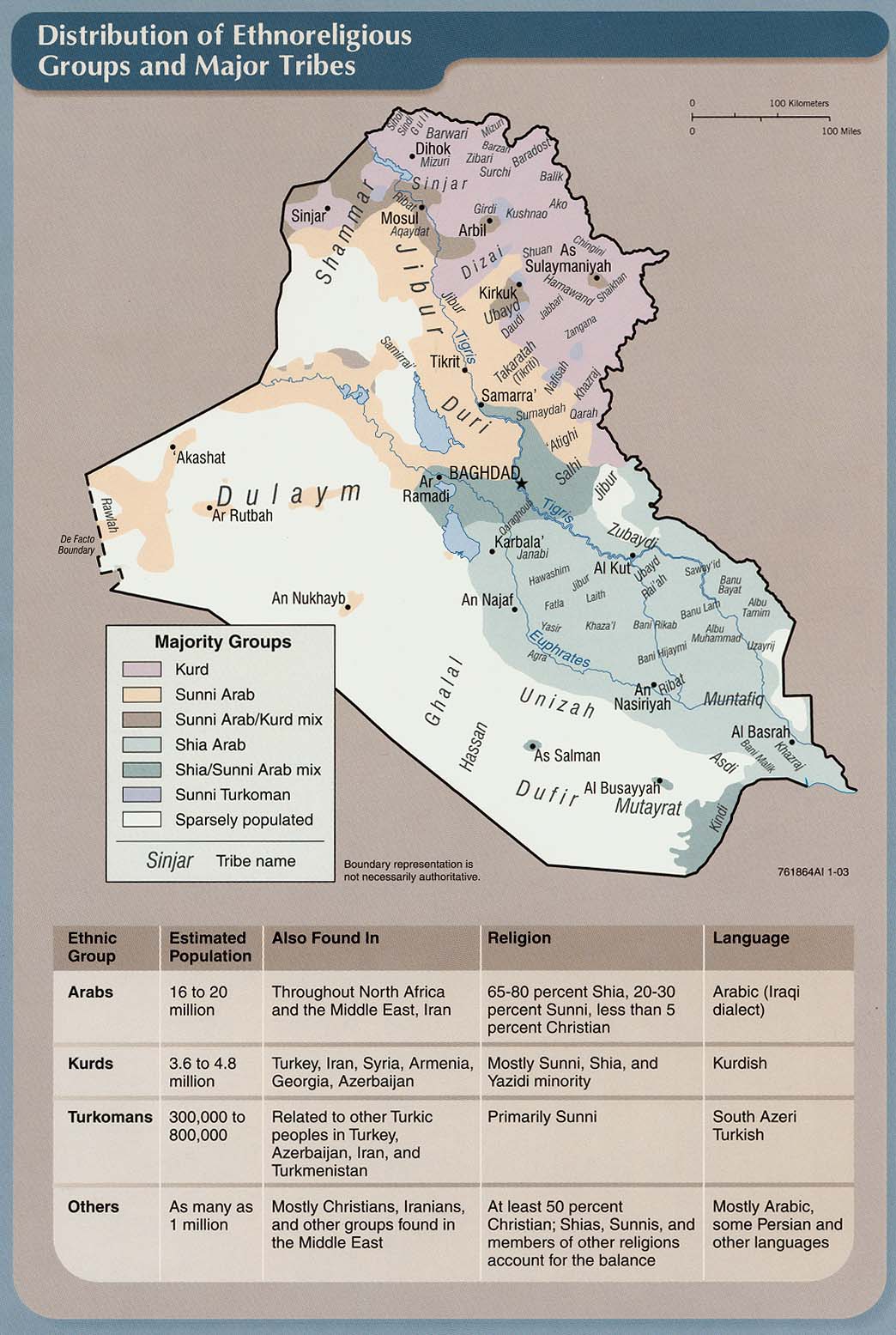
Sunni Arabs insist that Shiites aligned with sectarian groups with private militias cannot control the key interior and defense ministries that run the police and the army.
"We will work hard to not allow the security ministries to be in the hands of groups that have militias. And we will also work hard not to let those sectarian people head these ministries," said Thafir al-Ani, a spokesman of the main Sunni Arab bloc. "We will absolutely not allow this."
But Shiites say they must control those key ministries to ensure that members of their majority community are protected.
"We have red lines that cannot be crossed in regard to electoral weight and the interest of national security," Hadi al-Amri, head of the Shiite Badr militia. "We will never surrender these. We are subjected to a daily slaughter. We will not relinquish security portfolios."
This worked out about as well as the rest of it: Not long after the collapse of Saddam Hussein's regime in Iraq in 2003, a top aide to L. Paul Bremer III, then the head of the American occupation authority there, excitedly explained that Iraq had just become the front line in Washington's effort to neutralize Iran as a regional force.
If
So far, though,
In almost every conversation about
"
Negotiating with terrorists: American officials in
Even the good news is bad: Deadly fighting has erupted within
Mowaffak Rubaie, the Iraqi government's national security advisor, said a growing body of intelligence indicated that Iraqi-led groups were turning against Zarqawi's faction, Al Qaeda in
The protesters demanded the release of five men who were among 14 arrested by British and Iraqi forces last Tuesday to try to weed out security forces linked to Shiite militia groups operating in
"No, no for the occupation; no, no for taking Iraqis' rights," chanted the protesters outside the consulate. Many carried banners emblazoned with slogans demanding the release of the detainees.
Among the demonstrators, some who burned and tore British flags, were
Oil follies:
The sources said Ibrahim Bahr al-Uloum, from a prominent Shi'ite family, was quitting because of Shi'ite wrangling over the oil job since
The upheaval coincides with a collapse in
Wrecking the
The incredible shrinking Army: Since September 2001, the number of junior enlisted soldiers -- the bulk of the Army, and on whose shoulders rest most of the fighting in
And despite Army efforts to add soldiers to its payroll and historically high retention rates, the active duty force actually shrunk by 6,800 from 2004 to 2005.
These declines come as the Army is trying to increase its force to 512,400 soldiers, up from a baseline of about 480,000 in 2001.
That’s ok, we’ll just keep everyone in forever: The U.S. Army has forced about 50,000 soldiers to continue serving after their voluntary stints ended under a policy called "stop-loss," but while some dispute its fairness, court challenges have fallen flat.
The policy applies to soldiers in units due to deploy for the
"As the war in
"When a service has to repeatedly resort to compelling the retention of people who want to leave, you're edging away from the whole notion of volunteerism."
More Ancient History
It would be nice if this really blew up: Tony Blair knew that George Bush was only "going through the motions" of offering support for a second UN resolution in the run-up to the
According to reports in The Mail on Sunday, the Prime Minister and the
An updated edition of a book by Philippe Sands QC, a leading human rights barrister and Professor of Law at London University, to be published in Britain this week, is expected to strengthen claims that President Bush decided to go to war with or without UN backing, and that he had Mr Blair's support.
Hmmm
An odd little tale: For more than a decade, Osama bin Laden had few soldiers more devoted than Abdallah Tabarak. A former Moroccan transit worker, Tabarak served as a bodyguard for the al Qaeda leader, worked on his farm in
During the battle of Tora Bora in December 2001, when al Qaeda leaders were pinned down by
Tabarak was captured and taken to the U.S. Navy base at Guantanamo Bay, Cuba, where he was classified as such a high-value prisoner that the Pentagon repeatedly denied requests by the International Committee of the Red Cross to see him. Then, after spending almost three years at the base, he was suddenly released.
Today, the al Qaeda loyalist known locally as the "emir" of
When The People Lead, The Leaders Will Follow
Feinstein: Cindy Sheehan, the peace activist who set up camp near President Bush's
"She voted for the war. She continues to vote for the funding. She won't call for an immediate withdrawal of the troops," Sheehan told The Associated Press in an interview while attending the World Social Forum in Venezuela along with thousands of other anti-war and anti-globalization activists.
"I think our senator needs to be held accountable for her support of George Bush and his war policies," said Sheehan, whose 24-year-old soldier son Casey was killed in
Hillary,
"We want Hillary and other Democrats to show some teeth," said Nancy Mancias,
Hillary,
"I think she has left the Democratic Party behind," said protester Linda Wiener of Code Pink, an anti-war group that helped organize the demonstration. She said
Afterward, Wiener and as many as a dozen demonstrators managed to get into the ballroom and repeatedly interrupt her speech with shouts of "Hillary supports the war!" and "Stop the War!" At one point, they displayed an anti-Clinton banner that was ripped down by supporters as security guards repeatedly hustled out protesters who popped up in various parts of the ballroom.
Lieberman: Sen. Joe Lieberman of
Ned Lamont, a businessman and war critic, earlier this month publicly began seeking support for a run against Lieberman in the state's August nominating contest.
Lamont is attracting interest largely because of Democratic grumbling — in
"The indications I have is that a primary would be good for the party and very doable," said Lamont, 52, who founded a cable television company.
Commentary
My god! A clear unambiguous statement! Quick, Democratic leadership! Hide!
Philip Gailey: Karl Rove, the president's unindicted leaker in the CIA leak case, stooped to a new low in suggesting that Democrats still have a "pre-9/11 worldview" when it comes to fighting terrorists. "Let me be as clear as I can be - President Bush believes if al-Qaida is calling somebody in
What a loathsome insinuation. Some Republicans also have expressed doubt about the legality of Bush's surveillance program. Senate hearings are scheduled next month, but senators probably shouldn't expect much cooperation from an imperial White House that routinely defies congressional investigators.
Last week, the White House stiffed a Senate committee trying to determine why the administration was so unprepared for Hurricane Katrina. Bush to Senate: Drop dead. Citing executive privilege, the president's men have refused to provide the documents and witnesses the committee requested. If only the levees around
Bad news has no place in Bush's world. Neither does reality. To hear the president tell it, everything in
So much executive power, so little competence.
Sunday, January 29, 2006
Thursday, January 26, 2006
*Ashbah
The ghosts of American soldiers wander the streets of Balad by night, unsure of their way home, exhausted, the desert wind blowing trash down the narrow alleys as a voice sounds from the minaret, a soulfull call reminding them how alone they are, how lost. And the Iraqi dead, they watch in silence from rooftops as date palms line the shore in silhouette, leaning toward Mecca when the dawn wind blows.
*ashbah: arabic word for ghostsBrian Turner is a soldier-poet who served for seven years in the U.S. Army. Beginning in November 2003, he was an infantry team leader in Iraq with the 3rd Stryker Brigade Combat Team, 2nd Infantry Division. His book, Here, Bullet, reflects his war-time experiences in graceful and unflinching poetry. "CG wants the husband": Iraqi human rights activist Hind al-Salehi contends that U.S. anti-insurgent units, coming up empty-handed in raids on suspects' houses, have at times detained wives to pressure men into turning themselves in. Iraq's deputy justice minister, Busho Ibrahim Ali, dismissed such claims, saying hostage-holding was a tactic used under the ousted Saddam Hussein dictatorship, and "we are not Saddam." A U.S. command spokesman in Baghdad, Lt. Col. Barry Johnson, said only Iraqis who pose an "imperative threat" are held in long-term U.S.-run detention facilities. But documents describing two 2004 episodes tell a different story as far as short-term detentions by local U.S. units. The documents are among hundreds the Pentagon has released periodically under U.S. court order to meet an American Civil Liberties Union request for information on detention practices. In one memo, a civilian Pentagon intelligence officer described what happened when he took part in a raid on an Iraqi suspect's house in Tarmiya, northwest of Baghdad, on May 9, 2004. The raid involved Task Force (TF) 6-26, a secretive military unit formed to handle high-profile targets. "During the pre-operation brief it was recommended by TF personnel that if the wife were present, she be detained and held in order to leverage the primary target's surrender," wrote the 14-year veteran officer. He said he objected, but when they raided the house the team leader, a senior sergeant, seized her anyway. "The 28-year-old woman had three young children at the house, one being as young as six months and still nursing," the intelligence officer wrote. She was held for two days and was released after he complained, he said. The second episode, in June 2004, is found in sketchy detail in e-mail exchanges among six U.S. Army colonels, discussing an undisclosed number of female detainees held in northern Iraq by the Stryker Brigade of the 2nd Infantry Division. The first message, from a military police colonel, advised staff officers of the U.S. northern command that the Iraqi police would not take control of the jailed women without charges being brought against them. In a second e-mail, a command staff officer asked an officer of the unit holding the women, "What are you guys doing to try to get the husband - have you tacked a note on the door and challenged him to come get his wife?" Two days later, the brigade's deputy commander advised the higher command, "As each day goes by, I get more input that these gals have some info and/or will result in getting the husband." He went on, "These ladies fought back extremely hard during the original detention. They have shown indications of deceit and misinformation." The command staff colonel wrote in reply, referring to a commanding general, "CG wants the husband." "It's turning into our Vietnam": Aaron McGonigal knows all about patriotism and fighting terrorism. He was in the Illinois National Guard on Sept. 11, 2001. Soon after the attacks, he volunteered for active duty in the Army and ended up on a security force in Germany. McGonigal, 25, now a sales manager for a medical-technology company here, doesn't believe the war in Iraq has anything to do with battling terrorism. He also doesn't think his opposition to the war makes him less patriotic. "I don't think we should be there," he says. "It's turning into our Vietnam." The night the Americans came: Last weekend an American special task force unit raided my house. It was precisely the kind of terrifying experience I have had described to me over and over again by Iraqis I have interviewed in the past two-and-a-half years. My wife, Zina, described it as like something out of a Hollywood action movie. It began at half past midnight on Saturday when explosives blew apart the three entrances to my house. We thought we had been caught in a bombing, but then a rifle sneaked round our bedroom door and shot a couple of bullets blindly; suddenly our room was filled with the wild sounds of US soldiers. My three-year-old daughter Sarah woke to this nightmare. She pushed herself on to me and shouted "Daddy, Americans! They will take you! No, no, not like this daddy ..." She tried to say something to one of the soldiers but her tears stopped her from speaking. Instead of blaming the soldier I could see she was blaming me. I tried to calm her down but as I did so the soldier threw me on to the ground and tied me. They then took me downstairs and made me sit in the living room while they smashed every piece of furniture we have. There were about 20 soldiers inside the house and several others on guard on the roof. A blue-eyed captain came to me holding my Handycam camcorder and questioned me aggressively: "Can you explain to me why you have this footage?" I explained. "These are for a film we are making for Channel 4 Dispatches. There is nothing sinister about it." But that was not good enough. He seemed to think he had found very important evidence. Hooded and with my hands tied I was taken to an armoured vehicle. I was then driven to an unknown destination. I spent the entire journey thinking back on what has happened in the past two years of the occupation. I have so often heard of such things happening to others. But now I was experiencing it myself, and I too could feel the shame and humiliation. It is this kind of disrespect for the privacy of the home - that tribal people regard as a terrible humiliation - which Sunnis in the west of Iraq see as legitimising resistance. When the journey eventually ended I found myself in a small room, two metres square, with wooden walls, a refrigerator and an oval table in the middle. Soon two men came in, civilians, wearing vests. "Do you know why you are here, Mr Fadhil?" they asked me. I replied: "To be interrogated?" With a broad smile, one of them said: "No. There was a mistake in the address and we apologise for the damage." So that's it. They blew three doors apart with explosives, smashed the house windows, trashed all our furniture, damaged the car, risked our lives by shooting inside rooms aimlessly, hooded me and took me from my family who didn't know if they would ever see me again - and then, with a smile, they dismissed it as a small mistake. So was this intimidation or just a typical piece of bungled repression? I don't know and cannot tell, though I have yet to have my tapes returned. I do know, however, the effect it has had on my daughter. Sarah hates all soldiers and calls them Americans even if they are Iraqis. There is no way she will change her mind about them after that nightmare. There are many Iraqis - Iraqis who welcomed the fall of Saddam - who feel exactly the same today. "Maybe they just need to have their civil war": Not only the Embassy but the U.S. military was quite conscious of the serious consequences of its sectarian-ethnic strategy. Last May, for instance, Washington Post reporter Ann Scott Tyson wrote that "U.S. military analysts" conceded that, "by pitting Iraqis from different religious sects, ethnic groups and tribes against each other," the U.S. strategy "aggravates the underlying fault lines in Iraqi society, heightening the prospects of civil strife." With the Sunni community even more overwhelmingly behind the anti-occupation armed struggle than was the case a year ago, the U.S. command feels it has no choice but to depend on just such sectarian or ethnic units to help put down the Sunni insurgency. But even if they do not explicitly admit it, U.S. commanders know that this is a brutal and cynical policy. Thus, they have had to find a way to justify it to themselves. In October, a "senior military official in Baghdad" was quoted in another Tom Lasseter piece saying, "Maybe they just need to have their civil war. In this part of the world it's almost a way of life." That official was unconsciously echoing the words of General William Westmoreland, the former commander of U.S. forces in Vietnam, who rationalized the hundreds of thousands of deaths inflicted on the Vietnamese by the U.S. intervention in an infamous statement: "The Oriental doesn't put the same high price on life as does a Westerner... Life is cheap in the Orient." There is no doubt that the history of violence among the Sunnis, the Shiites, and the Kurds made for strong tendencies toward sectarian-ethnic violence in post-Saddam Iraq. But the fact that a senior American military official would resort to such a racist explanation to evade responsibility for creating civil-war conditions in Iraq only underlines the depths to which the United States has descended. Belafonte live on CNN: "I believe what our government does has terror in the center of its agenda": Transcript of "The Situation Room" hosted by Wolf Blitzer aired January 23, 2006 - 19:00 ET.
BLITZER: The new Gestapo. You know, those are powerful words, calling an agency of the U.S. government, the Department of Homeland Security with, what, about 300,000 federal employees, the new Gestapo. Do you want to take that back? BELAFONTE: No, not really. I stand by my remarks. I am very much aware of what this has provoked in our national community. People feel that I talk in extremes. But if you look at what's happening to American citizens, a lot is going on in the extreme. We've taken citizens from this country without the right to be charged, without being told what they're taken for, we've spirited them out of this country, taken them to far away places and reports come back with some consistency that they are being tortured, that they're not being told what they've done. And even some who have been released have come back and testified to this fact. BLITZER: But no one has taken you or anyone else, as far as I can tell, to an extermination camp and by the tens of thousands, or hundreds of thousands, even millions decided to kill them, which is what the Nazis did. BELAFONTE: Well, Mr. Blitzer, let me say this to you, perhaps, just perhaps had the Jews of Germany and people spoken out much earlier and had resisted the tyranny that was on the horizon, perhaps we would never have had... BLITZER: Well, wait a minute, wait a minute, are you blaming the Jews of Germany for what Hitler did to them? BELAFONTE: No, no. What I'm saying is that if it an awakened citizenry, begins to oppose the first inkling of the subversion of government, of the subversion of our democracy, then perhaps an early warning would have saved the world a lot of what we all experienced. I'm not accusing the Jews at all. What I was getting at really is that if all citizens, the Jewish community, the Christian community and all else had taken a very early aggressive stand rather than somehow suggesting or thinking or feeling that this would have gone away, we might have found that Germany would have been in a far different place than it wound up in. BLITZER: When you were in Venezuela with Hugo Chavez, you said that Bush is the greatest terrorist, the greatest tyrant. Are you saying that President Bush is worse than Osama bin Laden? BELAFONTE: I'm saying that he's no better. You know, it's hard to make a hyperbole stick. I obviously haven't had a chance to meet all the terrorists in the world, so I have no reason to throw around the words like the greatest or make some qualitative statement. I do believe he is a terrorist. I do believe that what our government does has terror in the center of its agenda. When you lie to the American people, when you've misled them and you've taken our sons and daughters to foreign lands to be destroyed, and you look at tens of thousands of Arab women and children and innocent people being destroyed each day, under the title of collateral damage, I think there's something very wrong with the leadership. BLITZER: What you did say in Venezuela was that President Bush was, and I'm quoting now, the greatest tyrant in the world and the greatest terrorist in the world. BELAFONTE: Yes, I did say that. BLITZER: Now that raises the issue of moral equivalency. Are you saying what the Bush administration, what the president is doing is the moral equivalent of what al Qaeda and Osama bin Laden ordered on 9/11? BELAFONTE: I think President George W. Bush, I think Cheney, I think Rumsfeld, I think all of these people have lost any moral integrity. I find what we are doing is hugely immoral to the American people and to others in the world. BLITZER: And the same, or if not worse than al Qaeda? Is that what you're saying? BELAFONTE: Well, I don't want to make those kind of comparisons. I'm not too sure all of what al Qaeda has done. Al Qaeda tortures. We torture. Al Qaeda's killed innocent people. We kill innocent people. Where do the lines get blurred here? BLITZER: What about -- and these were very, very damning words that you said a few years ago, and I wonder if you still stick by them. When you call Colin Powell, the secretary of state at that time, or Condoleezza Rice, the president's national security adviser now the secretary of state, plantation slaves. It's one thing to disagree with them, but when you get involved in name calling with all the history of our country, plantation slaves, isn't that crossing the line? BELAFONTE: Not at all. As a matter of fact, there are a lot of plantations in America where people are slaving away their lives. You know, one of the big problems that we have in this country is the inability to be honest and to be straightforward. We've never had a dialogue in this country on the real issues of slavery. I don't even want to get stuck there. But what I said about Colin Powell is that he serves his master well. And in that context, I was asked to describe what that meant. And I used the metaphor of slavery and the plantation. And I stand by it.Comment on this Belafonte interview by the Black Commentator:
Harry Belafonte is an esteemed elder, one of the tallest trees in the forest. Beside him, this president is a shrub. A bush.General Odom: "The biggest threat to the U.S. empire is incompetent U.S. leadership": Retired General William Odom, who served as a national security adviser to President Ronald Reagan, spoke last Thursday to the Committee for the Republic in Washington, DC. He described the IRAQ WAR as a historic blunder that the United States should end. He was asked - if U.S. PRESIDENT GEORGE W. BUSH sought your advice on IRAQ what would you say in a letter to him. Odom responded that he would tell the President that "he is losing in IRAQ" and that he "has made the most strategic foreign policy disaster in U.S. history." To get out he suggests the PRESIDENT sends Secretary of State CONDOLEEZZA RICE to Europe ostensibly to talk about Kyoto. In reality, the purpose of the visit would be to say the President wants to meet with you in the Azores to discuss IRAQ. Once a meeting is organized the President should tell other foreign leaders "I screwed up and am pulling out." He should make the point that the U.S. pulling out could make things worse for the region, Russia and the Far East because terrorists in Iraq will be freed up to go to other countries. The country least likely to be effected by this would be the United States. The President should seek the involvement of these countries in order to minimize the destabilization that might occur. Then he would instruct the Secretary of Defense DONALD RUMSFELD to develop the logistics for getting out of IRAQ. In order to bring stability to the region the best approach, according to Odom is to "develop an opening between the United States and Iran." The conflict with Iran needs to be turned on its head. THE PRESIDENT should send a private delegation to Iran to explain our common interests. We should be willing to make concessions on the nuclear bomb - get the nuclear bomb off the table and begin to work with Iran to stabilize the region. General Odom was asked by an IRAQ veteran who had just returned how he knew the war was lost when we have only been there for three years. Odom described the problems in IRAQ as beyond our ability to control. The multiple ethnic groups in IRAQ, the divisions in Arab culture and their lack of history with a limited state makes "IRAQ one of the hardest places on earth to put in place a liberal democracy." Odom sees spreading democracy, especially liberal democracy, as very difficult. When asked how we can bring THE PRESIDENT to heel? Odom responded with a question "how do you impeach THE PRESIDENT ?" He went on to express concern about the weakening constitutional balance in the United States. When it came to Congress, Odom talked about meeting with Rep. Walter Jones (R-NC) where he congratulated Jones for "taking the lead because then it won't go to the radical left and we won't be spitting on our soldiers." Regarding Rep. Jack Murtha (D-PA), Odom said he "absolutely agrees with Murtha." Odom came to oppose the VIETNAM WAR, not from the left but from the right and he is doing so on Iraq as well. He saw Vietnam as uniting our enemies and failing to contain China. He sees the same thing occurring in Iraq. The unintended consequences of strengthening Iran, undermining U.S. influence in the Middle East and the world and strengthening Osama bin Laden make this a war counterproductive to U.S. interests. He pointed out that like Vietnam the Iraq War was justified by false intelligence comparing the Gulf of Tonkin with the Weapons of Mass Destruction claims. Odom saw three stages in Vietnam: 1961-65 getting into the war; 1965-68 understanding we are not fighting it right, changing approach to a pacification policy; 1968 to end - Vietnamization and phony diplomacy in Paris. He sees us at the end of Phase II in Iraq and beginning Phase III this year. We are seeing the Iraqization of the war and concludes we will see Congress starting to break with the President more and more; and the final conclusion will be the U.S. leaving the "Green Zone" much like the U.S. left the embassy in VIETNAM. Odom noted that the United States is "running out of Army" and that people underestimate how difficult the Iraq War is on the Army. Indeed, he said "if we took a referendum among U.S. troops 80 percent would favor leaving. We might be winning tactically, but we are losing strategically." He predicted a dramatic draw down by next Christmas with some type of political cover invoked to accomplish it. As to the idea that the Iraq War is a war for oil, Odom described oil as a "red herring. Oil is a commodity. Our enemies will sell us oil." However, Odom did see a need to break U.S. addiction to oil. He recommended a $2 tax on oil to build up a research and development fund for alternative energies. He realized the political leadership may not be able to accomplish this feat. On the larger issue of American Empire, and the lessons from Iraq. Odom urges that "the United States should be an empire that acts like a Republic. We should use our power like a teacher on a playground - not like one of the kids." It is possible that the U.S. Empire is history, but he hopes not. Is Bush once again going to allow Israel to pull America into another quagmire?: Remember this when thinking about warfare-Iran was called Persia-they have 5000 years of military history behind them-with a lot more wisdom than these upstarts and uneducated men who are running our military. If this is the best that West Point and our other military academies have to offer for leadership-then we'd be ready to revamp those institutions and get some wiser and cooler heads to run our armed forces and maybe some men with courage enough to tell the president that he doesn't know a damn thing about war or strategy. As I said months ago, if Israel or the U.S. attacks Iran, "you ain't seen nothin' yet." Bush has already lost a war in Iraq, he has no victory in Afghanistan, and it seems his only solution is to start another war that he can't win-thus destroying our image as a democratic peace-loving nation, getting thousands more Americans killed in needless wars, totally busting the economy so that his friends at Halliburton and Blackwell and other firms can make money, and in the meantime, with his legal team in place, he's preaching democracy while destroying democracy and dissent at home in America. Does all of this sound like it's a madhouse? A friend of mine, Marvin X wrote a book recently, The Crazy House Called America. I'm afraid he's right, we've become a crazy house, led by an idiot, a man who should be treated for mental disorders and possibly dry alcoholism or worse, according to some prominent psychologists and psychiatrists in America and in the world. If he's not run out of office soon, the craziness will get further out of hand, and what is left of America as we knew it will be lost. US Tries to Pressure Iran with Attack Stories: Recent reports in the Turkish and German press of the U.S. asking the Turkish government to support a possible attack on Iran and alerting allied countries of preparations for such an attack appear to be part of a strategy to pressure the Iranian regime rather than the result of a new policy to strike Iran. The reports are unlikely to be effective in getting Iran to be more forthcoming, however. None of the stories suggested that the military option was anything more than a possibility. That would not represent anything new, because the administration's public posture since August 2005 had been that the "military option" was on the table. The press reports do refer to possible air attacks on Iran, but since fall 2004, Bush administration planning for possible military action against Iranian nuclear facilities appears to have focused on commando operations to sabotage them rather than on air attacks. The choice of covert operations instead of air strikes in administration planning reflected the serious downside associated with an overt attack on Iran. Administration policymakers were concerned about the likelihood of Iranian retaliation - in Iraq, Afghanistan, or elsewhere in the Middle East - for an open military air attack against Iranian targets. Having failed to get agreement by the European three to exploit the military option in the diplomatic maneuvering with Iran, the Bush administration apparently felt that it needed to take other steps to increase the pressure on Tehran, including arranging for sensational newspaper articles to appear in the Turkish and German press. The destruction of the myth of the "virtuous" Europe and the "civilized" West: In the face of the arrogance and the abuses committed by the United States over the past years - in particular, as Jacob Singer recalls, due to the huge demonstrations against the war in Iraq - a myth was created: that Europe serves as "counterweight" to the neoconservatives' imperial wishes. The absence of a true reaction to the case of human rights violations in its own territory seriously undermines this myth. In Al Watan, Kuwaiti intellectual and Parliament member Ahmed Yussef Al Daiij notes that this is a clear example of the double speech used by politicians. While, on the one hand, the West continues to make calls to respect human rights and takes to court those countries considered to be violating them, on the other hand, it submits itself without any resistance to a US administration that institutionalizes torture and disdain for human rights. Not only has the credibility of the United States but also that of the West, which likes to give lessons, been seriously put into question. Lebanese writer Hazem Saghieh, who had supported the United States during the two wars in Iraq, says nothing different in the Pan-Arab newspaper Dar Al-Hayat. He regrets that Europe and the United States, in other times champions of human rights, are every day seeing how this image is destroyed due to the new scandals that break after the abuses committed by the United States with European complicity. We should hope that this disappointment serves to accelerate the destruction of the myth of the "virtuous" Europe and the "civilized" West - two main ingredients of the war of civilizations and the moral justifications of colonial adventures. Torture worked perfectly: Let us then speak of interrogations justified by national security needs and let us evaluate its reliability: Lebanese citizen Ibn al Shaykh al-Libi was sent to be tortured by the Egyptians; he gave "evidence" of the links between Saddam Hussein and Osaama bin Laden, an assertion that proved to be completely wrong. But, as Robert Sheer recalls in AlterNet, "we should not pay attention to the conclusions of the majority of the experts in torture who explain that the method is not effective as the one who is tortured only says what they want him to say. In the case of al-Libi, torture worked perfectly to obtained precisely the necessary evidence needed to launch a long-desired war". The superpower without complex: From now on, the American empire assumes itself with no complex at all, it's even theorized by the elites of a country that accepts that democratic ideals are not theirs anymore. Thus, the Heritage Foundation held a conference on the lessons of the Roman empire for today's America (The Lessons of the Roman Empire for America Today). As in Rome, the United States is called to play its role as a superpower by means of war and devastation. The American imperialism is not a mental construction of leftists or other alter-worldists. It's a reality, in fact. In Defence of International Law: It is clear that the United States, and also those who support the actions of that country in the name of human rights, oppose the strengthening of that international order. It is very likely that the UN reforms currently being studied will lead to the legitimization of more unilateral actions. According to the argument most commonly used, it is an outrage to put democratic and undemocratic countries at the same level in the United Nations and particularly in its human rights commission. This argument ignores that in all the meetings of the Movement of Non Aligned Countries and in all the summits of the South, who represent 70% of humanity, they - not only "dictatorships" - have condemned all forms of unilateral interference, namely embargos, sanctions or wars. Anyway, liberal imperialists, that is, the majority of US Democrats and most of the European Greens and Social-Democrats - who defend democracy at the internal level while they support interference, that is, the dictatorship of a country or a small group of countries, at the international level - are completely incoherent. Finally, when complaining, as it often happens, about the inefficiency of the United Nations, we have to think of all the disarmament treaties or accords prohibiting weapons of mass destruction, whose main opponent is the United States. It is precisely the big powers the ones that more firmly oppose the idea of law acting against their last resort: the use of force. But, in the same way that no one suggests that, at the internal level, the mafia's hostility towards law can justify the abolition of the latter, no one can use the US's sabotage of the United Nations as an argument to discredit this organization. There is one last argument in favour of international law that may be even more important than all the others: international law is the paper shield that the Third World thought it could use against the West during the decolonization. Those who use human rights to undermine international law in the name of the "right to interfere" ignore that, during the entire colonial period, there were neither borders nor dictators preventing the West from establishing the rule of human rights in the submitted countries. If that was their intention, the least that colonized countries can say is that they did not prove it. Probably, that is one of the main reasons why the countries of the South so strongly condemn the so-called "right to interfere." "Fight the net": A newly declassified document gives a fascinating glimpse into the US military's plans for "information operations" - from psychological operations, to attacks on hostile computer networks. The declassified document is called "Information Operations Roadmap". It was obtained by the National Security Archive at George Washington University using the Freedom of Information Act. The operations described in the document include a surprising range of military activities: public affairs officers who brief journalists, psychological operations troops who try to manipulate the thoughts and beliefs of an enemy, computer network attack specialists who seek to destroy enemy networks. Perhaps the most startling aspect of the roadmap is its acknowledgement that information put out as part of the military's psychological operations, or Psyops, is finding its way onto the computer and television screens of ordinary Americans. "Information intended for foreign audiences, including public diplomacy and Psyops, is increasingly consumed by our domestic audience," it reads. "Psyops messages will often be replayed by the news media for much larger audiences, including the American public," it goes on. The roadmap, however, gives a flavour of what the US military is up to - and the grand scale on which it's thinking. It reveals that Psyops personnel "support" the American government's international broadcasting. It singles out TV Marti - a station which broadcasts to Cuba - as receiving such support. It recommends that a global website be established that supports America's strategic objectives. But no American diplomats here, thank you. The website would use content from "third parties with greater credibility to foreign audiences than US officials". It also recommends that Psyops personnel should consider a range of technologies to disseminate propaganda in enemy territory: unmanned aerial vehicles, "miniaturized, scatterable public address systems", wireless devices, cellular phones and the internet. When it describes plans for electronic warfare, or EW, the document takes on an extraordinary tone. It seems to see the internet as being equivalent to an enemy weapons system. "Strategy should be based on the premise that the Department [of Defense] will 'fight the net' as it would an enemy weapons system," it reads. The slogan "fight the net" appears several times throughout the roadmap. The authors warn that US networks are very vulnerable to attack by hackers, enemies seeking to disable them, or spies looking for intelligence. "Networks are growing faster than we can defend them... Attack sophistication is increasing... Number of events is increasing." And, in a grand finale, the document recommends that the United States should seek the ability to "provide maximum control of the entire electromagnetic spectrum". US forces should be able to "disrupt or destroy the full spectrum of globally emerging communications systems, sensors, and weapons systems dependent on the electromagnetic spectrum". Consider that for a moment. The US military seeks the capability to knock out every telephone, every networked computer, every radar system on the planet. WORLDWIDE Fidel Castro's prophecy has been fulfilled: One of the most significant events in 500 years of Latin American history will take place in Bolivia on Sunday when Evo Morales, an Aymara Indian, is inducted as president. Morales's victory is not just a symptom of economic breakdown and age-old repression. It also fulfils a prophecy made by Fidel Castro, who claimed the Andes would become the Americas' Sierra Maestra - the Cuban mountains that harboured black and Indian rebels over the centuries, as well as Castro's guerrilla band in the 50s. His prophecy exercised US governments in the 60s. Radical elected governments were destroyed by the armed forces - guardians of the white settler states - supported by Washington. Countries such as Brazil, Chile, Argentina and Bolivia were prevented from following anything that might have resembled the Cuban road. Today the rules have changed. The cold war no longer provides an excuse for intervention, and the US is stretched in other parts of the world. The ballot box, for the first time in Latin America, has become the strategy of choice for revolutionaries and the poor majority. The result in Bolivia is a president who invokes the memory of the silver miners of Potosi and Che Guevara, who dreamed of a socialist commonwealth of Latin America. Castro's prophecy looks close to fulfilment, and, in his 80th year, he will go to Bolivia to savour the moment. Why the West must reOrient: The West in recent decades has been attempting to change China through criticism and apocalyptic predictions. These help China to avoid traps, to prevent possible stumbles and to be careful about the direction it takes and the decisions it makes. For instance on human-rights issues, all the criticism helps the Chinese Communist Party to be on its toes, and in this way we Westerners help to make China a more harmonious society. Yet while we help China to change, we overlook the fact that we should change ourselves, because China's growth has brought a systemic change to the world at large. As it spearheads the general growth of Asia, particularly Southeast Asia and India, it foreshadows a different world, where for the first time in at least two centuries the West will become an economic minority. It is as if we were facing a huge climatic change, as if we went from the glacial era to a temperate era, or vice versa. In this climatic change, we are going to die if we don't change our habits. It is not because China is a threat, that it is malevolently planning an attack on the West. It is because there is a change of climate, and those who do not adapt to the new environment will inevitably suffer. Just a funny joke about Bush [from Russia]: A man enters a bar and orders a drink. The bar has a robot bartender. The robot serves him a perfectly prepared cocktail, and then asks him, "What's your IQ?" The man replies "150" and the robot proceeds to make conversation about global warming factors, quantum physics and spirituality, biomimicry, environmental interconnectedness, string theory, nano-technology, and sexual proclivities. The customer is very impressed and thinks, "This is really cool." He decides to test the robot. He walks out of the bar, turns around, and comes back in for another drink. Again, the robot serves him the perfectly prepared drink and asks him, "What's your IQ?" The man responds, "about a 100." Immediately the robot starts talking, but this time, about football, NASCAR, baseball, cars, beer, guns, and breasts. Really impressed, the man leaves the bar and decides to give the robot one more test. He heads out and returns, the robot serves him and asks, "What's your IQ?" The man replies, "Er, 50, I think." And the robot says... real slowly... "So............... ya ... gonna ... vote . for . Bush .. again???"
Alive in Baghdad Cross-post, January 26, 2006
In this post over at Alive in Baghdad, I again attempt to discuss the media's failure to draw sensible, nuanced conclusions from events in Iraq. If Hamas, which, btw, just won a major victory in the Palestinian election, is calling for the release of Jill Carroll and all foreign hostages, why does the mainstream press still see little reason to discuss the confusing nuances and contradictions within Iraq's competing/conflicting resistance and insurgent/terrorist forces?
I've recently had an article published by IPS about the ongoing dangers for Iraqi journalists, again repeatedly overlooked by the mainstream media. I'll be posting a segment from that later today.Hamas Calls For Jill Carroll’s Release, and Other Things Outside the Mainstream Press
On Monday a top official of Hamas, Saeed Syam, called for the release of American journalist, Jill Carroll. “Hamas joins those who ask to release American citizen Jill Carroll. Hamas is against the kidnapping of innocent people, of foreigners who are guests in the Arab countries, and those who introduce humanitarians services and help for the Arab people - and for any people in general - especially when they are not interfering in internal Arab affairs. We have declared many times we are totally against kidnapping civilians.”
Mr. Syam is the latest in a lengthening line of militant and anti-occupation leaders to oppose the kidnapping of Jill Carroll. Many of these groups have also condemned the kidnapping of Christian Peacemaker Team members in November of last year.
Despite the recurring and increasing calls by Sunni clerics and others, the mainstream press still has not bothered to question whether we can be certain that Sunni resistance groups are responsible for these kidnappings. Kidnappings have been a constant threat in Baghdad and the rest of Iraq, and they seem to be directed mainly by criminal elements, not resistance or insurgent forces.
Over the last three years we have repeatedly seen instances where those in leadership roles in Iraq have abused their power. It appears to be a running theme across Iraq’s entire history. Recently however, corruption in Iraq’s governing agencies has been exceptionally bad.
Wednesday, January 25, 2006
BAGHDAD, Jan 23 (IPS) - While politicians deliberate over Iraq’s future, Iraqis are dealing with the reality of the present. They are looking at the debris of a country where reconstruction has come to a standstill.
They are also looking at a situation in which the capital of the oil-rich country has been stricken recently by a dire shortage of gas and kerosene.
Iraqis in Baghdad had been receiving 12 to 13 hours of electricity a day on average over recent months. Over the past few weeks they say supply has fallen to just a few hours a day.
“We have no services at all,” Usama Asa’ad, a 31 year-old mechanic told IPS. “Our electricity is on only one or two hours a day.”
Many Iraqis thought the United States would improve their situation when the occupation began in April 2003, but those expectations are long over. Iraqis complain that the situation in Baghdad now is worse than it ever was under Saddam.
After most American ground troops leave Iraq, a sizable number, perhaps a few thousand, will stay behind to be embedded as advisers with the Iraqi forces. Seymour Hersh, in a recent New Yorker piece, reported that some military sources are expressing concern that Iraqi commanders will eventually be given the power to select targets for the American planes. The worry is that in ethnically fragmented Iraq, targets might be chosen to settle old scores, thus increasing civilian casualties and endangering the embedded U.S. advisers. Publicly, the Pentagon insists that target selection will be in American hands. My own experience in Indochina tells me it's rarely that neat and tidy. Keep in mind that no nation-state gives out complete military information. The Pentagon is no different; it's not overly trusting, especially not at a time when anyone can chat on the Internet and unthinkingly give away information that could cause harm. Also, the Pentagon spins information like any other government power center. For example, in the early stages of the Iraq war, U.S. forces hit Iraqi troops with incendiary bombs that exploded into fireballs like napalm and stuck to human skin and kept burning—just like napalm. American officers on scene told reporters it was napalm. The reporters wrote stories. Higher officials denied it was napalm. The Pentagon insisted that napalm—in response to international protests about its use in Vietnam and U.N. strictures approved in 1980—had been removed from the American arsenal. The last batch of napalm in storage, it said, had been destroyed on April 4, 2001. Some reporters, notably James Crawley of The San Diego Union-Tribune, kept digging. Five months later, in August 2003, the Pentagon finally admitted that while it wasn't exactly napalm, it was a very close relative. The napalm formula used in Vietnam was made from polystyrene (the jellying agent), benzene, and gasoline. After the protests and the U.N. ban, the military substituted jet fuel for the gasoline and benzene—and were now calling the weapon a Mark 77 firebomb. Its effects on a target were "remarkably similar" to the old napalm, the Pentagon said, but this version had "less of an impact on the environment." The Pentagon's moral of the story: We did not seek to deceive. If only the reporters had referred to the device by its correct name, there would have been no confusion.Destroying Iraq's Heritage:
In the preparations for the first Gulf war under Dick Cheney, then defence secretary, the Pentagon brought together detailed advice on the cultural heritage of Iraq and Kuwait from around 80 international experts and institutions. Several hundred specific sites, archaeological zones and monuments, and important historic buildings - including the National Museum in Baghdad and the Babylon and Ur archaeological zones - were identified for protection from direct acts of war such as air and ground attack, and from any postwar situation. The protected sites were then identified on military maps used for both aerial targeting and the ground campaign. The system worked extremely well, with only one or two apparently genuine mishaps due to missiles going off target. A postwar evaluation of these measures was reported to Congress by the department of defence in January 1993, in response to a Congressional inquiry into the war's environmental and heritage impact. In the concluding section of the report, the Pentagon gave an assurance that "similar steps will be taken by the United States in future conflicts". Two years later, the joint chiefs of staff unanimously recommended that the president and Congress ratify the key international treaty in this area - the 1954 Hague convention on the protection of cultural property in the event of armed conflict - which had been signed by the US in 1954 but had then been left in abeyance, apparently due to pressure from the nuclear-weapons lobby. (Though submitted to the Senate for approval in 1998, the Hague convention still has not been tabled for debate.) It is simply inconceivable that, during the planning of military action in 2002-3, the Pentagon did not turn up the detailed heritage-protection rules and maps applied so relatively successfully in the first Gulf war. Almost the first move of military planners in preparing for a possible conflict is to dust down records and maps, perhaps many decades old, and build on these. In this case, many of those responsible for developing and implementing the Desert Storm policy were still in the Pentagon. Someone or some group must have taken a positive decision to scrap the US's established protection policies and ignore the January 1993 assurance to Congress given by the defence department, still under Dick Cheney at the time. Who made that fatal decision? Who back in Washington refused to allow the Baghdad commander to move a tank 200 yards to protect the National Museum from looting - despite pleading by the museum and international experts - and who authorised the building of a gigantic military base in the middle of Babylon's archaeological zone and allocated an adjacent area of the site to the Kellogg, Brown, Root subsidiary of Halliburton, Vice-President Cheney's old firm?Hipocrisy:
An unexpectedly light sentence for a US army interrogator who once faced life in prison for the death of an Iraqi general could tarnish the US government and hurt human-rights efforts around the globe, observers say. Prosecutors said during Chief Warrant Officer Lewis Welshofer Jr's court-martial that his interrogation of Major-General Abed Hamed Mowhoush "could fairly be described as torture" and had stained the military's reputation. During the trial, testimony showed he stuffed Mowhoush in a sleeping bag and straddled his chest. Eugene Fidell, president of the National Institute of Military Justice, said if the tables were turned and an American general had fallen into enemy hands and suffered the same fate from interrogators, there would have been an uproar in the US. "How is this going to look overseas?" he said. Mowhoush, the former commander of Saddam Hussein's air defences, surrendered to the Army on 10 November 2003, in hopes of seeing or securing the release of his four sons. Sixteen days later, Mowhoush died after Welshofer covered him in a sleeping bag, straddled his chest and put his hand over the general's mouth, already covered by the bag.
Tuesday, January 24, 2006
War News for Tuesday, January 24, 2006
Bring ‘em on: Police raided the Toubji district in Baghdad on Monday. The Sunni Muslim Scholars' Association said 30 people had been detained and two killed.
Bring ‘em on: Twenty schoolchildren wounded, two seriously, when a roadside bomb targeted a British patrol in the southern city of Basra.
Bring ‘em on: Gunmen killed a senior member of Sunni Endowments, a group which administers Sunni mosques, in Baghdad on Monday evening.
Bring ‘em on: Two civilians killed and four wounded when U.S. forces and insurgents clashed in the Sunni rebel stronghold of Ramadi.
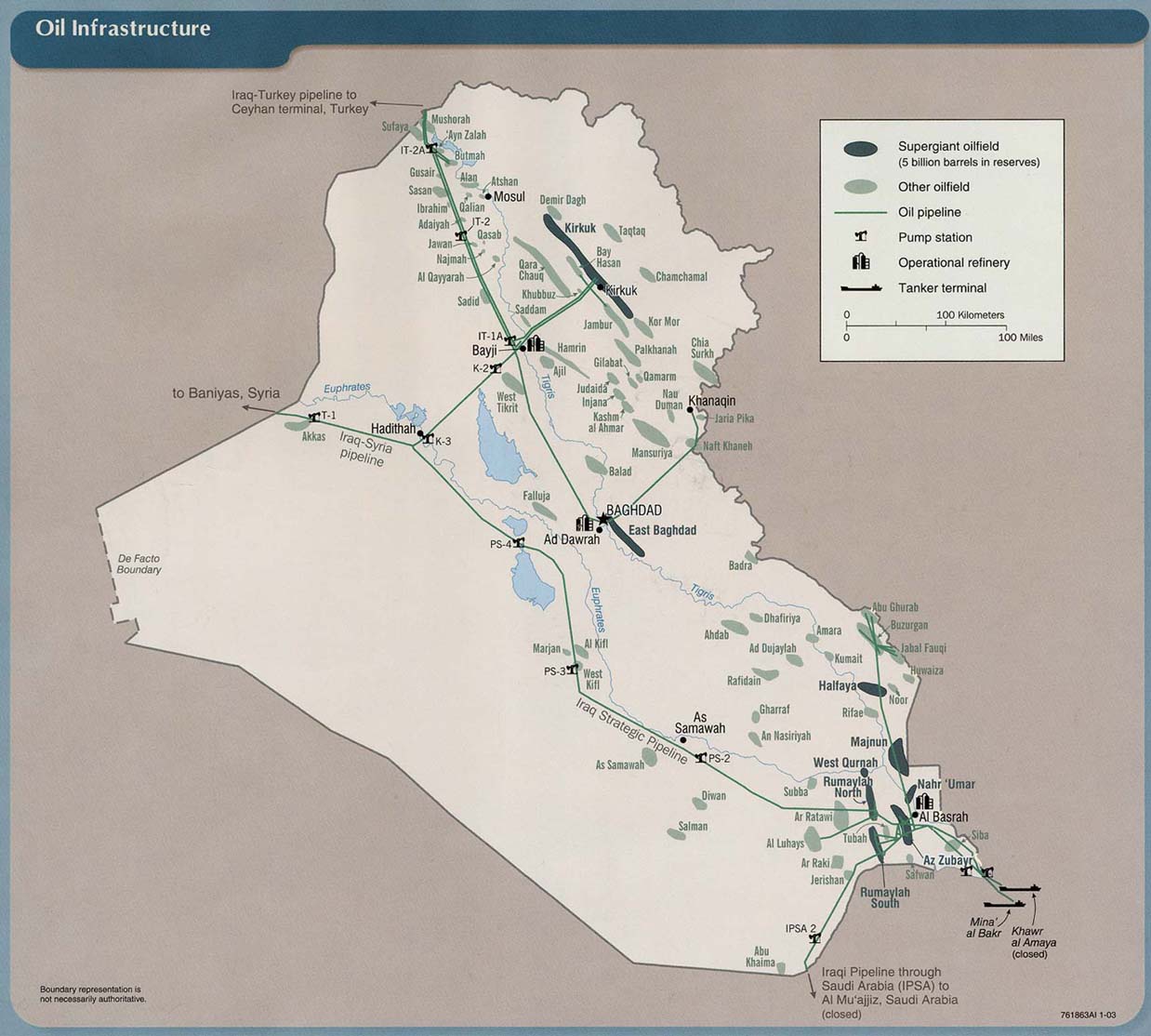
Bring ‘em on: A bomb exploded Tuesday under a pipeline linking an oilfield near Kirkuk with the terminal at Ceyhan, Turkey, causing a fire and a partial reduction in pumping. Meanwhile, security forces defused two bombs that had been placed under another pipeline in the Dibs area, 55 kilometres (34 miles) north of Kirkuk.
Bring ‘em on: A bomb exploded Tuesday in the southern Iraqi city of Basra, damaging a British tank and a nearby civilian car.
Bring ‘em on: Roadside bomb killed two U.S. soldiers in Baghdad.
Vehicle accident: Two Marines died in a vehicle accident near Taqaddum, about 45 miles west of Baghdad.
Bring ‘em on: US soldier killed in roadside bombing in Baghdad.
Bring ‘em on: Four US soldiers killed in a roadside bombing near the northern town of Hawijah.
Bring ‘em on: Car bomb exploded in eastern Baghdad shortly before the resumption of the Saddam Hussein trial, wounding at least one policeman and one civilian.
Bring ‘em on: Two German engineers working at detergent plant in northern Iraq abducted.
Bring ‘em on: Two bombs in Kirkuk killed one policemen and injured eight people including two civilian bystanders.
Bring ‘em on: Mortar attack on a US military base in Fallujah.
Bring ‘em on: Woman working as cleaner at US base in Tikrit shot dead by gunmen.
Bring ‘em on: Seven carloads of armed men, some wearing police commando uniforms, raided homes and a mosque in Baghdad’s neighbourhood of Toubji, shooting dead three men and detaining more than 20. Three were later freed, but the rest remained unaccounted for.
Bring ‘em on: Eight bullet-riddled bodies found in a field near Dujail, about 80km north of Baghdad. They were among 35 men who failed to get accepted into a police academy in Baghdad, 23 of whom were found slain on Sunday.
Bring ‘em on: Two policemen killed and three wounded when a car bomb exploded in the southern Dura district of the capital.
Bring ‘em on: Two civilians wounded when a roadside bomb exploded near an Iraqi police patrol in central Baghdad.
Bring ‘em on: Iraqi army soldier killed and another wounded when their patrol was struck by a roadside bomb in eastern Mosul.
Bring ‘em on: Two civilians wounded when a car bomb exploded near a joint Iraqi-US patrol in southern Baghdad.
Bring ‘em on: Iraqi civilian killed and four wounded when a car bomb exploded in Mahmudiya. The target of the explosion was not clear.
Bring ‘em on: Armed men killed an official with the Kurdistan Democratic Party as he was driving to work on Monday, east of Mosul, 360km northwest of Baghdad, Abd al-Ghani Yahya, a party spokesman, said on Tuesday.
Bring ‘em on: In the northern town of Kirkuk, a pedestrian was killed and four other people wounded when a roadside bomb exploded near a US patrol, police said. US soldiers were uninjured, they added.
NEWS
Attacks in Iraq jumped 29% in 2005: The number of attacks against coalition troops, Iraqi security forces and civilians increased 29% last year, and insurgents are increasingly targeting Iraqis, the U.S. military says. Insurgents launched 34,131 attacks last year, up from 26,496 the year before, according to U.S. military figures released Sunday.
Insurgents are widening their attacks to include the expanding Iraqi forces engaged in the fighting, said Brig. Gen. Donald Alston, a coalition spokesman.
The new statistics show:
•The number of car bombs more than doubled to 873 last year from 420 the year before. The number of suicide car bombs went to 411 from 133.
• Sixty-seven attackers wore suicide vests last year, up from seven in 2004. Suicide and car bombs are often targeted at Iraqis, causing high casualties.
• Roadside bombs, or improvised explosive devices, as the military calls them, continue to be the most common weapon. Roadside bombs increased to 10,953 in 2005 from 5,607 the year before. Those numbers include roadside bombs that are discovered and defused. These bombs account for nearly one-third of all insurgent attacks.
Jailbreak in Nasiriyah: On Sunday, 13 prisoners of the Nasiriyah jail attempted to escape the prison. Two of the involved were shot dead by police and security guards and four arrested. The remaining seven were being sought by police.
Sunnis call for self-defense: A leading Sunni Arab party on Tuesday called on fellow Sunnis to confront armed attacks on their community "by any suitable means" in the wake of a raid on a Sunni neighbourhood in Baghdad in which three men were killed and more than 20 abducted.
The call for Sunnis to defend themselves was made in a statement issued by the Iraqi Islamic Party a day after armed men, some wearing uniforms of the Shia-led security forces, swept into the Toubji area of Baghdad, raiding houses, abducting males and shooting three men dead.
An Interior Ministry official denied police involvement, saying an investigation is under way and the armed men may have been disguised as commandos.
In Samarra, 95km north of Baghdad, Sunni leaders have called for a three-day strike to condemn the killings of at least 31 Sunnis who were kidnapped from their bus last week after being rejected entry into the police academy.
Ongoing Military Operations: On Tuesday, US marines and Iraqi soldiers conducted a ninth day of sweeping operations through fields and villages along the western Euphrates River valley, in an attempt to isolate fighters and confiscate weapons and ammunition, the military said.
Operation Wadi Aljundi (Koa Canyon) in the troubled western province of al-Anbar has yielded thousands of pieces of ordnance, the US military said, but there was no word on any arrests.
The Iraqi army said it raided areas around the city of Baquba, 65km north of Baghdad, arresting 19 wanted men and seizing a number of weapons, ammunition and explosives.
Thousands of mines along with other explosive substances confiscated: Iraqi police forces confiscated today 3,252 mines and other explosive substances, Iraqi police spokesperson told KUNA in a phone call.
He added the police pulled over a suspected vehicel between Western and Eastern Ali area in Misan governorate and found 2,800 mines in the car. The mines were confiscated and the driver was arrested.
Moreover, Misan police confiscated another 452 mines wound in Sayd Noor area along with other explosive substances.
KBR accused of providing contaminated water to US troops: A Halliburton Co. subsidiary provided water to U.S. troops at a camp in Iraq that was twice as contaminated as water from the Euphrates River, former employees of the company said on Monday.
The subsidiary, Kellogg Brown and Root, also blocked employees' attempts to inform the U.S. military at Camp Junction City in Ramadi that the water was foul or tell them that water tanks should immediately be chlorinated, the workers said. "We exposed a base camp population (military and civilian) to a water source that was not treated," said an internal e-mail from Will Granger, who was KBR's water quality manager for all of Iraq and Kuwait.
"The level of contamination was roughly 2x the normal contamination of untreated water from the Euphrates River," continued the e-mail dated July 15 of last year and released at the hearing. It said the exposure lasted for up to a year.
Oahu losing medevac transport to Iraq war: Army helicopters that have flown severe medical emergencies to Oahu hospitals for 32 years are being deployed to Iraq and will no longer be available as of April 1. Oahu's emergency medical service community has known that this day could come "from the day we went to war," Robert Pedro, a supervisor for the city's Emergency Medical Services, said yesterday.
American contractors leaving Iraq: American private contractors are preparing to leave Iraq as US money runs out and government ministries take charge of the reconstruction effort, according to the Washington Times. (…)
The Times said most US-funded projects are scheduled to be completed by the end of this year, and it is unlikely that any significant new US funds will be forthcoming. Iraqi government ministries, which will be taking over responsibility for the reconstruction effort, tend to issue much smaller contracts that do not interest large US companies. It quoted retired Col Paul Hughes of the United States Institute of Peace saying that the US Congress has made it clear that it will not provide any more money.
Some contractors say privately that they do not want to deal with the Iraqi government and that without the protection and support of the US military, it is simply not safe to work in Iraq. Last week, fatal attacks were launched against US and Iraqi personal security details in Baghdad and in the southern city of Basra.
China Increases ties with Iraq: China is keen to train Iraqi personnel working in the oil sector and other fields, a foreign ministry statement said. The statement, faxed to the newspaper, said the Chinese were willing to provide training in the spheres of telecommunications, power generation and diplomacy as well as oil.
“China is keen to do whatever it takes to press ahead with the Iraqi reconstruction,” the statement quoted the envoy as saying.
Saddam Trial Postponed: The court trying Saddam Hussein cancelled the resumption of his trial Tuesday, delaying the session for five days. The postponement came amid a dispute among judges over a last-minute shakeup in the court, according to judges. The delay was the latest sign of disarray in the trial of the ousted Iraqi leader and his former regime officials. It came a day afer one judge was removed from the five-member panel and a new chief judge was appointed.
Iran, Iraq natural allies, says Iran top cleric: Iran and Iraq are natural allies and have always stood by each other, said Secretary of Iran's Supreme National Security Council Ali Larijani here on Sunday.
"We will continue to side with them (Iraqis) until the establishment of a broad-based and popular government," Larijani told reporters after a meeting with senior Iraqi political-religious figure Moqtada Sadr.
After Iraq's occupation, Sadr made intense efforts to launch a sound movement in Iraq and there is a good cooperation between him and various Iraqi Shiite groups. In view of his stances, "We have high hope for Iraq having a powerful and popular government in the future to be able to settle Iraq's security and economic problems."
Sadr for his part commented on unity among various Iraqi groups, saying, "If the unity is further consolidated, Israel and the US will not be able to have constant presence in Iraq." The American enemies have targeted neither oil nor other things in Iraq but Islamic thought, said Sadr, adding that to foil the plot of the occupiers, extensive cultural activities should be done.
Sadr pledges to defend Iran: An Iraqi Muslim cleric who leads a major Shiite militia pledged to come to the defense of neighboring Iran if it were attacked, aides to the cleric, Moqtada Sadr, said Monday.
The commitment, made Sunday in Tehran during a visit by Sadr, came in response to a senior Iranian official's query about what the cleric would do in the event of an attack on Iran. It marked the first open indication that Iraq's Shiite neighbor is preparing for a military response if attacked in a showdown with the West over its nuclear program.
The pledge was also one of the strongest signs yet that Iraq could become a battleground in any Western conflict with Iran, raising the specter of Iraqi Shiite militias - or perhaps even the U.S.-trained Shiite-dominated military - taking on American troops here in sympathy with Iran.
COMMENTARY AND ANALYSIS
Nothing depleted about 'depleted uranium': Iraqi and visiting doctors, and a number of news reports, have reported that birth defects and cancers in Iraqi children have increased five- to 10-fold since the 1991 Gulf War and continue to increase sharply, to over 30-fold in some areas in southern Iraq. Currently, more than 50 percent of Iraqi cancer patients are children under the age of 5, up from 13 percent. Children are especially vulnerable because they tend to play in areas that are heavily polluted by depleted uranium.
The Pentagon has been using radiooactive weapons for at least a decade and a half with full complicity of at least three White House administrations and Republican and Democratic congressional legislators. Conservatively, at least 300 tons and 1,700 tons of depleted uranium were used in the Gulf War and the current Iraq War, resectively. This is about 70 grams of depleted uranium per Iraqi citizen, and if inhaled or ingested, it is enough to kill them all.
Is this not radioactive genocide, especially when our troops used and continue to use most of the depleted uranium munitions in densely populated areas such as Baghdad and Fallujah? Depleted uranium has a half-life of billions of years. Consequently, Iraq will be a wasteland forever and essentially uninhabitable for anyone.
After the 1991 Gulf War, about 1 in 4, or 150,000, U.S. veterans came down with what is referred to as "Gulf War Syndrome." Most of the ailments characteristic of Gulf War Syndrome are consistent with radiation or heavy-metal poisoning. Veterans' children are now also born with higher proportions of birth defects and other genetic disorders, according to sporadic accuonts. The Pentagon continues to deny the harmful effects of depleted uranium or its role in Gulf War Syndrome.
Our troops in Iraq will be severely affected by this radioactive war, not only because a lot more depleted uranium has been used and continues to be used, but also because they have been there a lot longer than during the Gulf War. Hundreds of thousands of our troops will come down with Gulf War Syndrome as a result of depleted uranium poisoning, and thousands will die from it. Thousands of their children will be born with genetic diseases, cancers and birth defects.
A New Strategy for Victory in Iraq?: All unheralded, the United States seems to be embarking on a massive shift in its Iraq strategy. The first inkling came on December 20, when U.S. ambassador to Iraq Zalmay Khalilzad, while uttering the usual bromides about the elections, also had this to say:
"It looks like people preferred to vote for their ethnic or sectarian identity. But for Iraq to succeed, there has to be cross-sectarian and cross-ethnic cooperation."
Months earlier, in the midst of the mindless triumphalism over the constitutional referendum, it was mostly us in the antiwar movement and a few other critics who pointed out that the vote on that, as well, had been an ethnic census. Suddenly, we were hearing it from the highest civilian representative of the U.S. government in Iraq. Since that time, that evaluation has been repeated until it is a standard of mainstream “respectable” commentary.
On the flip side, where once it was wishful thinkers among antiwar activists who constantly proclaimed that Iraqis had strong national unity and minimal sectarian conflict, now it is wishful thinkers like President Bush and Christopher Hitchens who say it.
Another clue is the fact that, as reported in the New York Times a week ago, the United States is in serious talks with Sunni insurgents, the idea being to separate the mainstream insurgency from the sectarian jihadists like Zarqawi’s Al-Qaeda in Mesopotamia, eliminate the latter, and integrate the former into the political process. As a goodwill gesture, the Americans even released Satam Quaood, a former associate of Saddam’s, and the type that so far U.S. forces have been more likely to beat to death than to release.
These official signals have also been picked up by various establishment-serving pundits and analysts, culminating in an article by Roger Cohen in the New York Times that makes a point of distinguishing the “resistance” from the “insurgency.” “The resistance,” he says, is “the great mass of Sunni Arabs for whom the American invasion turned life on its head” and who have, in turn, “granted insurgents safe passage, turned a blind eye to myriad acts of sabotage, taken small payments for small services, and generally wished America ill.” This resistance, he says, is “composed for the most part of people who want jobs and a stake in the new Iraq and may start to think differently should those be provided.” Now, it’s the establishment using the term “resistance.”
Indian Wars Not Over Yet: I'd like to suggest another way of looking at the War on Terror: as a twenty-first century continuation of, or replication of, the American Indian wars, on a global scale. This is by no means something that has occurred to me alone, but it has received relatively little attention. Here are ten reasons why I'm making this suggestion:
1. Key supporters of the War on Terror themselves see GWOT as an Indian war.
2. The essential paradigm of the War of Terror – us (the attacked) against them (the attackers) – was no less essential to the mindset of white settlers regarding the Indians.
3. GWOT is based on the principle of preventive strike, meant to put off "potential, future and, therefore, speculative attacks" – just as U.S. Army conflicts against the Indians often were.
4. While U.S. mainstream thinking about GWOT enemies is that they are total aliens – in religion, politics, economics, and social organization – there are Americans who believe that individuals in these "primitive" societies can eventually become assimilated and thus be rendered harmless through training, education, or democratization. This is similar to the view among American settlers that in savage Indian tribes hostile to civilization, there were some that could be evangelized and Christianized and brought over to the morally right, Godly side.
5. GWOT is fought abroad, but it's also a war at home, as the creation after 9/11 of a Department of Homeland Security illustrates. The Indian wars were domestic as well, carried out by the U.S. military to protect American settlers against hostile non-U.S. citizens living on American soil.
6. America's close partner Israel, which over the years has taken over Arab-populated lands and welcomes U.S. immigrants, can be considered as a kind of surrogate United States in this struggle. Expanding into the Middle East, the Israelis could be seen as following the example of the American pioneers who didn't let Indians stand in their way as they settled, with the support of the U.S. military, an entire continent, driven by the conviction that they were supported by God, the Bible, and Western civilization.
7. As for the current states that are major battlefields of GWOT, Afghanistan and Iraq, it appears that the model for their future, far from being functional democracies, is that of Indian reservations.
8. The methods employed by the U.S. in GWOT and the Indian wars are similar in many respects: using superior technology to overwhelm the "primitive" enemy; adapting insurgency tactics, even the most brutal ones, used by the opposing side when necessary; and collaborating with "the enemy of my enemy" in certain situations (that is, setting one tribe against another).
9. As GWOT increasingly appears to be, the Indian wars were a very long conflict, stretching from the seventeenth century to the end of the nineteenth – the longest war in American history, starting even before the U.S. existed as a nation. And GWOT is a war being fought, like the Indian wars in the Far West, over large geographical areas, including the Mediterranean basin, through the Fertile Crescent, and into the remote valleys and gorges of the Caucasus and Pakistan, the deserts of Central Asia, the plateaus of Afghanistan."
10. Perhaps because they are drawn-out wars with many fronts and changing commanders, the goals of GWOT and the Indian Wars can be subject to many interpretations. For many abroad, GWOT is a brutal expression of a mad, cowboy-led country's plans to take over the world and its resources. In the United States, a large number of Americans still interpret these two wars as God-favored initiatives to protect His chosen people and allow them to flourish. But just as attitudes in the U.S. toward Native Americans have changed in recent years (consider, for example, the saccharine 1990 film Dances with Wolves, which is sympathetic to an Indian tribe, in contrast to John Wayne shoot-the-Injuns movies), so suspicious views among the American public toward the still-seen-as-dangerous "them" of GWOT might evolve in a different direction. Such a change in perception, however, is unlikely to occur in the near future, especially under the current bellicose Bush regime, which manipulates voters' fear of terrorists to maintain its declining domestic support.
Pepe Escobar on the new Bin Laden tape: Just a slow, composed, husky voice out of a telephone line recorded on a scratched tape (not digital; a mere cassette). No video. Just a voice - capable of sending the markets into a tailspin and the networks into hysteria, spiking the oil bourses in London and New York, resetting the global agenda, unleashing armies of US intelligence analysts scrambling to confirm if the voice is real or fake.
You had totally vanished from the face of the Earth for more than a year. You are the most wanted man in the world. You re-enter the global stage just with your voice, a mere whisper. The simplicity of it. What politician would not dream of such power?
What type of relations does the US want with the Caliphate?: Not so long ago, President Bush announced his much coveted Greater Middle East Initiative. The aim of the plan was to preserve the existing secular order across the region through the promotion of freedom and democracy. But in today’s Middle Eastern societies, Bush’s initiative is having just the opposite effect. Islamists throughout the region have shown unprecedented gains in recent elections and now pose a direct challenge to the dictatorships and monarchies that thrive under American patronage.
The collapse of Bush’s plan to advance democracy in the Middle East has not escaped the attention of policy makers back home. A bitter dispute has broken out between supporters of Bush and the critics of his plan. The opponents of his plan argue that Bush is not doing enough to isolate the Islamists and promote the moderates as part of the democracy push in the Middle East. They also maintain that Islamists, especially those that are vociferously anti-American cannot be trusted and must be excluded from the democracy experiment. Their view is based on the idea that the refusal of the Muslim world to accept western values lies with the ideology of Islam. In their opinion the Islamic texts have to fundamentally change before the Arab world can be accepted by the West.
The supporters on the other hand advocate a more pragmatic approach. They believe that by co-opting Islamists in the democratic process, the Arab world can be moulded into a region that accepts western values, is substantially less anti-American and willingly accepts American hegemony. Their belief rests on the premise that by keeping Islamists out of the democratic process will only breed resentment and violence against the West. They cite Turkey as the ideal model for the Arab world to follow. A major proponent of this view is the neoconservative Marc Gerecht who recently argued in an article entitled ‘Devout Democracies’ that self rule in the Muslim world will have a religious component and the West should not be afraid of this phenomena.
Whichever of the two views succeeds in guiding America’s democracy experiment in the Middle East, it will have a negligible impact on curbing the rise of political Islam. This is because the people of the Middle East will never forget or forgive America’s unstinting support for Israel, her unflinching support for the brutal Arab dictatorships, her exploitation of their natural resources, her imposition of capitalist solutions and values, and her determined efforts to wage wars against the people of Iraq and other Muslims. These painful realities are permanently etched on the minds of the Arabs and continuously urge the Arab populace to seek solace in political Islam.
The Middle East is the heart of the Islamic world and right now it is pulsating with political Islam that will inevitably lead to the re-emergence of the Caliphate. Promoting democracy or eschewing its implementation, substituting Islamic texts with secular interpretations, isolating Islamists and encouraging moderates, destroying regimes and replacing them with compliant US surrogates is not going to change the outcome. America’s past relations with the Arabs has sealed her fate with the present Arabs. The time has come for US policy makers to think about the future – what type of relations does the US want with the Caliphate?
Iraqi journalist directs sarcasm at Bush: Many Iraqis have expressed their indignation and disappointment at U.S. President George W. Bush’s predictions that violence is set to intensify further this year.
They were even angrier when the president openly supported the government’s decision to boost fuel prices nearly fivefold.
Some even accused the president of negligence and inaction. His predictions show that he is aware of the calamities that are to come while he does nothing about them, they said.
This is a president Iraqis have come to know and in many respects even better than the U.S. citizens he rules.
Many of them believe in the hands of this president rests their destiny and that he has a hand in whatever has been happening to the country since his 2003 invasion.
Two months ago he raised Iraqis’ expectations when he presented U.S. legislators with a new strategy for what he described as ‘victory’ in the war against the violence plaguing the country.
He also promised to speed up the reconstruction of the war-torn country.
Then he made his New Year remarks that violence was to continue and even intensify.
The president, many now say, has dumped our hopes of ‘victory’. He simply gave us no time to relish the good news of his new strategy for ‘victory’ in Iraq, they said.
In the nearly three years since the president dispatched his troops to deliver the country from dictatorship, many Iraqis receive his remarks with sarcasm.
Here are a number of ideas of what Iraqis say they will do if the president fails to deliver his promise of ‘victory’ in the war:
We will launch another November 11 attack
We will establish a new sovereign government that will prevent our own president from visiting America and meeting with U.S. president
We will not prevent our own president from addressing the U.S. congress using a script prepared for him by the State Department
We will persuade our forthcoming parliament to regain the control of our oil output and exports, scrap latest fuel increases and hike prices on international markets that will eventually lead to a fivefold increase in fuel rates in the U.S.
We will withdraw our support to the U.S. in its war on terror
We will torpedo the Middle East peace process
There are of course many other ideas which I cannot mention here for fear of accountability.
But I would like to end my article by giving President Bush credit for being frank and candid with the Iraqi people.
Unlike our politicians whose statements are far from reality and work behind concrete walls and closed doors, at least the president of the United States now talks the truth about his expectations for the course of events in Iraq.
Introduction to Human Rights Watch World Report 2006: “Practice what I preach, not what I do” is never terribly persuasive. Yet the U.S. government has been increasingly reduced to that argument in promoting human rights. Some U.S. allies, especially Britain, are moving in the same disturbing direction, while few other powers are stepping in to fill the breach.
This hypocrisy factor is today a serious threat to the global defense of human rights. Major Western powers historically at the forefront of promoting human rights have never been wholly consistent in their efforts, but even their irregular commitment has been enormously important. Today, the willingness of some to flout basic human rights standards in the name of combating terrorism has deeply compromised the effectiveness of that commitment. The problem is aggravated by a continuing tendency to subordinate human rights to various economic and political interests.
The U.S. government’s use and defense of torture and inhumane treatment played the largest role in undermining Washington’s ability to promote human rights. In the course of 2005, it became indisputable that U.S. mistreatment of detainees reflected not a failure of training, discipline, or oversight, but a deliberate policy choice. The problem could not be reduced to a few bad apples at the bottom of the barrel. As evidenced by President George W. Bush’s threat to veto a bill opposing “cruel, inhuman, and degrading treatment,” Vice President Dick Cheney’s lobbying to exempt the Central Intelligence Agency (“CIA”) from the bill, Attorney General Alberto Gonzales’s extraordinary claim that the United States is entitled to subject detainees to such treatment so long as the victim is a non-American held overseas, and CIA Director Porter Goss’s defense of a notorious form of torture known as water-boarding as a “professional interrogation technique,” the U.S. government’s embrace of torture and inhumane treatment began at the top.
Late in 2005, increasing global attention to the U.S. policy of holding some terror suspects as “ghost detainees”—indefinitely, incommunicado, and without charges at undisclosed locations outside of the United States—further damaged U.S. credibility.
Key U.S. allies such as Britain and Canada compounded the leadership problem in 2005 by seeking to undermine certain critical international rights protections. Britain sought to justify sending terrorist suspects to countries that torture, and Canada worked aggressively to dilute key provisions of a new treaty on enforced disappearances.
These governments, as well as other members of the European Union, also continued to subordinate human rights in their relations with others whom they deemed useful in fighting terrorism or pursuing other goals. That tendency, coupled with the European Union’s continued difficulty in responding firmly to even serious human rights violations, meant that the E.U. did not compensate for this diminished human rights leadership.
Essay: Morality and foreign policy: Powerful states are generally `satisfied powers' which uphold the status quo. The weak are revisionists, agitators who seek change. Common to both is the task of devising an agreed world order, which is thus invested with legitimacy.
IRAN STANDOFF
Achieving a nuclear capacity is the ultimate aspiration of the Iranian regime: The development of a nuclear capacity has come to epitomise the Iranian national dream, the interpretation and pursuit of which is monopolised by the power centres of the Islamic republic. Moreover, there is a closer meeting of minds than ever in these power centres, now that the conservatives have come to dominate all the country's executive and legislative institutions, to the almost total exclusion of the reformists, a development that was crowned with the rise of Ahmadinejad as president of the republic. Certainly this helps to account for the current tenor of Tehran's diplomatic and media drive. If achieving a nuclear capacity is not just one of the aims, but the ultimate aspiration of the regime and the cornerstone of its legitimacy, it has little alternative, in view of the logic of domestic politics, but to meet mounting pressures from abroad with an escalation of its own. This has taken the form of the decision to restart uranium enrichment operations regardless of the consequences.
Iranian Nuclear Ambitions and American Foreign Policy: The controversial issue of Iranian ambitions for a civilian nuclear energy project ironically began with the assistance of the United States during the reign of Muhammad Reza Shah Pahlevi. In 1957, Iran signed a civil nuclear cooperation agreement with the United States as part of the United States Atoms for Peace Program. Additionally, under this program Iran purchased a research nuclear reactor from the United States that was put into operation in 1967.
Thus, these recent Iranian aspirations for nuclear weapons as purported by American policy makers are not a recent occurrence; the Shah in 1974 established the Atomic Energy Organization of Iran and stated that Iran would have nuclear weapons without a doubt very soon. This pursuit of nuclear aspirations both for civilian power and regional military deterrence of Egypt and Iraq began before Israel was considered as a target, as is widely purported today; in fact during this period prior to the 1979 Revolution in which the Arab coalition had an oil embargo in place, Iran was an implicit supplier of petroleum products to Israel.
In addition to the financial and technological assistance from the United States, France and Germany signed several agreements with the Shah to provide Iran with enriched uranium, nuclear reactors and research centers. However, following the 1979 Revolution, Ayatollah Khomeini immediately suspended construction indefinitely at all nuclear facilities in the “Islamic State” because as aforementioned, fundamental Islamic religious and jurisprudential beliefs consider all weapons of mass destruction as immoral.
Even during the Iran-Iraq War, Iran never explicitly announced a decision to pursue proliferation of weapons of mass destruction albeit their neighbor to the West, Iraq, was offered arms and military guidance from the United States and its Cold War allies. Throughout this period of internal institutional change and external military engagement with Iraq, Iran never resorted to the proliferation of weapons of mass destruction even though Saddam Hussein, a secular dictator in control of a nation with a Muslim majority, began to produce and amass a stockpile of lethal nerve agents such as Sarin and VX nerve gas and other unconventional weapons which he would later use on his own populace in the first Gulf War.
Additionally, it has been widely reported in intelligence circles but never truly confirmed, that Israel has a nuclear program in place for defensive military purposes which was assembled hastily with American and Norwegian support during the Six-Day War against the Arab coalition. Thus, despite these aforementioned geopolitical threats throughout the Cold War and the collapse of Arab nationalism which were great periods of instability in the region, Tehran never restarted their nuclear program which was originally started by the Shah nor resorted to proliferation of non-conventional weapons.
What is the Iranian Bourse and what has a Russian natural gas curtailment got to do with it?: Well, to answer the second question; in future, some gas delivered to Ukraine and perhaps on to Western Europe via pipeline will be Iranian.
And, according to Iranian officials, the Iranian Bourse will be a state-owned international oil, gas and refined products exchange, operating principally over the Internet, with transactions denominated principally in Euros.
The Iranian Bourse will be competing directly with London’s International Petroleum Exchange and New York’s Mercantile Exchange, both of which are owned by US corporations, and whose transactions are denominated in Dollars.
At present, the Dollar is the global monetary standard for petroleum exchange. Hence, all petroleum consuming countries – including China and Japan – must buy and keep a large cache of dollars in their central banks.
What would be the effect of an Iranian Bourse operating on petroeuros rather than petrodollars?
Well, back in 2000, Saddam Hussein converted Iraqi bank reserves from the Dollar to the Euro, and began demanding payments in Euro for Iraqi oil. Central banks of many countries – most notably Russia and China – began keeping Euros and Dollars as monetary "reserves" and as an exchange fund for oil.
And, perhaps at least partially because of Saddam’s conversion to it, by 2003 the Euro was stronger than the Dollar.
So, there are some observers who fervently believe that the real reason Bush-Cheney launched a war of aggression against Iraq was to restore the primacy of petrodollars and to demonstrate to any country – such as Iran, who had begun serious planning for the Iranian Bourse in 2000 – what would happen to them if they followed Saddam’s lead.
Of course, once occupied by the US-UK-Halliburton coalition, Iraqi oil sales were once again denominated in petrodollars.
Living without Iranian oil?: In a worrisome article in the Christian Science Monitor, “On Iran, the West looks for a Plan” reporter Howard LaFranchi notes, “For some experts the time is ripe to prepare the world economy for living without Iranian oil—by developing pipelines in the oil-rich Gulf region to circumvent Iran-dominated transport routes”….”countries should take steps now to ease the burden of future moves”.
“If you’re not prepared to do this”, says Henry Sokolski, executive director of the Nonproliferation Policy Education Center of Washington, “you’re not going to do very much.”
“Living without Iranian oil”?!?
This shows us how grave the situation really is, and how the administration and Israel may be willing to disrupt the global economy and sent oil prices shooting through the ceiling to achieve there mutual objectives.
Nuclear Threat: What on earth was going through Chirac's mind?: French President Chirac’s announcement on Thursday that France would consider using nuclear weapons against any country that launches a terrorist attack against it is political bombshell. Not even George Bush has gone as far as saying that, even though he might like to. Chirac’s threat is alarming. Clearly, had Al-Qaeda flown hijacked planes into the Eiffel Tower or the Montparnasse Tower rather than the World Trade Towers, Chirac might have nuked Kabul. Again, not even George Bush considered that — or if he did, he wisely kept quiet about it.
What on earth was going through his mind? Where is the threat to France? Which country would want to unleash a terrorist attack on it? Yes, there are terrorists out there who might want to attack; they have done it before. But a state? The one worry is that Chirac was thinking of Syria; relations between Damascus and Paris are at their lowest ebb for years. Or maybe Iran? In which case, it raises questions about the French naval force currently in the Gulf of Oman as part of the US-led Operation Enduring Freedom and the war on terror — except that Operation Enduring Freedom is about Afghanistan and the French media have showed that the force could attack unnamed targets in the Middle East. Does the force possess nuclear missiles?
Whatever the answer, it is still inconceivable that France would launch a nuclear attack on any country. It is, after all, the same France that three years ago argued so convincingly in the UN against intervention in Iraq without international consensus and due legal process. But here is Chirac threatening to act unleash nuclear weapons unilaterally. If the threat is real, the world will have to re-evaluate its attitude to France.
Note To Readers: This is zig’s first main page post. Nice job, eh? He ran into some technical difficulties (read: Blogger) so I put it up for him. Thanks zig! But please let us know – does it look ok in Internet Explorer? The formatting was different from what I usually do, it looks ok in Mozilla, but IE can be touchy...
Monday, January 23, 2006
“Had we to do it over again, we would look at the consequences of catastrophic success being so successful, so fast, that an enemy that should have surrendered or been done in, escaped and lived to fight another dayFrom the CIA Fact Book on Iraq:
Coalition forces remain in Iraq, helping to restore degraded infrastructure and facilitating the establishment of a freely elected government, while simultaneously dealing with a robust insurgency.From the Vice President of the United States:
"I think we may well have some kind of presence there over a period of time," Cheney said. "The level of activity that we see today from a military standpoint, I think, will clearly decline. I think they're in the last throes, if you will, of the insurgency."So. Created by a catastrophic success the robust insurgency is in its last throes? One of the many frustrations about the whole Iraqi quagmire is that Bush (the older, smarter one) saw this mess coming:
most significantly had we gone the invasion route, the U.S. could conceivably still be an occupying power in a bitterly hostile land. It would have been a dramatically different--and perhaps barren--outcome.I wonder what would the reaction on the right would be if Elder Bush published something like that today? I’m sure they’d start by trashing his World War II heroics as exaggerations if not lies and then denounce Bush as a traitor. There is a bizarre cognitive dissonance at play that one day may be studied as some sort of syndrome. It seems that no matter what happens, Iraq is going fine and that the Bush Administration is doing the exact right thing. Examples of this veracity deficiency can be found on right wing blogs all over the Internet. I think this Power Line post is a perfect representation:
Why We're Winning In Iraq Power Line reader Jean Palmer sent us this great photo of her brother, Brigadier General Pete Palmer, in an Iraqi hospital with a boy named Ahmed Hameed (click to enlarge):Now where is the reasoning there? The insurgency isn’t over for practical or even impractical reasons; it is exactly as it was last year and the year before, yet based on a photo they’re declared “over”! If that isn’t a delusion that demands professional study and help I don’t know what is. Now I wonder, what would John Hinderaker say to another photo of another Iraqi child?Here is what General Palmer wrote about the photo:
Visited the hospital today (I try and swing by and say hello to soldiers that have been wounded and make sure they are doing as well as possible) and ran into this young guy. He is 4 yrs old and was shot 7 times in the one leg. Appears they were able to save the leg too. As you can see he was in a great mood and wanted his picture taken so we did.The Iraqis have pretty well figured out who is shooting at them, and who is trying to heal them. The "insurgency," as we've said before, is, for practical purposes, over.
If a smiling Iraqi adolescent with a U.S. soldier is all that some need to be convinced that Iraq is being won what does a photo of a little screaming girl soaked in her family’s blood say? Can I, with the confidence of a lawyer from Time Magazine’s Blog of the Year, declare it “Why the U.S. is losing in Iraq”?
It seems to me that no matter what happens anywhere, good, bad it all means the same thing to them; Bush (and us!) were Right. Case in point:
From the blog of Congressman Conaway:
Bin Laden Tape Proves Strategy is Working This is an admission of great significance, because it proves that al-Qaeda’s operatives are on the defensive. Bin Laden’s transition from jihadist rhetoric to reasoning with the United States government is evidenced in his call for a ‘truce’ and it is a sign that we are winning the war. Now, more than ever, we must continue to stay on the offensive in Iraq and do what is necessary here at home to keep Americans safe.Of course bin Laden’s message to the world means no such thing, all it proves is that the man who killed 3,000 Americans four years ago continues to be free to make tapes. It proves that Bush failed in his word and duty. This isn’t the first time I’ve read something like this and flash-backed to Lisa Simpson’s wonderful enlightenment of spurious reasoning:
Homer: Not a terrorist in sight. The Bush Patrol must be working like a charm. Lisa: That's spacious reasoning, Dad. Homer: Thank you, dear. Lisa: By your logic I could claim that this Iraq keeps terrorists away. Homer: Oh, how does it work? Lisa: It doesn't work. Homer: Uh-huh. Lisa: It's just a stupid Iraq. Homer: Uh-huh. Lisa: But I don't see any terrorists around, do you? [Homer thinks of this, then pulls out some money] Homer: Lisa, I want to buy your Iraq. [Lisa refuses at first, then takes the exchange]Vice President Cheney perhaps needs a Lisa of his own to explain it to him after declaring:
It is no accident that we haven't been hit in more than four years.Really? I guess the American soldiers and civilians in Iraq don’t count as “we”. And finally from The Conservative Voice, outright denial. Don’t like the reality? Customize it!
So let's recap. In four years we have liberated two countries, 48 million people, democracy is beginning to take root in places where it had never been before. We toppled two bloodthirsty, fascist, regimes in two quick campaigns. We have reduced the Taliban to a memory and have the Baathists in jail and standing trial.Is there anything in that statement that can stand up to any sort of scrutiny? If so I couldn’t find it. Iraq and Afghanistan are occupied nations, they will be liberated when it’s their armed forces and police keeping order rather that the Coalition’s. While both nations have had elections would the democratic roots live without the Thomas Jefferson style “watering” by the Coalition forces? It would seem unlikely so I’m not sure you can call them democracies. And is it really a democracy when you have to shut the entire country down under martial law to hold an election? I voted today in Canada, I was able to drive right up to the polling station, I wonder how it would feel to vote while being watched by armed foreign soldiers? Perhaps my memory is a little foggy but wasn’t bringing bin Laden to justice part of the mission of Afghanistan? So how can that campaign be over? Or am I being pedantic with Bush’s “Dead or Alive” statement? Would it be difficult to imagine if it were President Gore that every right-wing news and web site having a little counter in the bottom right hand corner counting the days that bin Laden remained free? Anyone who says the Iraq campaign is over is either a liar or a madman or a startling combination of both and really needs to be medicated. The Taliban killed 26 people last week and the Baathissts are part of the insurgency in Iraq, so both are still fighting, hardly just “a memory”. And that is why I think Today in Iraq is so important, these fantasies of the right wing have of Iraq need to be balanced off and not with rhetoric from mouthy jerks like me but with the simple and hard realities; Iraq is still a troubled land and only the source of her misery has changed. So please keep it up, the links, the stories that I, and many others, wouldn’t have found on our own. At some point the American people are going to want to know where their blood and treasure is going and Today in Iraq provides the unvarnished truth that only the deeply delusional could deny. Thanks to FF for the opportunity!
Most striking of all, there is something shockingly wrong with our process of democratic accountability when Tony Blair remains in Downing Street after taking the country to war on a false pretext. Yet we can be confident that he would be obliged to resign if exposed in dalliance with a prostitute of either sex. For the media to investigate misgovernment requires endless labour for uncertain results and often little thanks from readers or viewers. Uncovering sexual lapses is incomparably easier. All that is needed is to persuade a second party to talk, usually for cash. It is even possible for newspapers to argue that to refuse lovers a right to tell their stories is to compromise free speech.My point: Well George and his poodle say there is a "special relationship" between the USA and the UK, I think I know what it is now, it is the gutter that journalists live in.
Many Iraqis living abroad opted to return home in the aftermath of the fall of former leader Saddam Hussein. But most of them are now taking the opposite journey, returning once again to the foreign countries which sheltered form Saddam’s oppression. Meantime, Minister of Replacement and Migration Suhayla Abd-Jaafar has said conditions in the country were not safe for Iraqi refugees abroad to return. Iraqi expatriates are disappointed with the course of events since the 2003-U.S.-led invasion. They cite violence, insecurity, instability and unemployment as the main reasons for their decision to return to exile once again. Some said they were targets of attacks by armed groups battling the U.S. occupation and the government. Many members of these armed organizations were affiliated to Saddam’s Baath party and they see the expatriates as enemies. “I escaped the country 25 years ago fearing for our lives as we were communists. I decided to return when the former regime fell. But I had to return to exile because it was impossible for me to live in the country,” said Qassem Khalifa. Saddam Hussein was friendly to Iraqi communists in the early years of his Baathist rule. But he turned against them when he felt his position was secure. “I left the country 20 years ago to protect my son from persecution. We lived in America for the whole period and decided to return home when Saddam was overthrown. But there was no security and we could not stay,” said Majeed Saadoun. Mohammed Saleh, a dentist, left Canada for home after 18 years of exile. “But I had to go back. True exile is hard but what can I do? I only returned to my exile when I felt that there was no hope at the end of the tunnel,” said Saleh. Human rights activists say Iraqis abroad were shocked and disappointed on their return home. “The main reason compelling Iraqi expatriates to go into exile again is lack of security,” said Mohammed al-Mawsawi, the head of Iraqi human rights organization, a non-governmental group. Abd-Jaafar, the migration minister, said she would not encourage Iraqi refugees to return. Rather “I would advise the countries hosting them to grant them residency.” However, she said, her ministry has plans to help those returning home to get “reintegrated in the society”.Opinion and Commentary Joe Wilson:
He asked how many people in the packed auditorium knew his wife's name and indicated that obviously all or nearly all did. But how many people knew who had inserted the statements into the president's speech about uranium? No hands were raised. "This administration decided well before 9/11 that Iraq and the overthrow of Saddam Hussein" would have high priority, he said. The invasion and occupation of Iraq has been costly to the United States, Wilson said. He cited 2,200 Americans killed, 10 times the number who died in the first war with Iraq. Also, 14,000 have been wounded. The war has cost $150 billion and possibly will cost much more, he added. Wilson added that at the end of the first war with Iraq, America's international prestige was high. But it is suffering badly because of the second, he said. During a question-and-answer session, he was asked why the United States had invaded, if not because of the issue involving weapons of mass destruction. The reason, according to one political opponent Wilson debated, was that it would change the political dynamics in the Middle East. Wilson said that was not the reason Americans thought they were going to war. Wilson said the United States should not set a timetable for withdrawal from Iraq. But the government should determine what the military needs to do and how many troops are needed. That role would be different from what it is today, he said. "It's absolutely inappropriate for Americans to be easy targets. . . . It does us no good at all" for U.S. soldiers to go on patrol and get attacked. Also, he said, the country should get out of the position where Americans are "unnecessarily killing Arabs. . . . Iraqis should be fighting their civil war, not Americans." According to him, "The big winner so far has been Iran." Wilson said America is a great country, a great democracy. But he warned that it would be great only so long as Americans remain vigilant in the oversight of their government.Sorry for the short post today, I will update it later, in addition there may be posts from other bloggers put up.
Sunday, January 22, 2006
War News for Sunday, January 22, 2006
Bring ‘em on: Two US Marines were killed by a suicide car bomber while on a combat mission near Ramadi.
Bring ‘em on: Two African telephone engineers were kidnapped last week after their convoy was attacked in a daylight ambush on a busy
Bring ‘em on: Two civilians were killed in one of several bomb attacks on US and Iraqi patrols, location of attacks not stated in this article.
Bring ‘em on: Five people were wounded, including an adviser to the president, when a roadside bomb struck a motorcade carrying members of President Jalal Talabani's staff. Talabani himself was not present.
Bring ‘em on: Four children, aged 6-11, and their uncle killed when insurgents fired rocket propelled grenades at the home of an Iraqi police officer in Balad Ruz. The officer was unharmed, but his wife was wounded.
Bring ‘em on: The bodies of a prominent Sunni Arab tribal leader and his son were found in a field near Hawija. Sayid Ibrahim Ali, 75, and his 28-year-old son Ayad were shot as they left a funeral Saturday.
Bring ‘em on: Four policemen were killed and nine were wounded in a pre-dawn roadside bomb blast that targeted their patrol in Baqouba.
Bring ‘em on: A car bomb exploded midday near the crowded Medina Market in eastern
Bring ‘em on: The bodies of two people were found, bound and blindfolded, on Saturday in Mahaweel. They had been shot in the head.
Bring ‘em on: Three policemen were wounded when a roadside bomb went off near their patrol in Hawija, southwest of the northern oil city of
Bring ‘em on: Ibrahim Ali al-Nuiemei, a tribal leader, and his son were found shot dead several hours after being kidnapped in the village of Minzila just south of Kirkuk.
Bring ‘em on: U.S. troops opened fire at civilian cars Saturday night in Baiji town, some 200 km north of Baghdad, killing three people, who turned out to be U.S.-trained Iraqi army soldiers. "The Multi National force opened fire last night at four civilian cars travelling on the main road between Tikrit and Baiji, setting fire to all the cars," the source from the
More on the above story: Iraqi police accused US soldiers today of shooting dead at least three civilians after an attack on their patrol, but the
Bring ‘em on: Security contractor killed by a roadside bomb according to British officials, no location given in this article.
Bring ‘em on: Police said a man was gunned down at a west
Bring ‘em on: In the central city of
Bring ‘em on: A Latvian soldier was wounded in a small-arms attack on a military base southeast of
Bring ‘em on: Bodies of twenty-three Iraqis found shot to death and partially buried in a village about 50 miles north of
Argument: Iraq's Justice Ministry said on Sunday it still expects U.S. forces to release six Iraqi women prisoners this week, despite U.S. comments to the contrary.
The issue of the detainees has become central to the release of kidnapped U.S. journalist Jill Carroll, whose abductors have threatened to kill her unless all female prisoners are freed.
Iraqi officials have since been at odds with their U.S. counterparts over the release of the six, among eight women terrorism suspects in American custody. The Justice Ministry said last week the six were about to be freed, but U.S. officials have insisted no releases are imminent.
Plot foiled: Iraqi forces foiled a plot to mount an attack with gunmen and suicide bombers against a senior Shi'ite Islamist leader coinciding with the release of election results, a senior Iraqi military source said on Friday.
Speaking hours before results were issued showing continued domination by the Shi'ite Islamist Alliance, the source said several suspects had confessed to a role in a plot by Sunni Arab rebels to attack the Baghdad headquarters of Abdul Aziz al-Hakim, a key figure in the Alliance.
"About 50 people, including several suicide bombers, were going to take part in the attack just as the election results were being announced," the source said, showing Reuters official documents to support his statement.
Gee, they even have official documents to prove there was really a plot. Boy, those Iraqi forces are really getting their act together, aren’t they? We should just turn the whole country over to them and get out.
Iraqi Politics
Shiites in charge: Iraq's Shi'ite Islamists sealed power yesterday and security forces went on alert in Baghdad against attacks by Sunni Arab rebels.
Election results released gave Shi'ites a near-majority and paved the way for negotiations to begin on a national unity government.
The Shi'ite Islamist Alliance won 128 seats, 10 short of retaining the slim majority it enjoyed last year in the Sunni-boycotted interim assembly. The main Kurdish bloc won 53 seats while the two main Sunni groupings shared 55 seats.
Still a long way from a government: Iraq's elections commission announced the final results for the December 15 elections yesterday, giving a Shia Islamist coalition just under half the seats in the country's first permanent postwar parliament.
Disputes both inside the Shia-led United Iraqi Alliance and between ethnic and sectarian groups, however, mean that the formation of a government is probably weeks, if not months, away.
Fading US influence: Disappointed by the election performance of Iraq's moderate parties, U.S. officials have established a more modest goal as Iraqi leaders divide power in a new government: preventing religious or nationalist parties from gaining a strong hold on the army and police. American officials have made it a priority to persuade the winners in the election not to give top posts in the defense and interior ministries to anyone linked to armed groups such as the Shiite Muslim-controlled Badr and Al Mahdi militias, and the Kurds' peshmerga forces, U.S. and Iraqi officials say.
Washington fears that such ties could again alienate Sunni Muslims — many of whom are being drawn into the political process — sparking violence and slowing efforts to withdraw U.S. forces.
Sunni concerns: Sunni Arab politicians called for a government of national unity Saturday and signaled they will use their increased numbers in parliament to curb the power of rival Shiites, who have claimed the biggest number of seats in the new legislature.
In separate press conferences Saturday, two leading Sunni politicians expressed interest in joining a coalition government. But they made clear they will insist on curbing the trend toward sectarianism, which many Sunnis blame on policies of the outgoing government led by Shiites and Kurds.
"We will participate actively in the political process and we will cooperate with many political entities that share us the same principles," said Adnan al-Dulaimi, whose Iraqi Accordance Front won 44 seats.
"We believe in achieving stability, halting random arrests, releasing all detainees, eliminating sectarianism and preventing any sectarian group from dominating the government and rule the country in a dictatorial manner."
Drawing lines: Sunni Arabs will reject certain officials returning to key posts in Iraq's new government, a Sunni leader said Sunday in a clear reference to complaints of violence allegedly committed by Shiite-backed security forces against Sunnis.
The warning comes as Iraq's dominant Shiite leaders prepare for talks with Kurdish and Sunni politicians in a U.S.-backed bid to form a national unity government following Friday's announcement of uncertified final results from Iraq's Dec. 15 elections.
Better hope the politicians can make a difference: An official assessment drawn up by the US foreign aid agency depicts the security situation in Iraq as dire, amounting to a "social breakdown" in which criminals have "almost free rein".
The picture it paints is not only darker than the optimistic accounts from the White House and the Pentagon, it also gives a more complex profile of the insurgency than the straightforward "rejectionists, Saddamists and terrorists" described by George Bush.
The USAid analysis talks of an "internecine conflict" involving religious, ethnic, criminal and tribal groups. "It is increasingly common for tribesmen to 'turn in' to the authorities enemies as insurgents - this as a form of tribal revenge," the paper says, casting doubt on the efficacy of counter-insurgent sweeps by coalition and Iraqi forces.
Meanwhile, foreign jihadist groups are growing in strength, the report said.
As the talks go on: In the past year, there have been close to 20 large-scale assaults on or around Fatah, part of Iraq's largest oil-production complex in Bayji, deep in the Sunni Triangle northwest of Baghdad. Last month the Bayji site shut down completely for two weeks. It reopened with the New Year, but three days later insurgents pinned down a 60-truck fuel convoy there in an hourlong gun battle. Across the country, insurgents mount a major attack on oil facilities about once every three days, and the situation is getting worse. December was the third month in a row that Iraqi oil production went down, marking the lowest level of exports since the invasion. At a time when global supplies are stretched thin, the Iraqi oil bust helps keep world prices near record highs. Instead of looking forward to the prospect of their country standing on its own, after final results in polls to elect a new, permanent government were announced last week, Iraqis are now facing a massive oil and gas price hike designed to ease part of a crippling $120 billion debt.
Only three years ago, before the United States led the invasion of Iraq, the Bush ad—ministration dreamed of liberating the country on the cheap. Billions in untapped oil reserves would pay for reconstruction and nation-building. But hundreds of billions of American tax dollars later, Iraq's oil still isn't flowing at prewar levels. And in a country where 90 percent of the government's $35 billion in revenues comes from petroleum, the old promise has come to seem a curse. "Some people wish we didn't have all this oil," says National Assembly Speaker Hajim al-Hassani, "because it has brought us all these problems."
Is US policy interfering with stabilization?: The regiment's success and the mayor's concern about its departure raise two important questions about America's strategy in Iraq:
The first is whether the American practice of rotating troops in and out of Iraq - typically one-year tours of duty for soldiers and seven months for Marines - may be undermining the fight against Iraq's insurgency.
Limiting tours as the United States did in Vietnam helps relieve stress, support families and maintain morale. It also means that soldiers and Marines who are new to an area have to learn all over again what their predecessors discovered, often the hard way. And it disrupts personal relationships, such as the one al-Jibouri has developed with McMaster and Hickey, which are indispensable in Iraq.
The second question is whether the United States has sent enough troops to Iraq to duplicate the 3rd ACR's success in Tal Afar in bigger cities and nationwide. Al-Jibouri said the American cavalrymen in Tal Afar had conducted "the best operation in Iraq, with none of the big destruction like in Fallujah."
Declare victory and go: Colin Powell, who warned President Bush on the eve of the Iraq war that US forces would have to stay for the long haul after toppling Saddam, yesterday predicted that troop withdrawals would begin by the end of this year.
Yeah, my bet is that we’ll see a big PR blitz about a few thousand being pulled out right around, hmmm…September? October? Before November for sure…
Rule of Law
Negligent homicide: A U.S. Army officer was found guilty on Saturday of negligent homicide in the death of an Iraqi general during an interrogation in Iraq but the jury said he was not guilty on the more serious charge of murder.
A jury of six Army officers convicted Chief Warrant Officer Lewis Welshofer Jr. in the suffocation death of Iraqi Maj. Gen. Abed Hamed Mowhush. The general was placed head-first in a sleeping bag while Welshofer covered his mouth and sat on his chest during an interrogation in November 2003.
Due process: The United States has brought criminal charges against a 10th Guantanamo Bay prisoner, charging an Afghan man with conspiracy, aiding the enemy and attacking civilians, the Pentagon said.
The case against Abdul Zahir means that 2% of the estimated 500 foreign terrorism suspects held at the U.S. naval base at Guantanamo Bay, Cuba, have been charged with a crime.
US Military News
Traumatic brain injuries: The survival rate among Americans hurt in Iraq is higher than in any previous war, thanks to improved body armor, advances in battlefield medicine and swift evacuation.
There are seven to eight survivors for every death, compared with just two survivors per death in World War II.
But these survivors are coming home with serious injuries that will transform their lives.
More than 1,700 of those wounded in Iraq are known to have brain injuries, half of which are severe enough they could permanently impair thinking, memory, mood, behavior and the ability to work.
When mommy or daddy comes home from Iraq with a traumatic brain injury, this should help: The Pentagon has gained a very welcome and popular reinforcement for the home front — a furry red monster called Elmo.
As the third anniversary of the war in Iraq approaches and the casualties continue to mount, the creators of Sesame Street, the American educational television show, have announced plans to make an episode for the children of military families.
It is one of several such initiatives to have emerged in recent months as America starts to confront the consequences back home of what looks increasingly like a very long-term commitment to combating terrorism.
Sesame Workshop, the production company behind -Sesame Street, plans to distribute about 125,000 of the new DVDs starring the famous muppets to military families across the country.
The aim is to help children of pre-school age tackle the stress of their parents’ deployment, the absences, and, more sensitively, death and injury.
It is estimated that there are nearly half a million children of serving military below the age of five, and nearly 200,000 of reservists and national guardsmen.
This makes me want to puke. It encapsulates the Bush Republican approach to everything. Create, through incompetence, arrogance, and ideological blindness, the ugliest problems and most unworkable solutions, destroy lives forever, and then put a propaganda bandaid on the festering putrescent wounds they’ve created. Daddy comes home from an illegal immoral war based on lies with half his face blown off and Elmo is going to help little Susie get used to it. Bastards.
Suck it up, Kansas: Kansas Gov. Kathleen Sebelius will fly on President Bush’s helicopter Monday, when she hopes to bring up the return of Kansas military equipment.
In a Dec. 30 letter to Secretary of Defense Donald Rumsfeld, Sebelius urged the return of Kansas National Guard equipment shipped to Iraq and Afghanistan.
“The Guard was critical to responding to recent blizzards and floods in Kansas, yet its ability to respond to similar situations is being diminished by a lack of equipment,” she wrote.
She said Rumsfeld had not responded.
Attention Anti-War Leftists It's time to reach out to all Americans. On January 30, the College Republicans will sponsor "Finish the Job: Support Our Troops" Rallies in Washington DC and All Over America to support President Bush's January 31 State of the Union address. All of you can support every American's First Amendment rights and make a patriotic impression on our great country. Red States and Blue States together, we're all Americans. Cindy Sheehan said it best: If you support the war, I think you should join it. I hear recruiting numbers are low. It's the College Republicans' day; don't spoil it with anti-Bush counter-protests against the war itself. Instead, encourage the College Republicans and their supporters, including Protest Warrior, to volunteer for military service: Be A Man! Enlist! Iraq, Afghanistan and other veterans of all ages can help by wearing their uniforms and personally inviting military recruiters to join them. The Washington DC rally will take place Monday, January 30, at 6:30 p.m., at American Legion Post No. 8, 224 D St., SE (Metro Capitol South). Be there! Let's do this right.
Commentary
Letter to the editor: The new year finds our nation still "bogged down in the quagmire inside Iraq," as Dick Cheney had predicted when he warned against taking over the country on April 29, 1991. Cheney was tragically right then about what would happen if Iraq were invaded.
More than 2,200 of our brave military service personnel have been killed in George W. Bush's immoral, disastrous war, 841 of them in 2005. Also slaughtered were many thousands of Iraqi men, women and children -- more than 4,000 civilians, along with 1,700 policemen and soldiers dying last year. Every one of these deaths is the fault of the corrupt president and indirectly that of all Bush supporters. The carnage is unabated.
On Jan. 1, he stated, "I'm going to work as hard as I can to lay down the foundation for peace." This warmonger has no conscience or shame.
Instead of promoting peace and combating terrorists, he has waged an evil war and unleashed terrorism worldwide.
Also, he has authorized torture, numerous violations of human rights and rampant unconstitutional abuses of power.
In addition he has continued to mislead and blatantly lie to the American people, as he did about bugging citizens' telephones, and to the world. He must be called to account for malevolence and crimes of which he is clearly guilty.
In Iraq, no more of our young people should have to die to satiate Bush's egomania. Bring our troops home.
Casualty Reports
Killed:
Chief Warrant Officer Mitch Carver
Quote of the day: “When the people clamor to be shielded from reality, when they praise their government for keeping things from them, when they choose to conduct their lives within the limits of whatever fantasy the government supplies, then they are no longer consenting to be governed, they are begging to be ruled.”
— Michael Ventura
Saturday, January 21, 2006
DAILY WAR NEWS FOR SATURDAY JANUARY 21, 2006
Photo: Cars burn after a car bomb attack in Baghdad January 21, 2006. One civilian was killed and three were wounded in the latest attack in the Iraqi capital, witnesses said. REUTERS/Stringer
Bring ‘em on: Three personnel from a gas company wounded by fire from US troops in Kirkuk.
Bring ‘em on: Still no information on Brazilian engineer kidnapped in Iraq one year ago.
Bring ‘em on: IED wounds five on Iraq president’s staff north of Baghdad in the town of Tuz Khurmatu. Mortar attacks on two US bases near Ramadi, causing minor injuries among US soldiers.
Bring ‘em on: Iraqi army major and his son and bodyguard were killed in a drive-by shooting in the town of Qadisiyah.
Bring ‘em on: A car bomb exploded in the Median Market in Baghdad wounding four people.
Bring ‘em on: A former Iraqi army major, Haider Mohammed, was shot outside his home in Diwaniyah.
Bring ‘em on: Gunman killed three butchers standing in a street in Dora neighborhood of Baghdad.
Bring ‘em on: One civilian killed and two wounded by IED intended for Iraqi police in Karbala.
Bring ‘em on: Iraqi commando Ali Hussein and Baath party member Abdun Hamid found shot dead near Karbala. British contractor Stephen Enwright killed by IED on Thursday.
Bring ‘em on: One died from the car bomb in Median Market (mentioned above) in Baghdad.
Bring ‘em on: Gunman killed an engineer working for US military base in Dujeil (north of Baghdad) as he drove out of the base.
Bring ‘em on: One person killed and two wounded by IED in Dour.
Bring ‘em on: One policeman killed and another wounded by IED in al Rasheed area south of Baghdad.
Bring ‘em on: Two policemen killed and six wounded by car bomb near Baquba.
Bring ‘em on: Five civilians injured by IED near US base in Siniyah on Thursday.
Bring ‘em on: Two Iraqi army officers killed by gunman on Saturday in Tikrit.
Bring ‘em on: Four suspects detained that are believed to be involved in explosion that leveled the As Siniyah city government building on Thursday. No injuries from that explosion.
Bring ‘em on: Four detained after a reported IED detonated prematurely near Tikrit. One man was injured.
Bring ‘em on: Iraqi militant group kidnapped son of Iraq Defense official.
Bring ‘em on: US soldiers killed six reported insurgents when tanks returned fire at a checkpoint in Ramadi. More information on the attacks against US bases in Ramadi on Friday also. These events left one Iraqi and seven US soldiers wounded.
Bring ‘em on: US soldier killed in Iraq. Not confirmed by Dept of Defense.
Bring ‘em on: Iraqi forces foil a plot against Shi’ite leader in Baghdad.
Bring ‘em on: Two Marines killed by suicide car bomber in western Iraq. Not confirmed by Dept of Defense.
REPORTS
THE TRAGEDY OF IRAQ: A Town Becomes a Prison
"Our city has become a battlefield," 35 year-old engineer Fuad Al-Mohandis told IPS at a checkpoint on the outskirts of the city. "So many of our houses have been destroyed, and the Americans are placing landmines in areas where they think there might be fighters, even though most of the time it is near the homes of innocent civilians."
Soldiers of the 101st Airborne Division have been coming under nearly daily attack from roadside bombs. Fuad said the U.S. military was now enforcing a curfew from 5pm. He said "so many explosions occur now which terrify our children." The U.S. military began to use bulldozers Jan. 7 to build a large sand barrier around the town in an effort to isolate fighters who have been attacking U.S. patrols. Oil pipelines from the area which lead to Turkey have been regularly sabotaged by resistance groups. The drastic measures have enraged many of the 3,000 residents of the town.
"They think by these measures they can stop the resistance," Amer, a 43-year-old clerk at the nearby Beji oil refinery told IPS. "But the Americans are creating more resistance by doing these things. The resistance will not stop attacking them unless they pull out of our country."
THE TRAGEDY OF IRAQ: Kurds announce the discovery of a mass grave near Chamchamal. This was found during routine roadwork, and four human remains were discovered.
THE TRAGEDY OF IRAQ: Iraq Rebels Plan Bombs, Not Talks After Polls
Sunni Arab rebels say they are digging in for a long fight with the next Iraqi government after a December election in which large-scale Sunni voting still failed to win their community a firm grip on political power. "We'll spread snipers in all of Iraq's cities," said Abu Huda al-Aslam, a senior member of the Iraqi militant group Mujahideen Army Brigades, who served in Saddam Hussein's army. "The coming period will witness a military escalation against occupation forces and the Iraqi army. We will focus on planting roadside bombs," he added.
Such attitudes, echoed by some other insurgent leaders interviewed by Reuters, contrast with hopes of U.S. and Iraqi officials that the high Sunni Arab turnout in the polls heralded success for their strategy of drawing the once-dominant minority into politics to defuse the insurgency.
THE TRAGEDY OF IRAQ: Iraq Tops List of Threatened Minorities
Iraq topped the report's list of areas where minorities are under threat, scoring the highest total of a combination of factors which include "major armed conflicts" and "rise of factionalised elites". Minority Rights Group International, a British advocacy organisation, found that violence was targeted at religious, ethnic and other minority groups in three-quarters of the world's conflicts in 2005. Mark Lattimer, the group's executive director, told a press conference on Thursday: "In every world region, minorities and indigenous peoples have been excluded, repressed and, in many cases, killed by their governments. In war today, the targeting of minorities is no longer the exception, but has become the norm."
The group used data collected by the World Bank, conflict prevention institutes and the Organisation for Economic Cooperation and Development in preparing its first State of the World's Minorities report. While Lattimer acknowledged that Iraq's parliamentary elections were a huge step towards democracy, he said: "The likely result is a political pattern in Iraq which shows an increased division between different ethnic or religious groups."
He cited a series of mistakes since the US-led war in 2003 which "helped encourage a division by ethnicity or by religion" starting with the decision to split up membership of the Iraqi governing council by religion. He said it has continued with one-sided criticism of insurgent killings of Shia but a failure to criticise human rights violations against Sunni civilians "by the governing forces in Iraq".
NEWS: US General Describes Insurgent Fight in Northern Iraq
General Turner says most of the insurgents in northern Iraq are Iraqis, but he says there are still some organized al-Qaida groups, and sometimes the Iraqi and foreign forces work together. However, the general says the goals of the two groups are different and while he has not seen any rift between them in his area he is encouraged by reports of splits between Iraqi and foreign insurgents in other parts of Iraq. General Turner also reports that the 105,000 Iraqi troops in his area are taking more and more responsibility for security operations.
"We have four Iraqi battalions that have assumed battle space in our area, and one brigade," he added. "The division that has responsibility for Mosul is doing very well, and in the next couple of months they will have battalions that will begin to assume battle space in that area, and the same is true in Kirkuk."
NEWS: Kurdish Court Rules out “30 year sentence” for Articles Written Criticizing KDP.
A Kurdish online journal reported today that the Hewler (Erbil) Appeals Court has today rejected the decision of the Erbil Court which sentenced Dr. Kamal Sayid Qadir on 19th of December 2005 for 30 years in prison. According to “Kurdistan Net”, Dr. Kamal Sayid Qadir (48), who was kidnapped and later sentenced by the Kurdistan Democratic Party (KDP) for 30 years in prison for writing two articles criticising the leadership of the KDP, will have a fresh trial.
Kurdistan Net reported that the Hewler Appeals Court has ruled that the sentence of Dr. Qadir is not appropriate and has transferred the case to a civil court, in which according to the Kurdish journal, he might either be freed or face a small fine. Observers monitoring the legal case Dr. Kamal Sayid Qadir told TheKurdistani.com that the Kurdistan Regional Government’s handling of Dr. Kamal Sayid Qadir’s case reflects the lack of the rule of law and the chaos, which faces the legal, and judiciary system in Kurdistan. There was no media presence during the sentencing of Dr. Kamal Sayid Qadir in December 2005. The news surrounding his sentence was reported solely by his family.
NEWS: Families of Kenyans Kidnapped in Iraq Urge Release
The families of two Kenyan telephone engineers kidnapped in Iraq appealed on Friday for their quick release saying they only went to the country to earn money. Moses Munyao and George Noballa worked for a unit of Egyptian-owned Orascom Telecom group and were snatched on Wednesday after an elaborate ambush in which at least nine of their security guards were killed on a busy Baghdad street. "I appeal to them not to harm him, all he was doing was to fend for his young family," Florence Munyao, the wife of one of the kidnapped men, told Reuters from her home in Nairobi. Many Africans go to Iraq in search of jobs that pay much better than salaries at home.
LIFE IN IRAQ: The common way to warn people of a moving car is to honk the horn, and of the emergency vehicles is to use siren. A brand new way of warning people of a coming procession is used nowadays in Iraq, that’s shooting guns in air. So a driver may be totally taken by surprise by an IP or National Guard vehicle shooting in the air to make their way. The American troops use a developed method by shooting directly at cars to draw attention of other drivers.
What makes such conduct dangerous, dealing with a chosen sample, is the repetition of it. As an example, in the past month two of my neighbors witnessed such incident. One of them died and the other barely escaped being killed. I’m speaking about a neighborhood of less than 35 houses and a period of time less than month.
BATTLEFIELD IRAQ: Three US veterans are in a film about the war in Iraq, called “The Ground Truth”. This is a documentary film showing at the Sundance film festival.
Sean Huze: It all comes down to weapons of mass destruction, for me. And they weren't there. Dick Cheney's going around accusing all of us of being revisionist now. But if you're trying to say that the war in Iraq was about anything other than WMD, that's revisionism. I don't care how many times Karl Rove, Dick Cheney, George Bush, Donald Rumsfeld, whoever, says that this war was about anything other than WMD, or that we were given a justification or rationale other than WMD. I've got a long memory, and it was only a couple of years ago. I know why I was sent to Iraq; I know why I went to war. And when that proved to be false, I think that's when we lost our credibility and our world standing. And ultimately we're in a quagmire right now.
It's not like two armies went out there on a battlefield. This war was fought in an urban environment amongst the civilian population, and ultimately it is that civilian population that has paid the heaviest toll. It's difficult as a husband and as a father to reconcile who I was over there with some of the things that I saw. I mean, a dead child on the side of the road in Nasiriyah, about the same age as my son right now. And how unfeeling I was at the time about it, with who I am now, how I feel about it now.
Paul Rieckhoff: Well I think, like Sean and Jimmy, when I came home I was pissed off and dissatisfied with the dialogue. In the spring of 2004, John Kerry and George Bush were throwing the Iraq war back and forth like a political football. And to be honest with you, nobody really knew what the heck they were talking about. The news media was dominated by Martha Stewart and what color pajamas Michael Jackson was wearing, and the country didn't really seem connected with the war. We felt it was about time to inject people who'd been on the ground into the discussion. We formed IAVA last summer, and have been focused primarily on trying to connect people with the war, giving them a way to get involved.
Jimmy Massey: Yes, primarily the killing of innocent civilians. That's where I really began to question our overall motives. My questions to my command became, how do you tell a 25-year-old Iraqi male who just witnessed his brother being killed at a checkpoint, how do you tell this young man not to become an insurgent? So I was very critical of our mission and what we were performing and the lack of humanitarian support to the Iraqi people.
Interviewer: If you could say one thing to the American people, what would you say?
Sean Huze: Accountability and responsibility. I bring up these two words because the American public is largely responsible for where we are right now, therefore they are accountable for our nation's failure in Iraq and diminishing status abroad. We sat idly by and accepted the Supreme Court's anointment of George Bush. We allowed ourselves to be manipulated following 9/11 and adopted the "any Muslim will do" attitude that afforded the administration the opportunity to use 9/11 to justify Iraq, a nation that had nothing to do with the attacks.
THE WAR AT HOME: US Governors Aim to Prevent Cuts in National Guard
U.S. state governors called on the Pentagon Thursday not to make cuts in the National Guard, calling such a move "inconceivable" considering the role played by Guard troops in Iraq, disaster relief and homeland defense. "We need more Guard troops at this time, not less," the National Governors Association wrote to Defense Secretary Donald Rumsfeld in a letter signed by Govs. Mike Huckabee of Arkansas, Janet Napolitano of Arizona, Dirk Kempthorne of Idaho and Michael Easley of North Carolina.
THE WAR AT HOME: Heads Roll at Veterans Administration
Preventive Psychiatry E-Newsletter charged Monday that the reason Veterans Affairs Secretary Anthony Principi stepped down earlier this month was the growing scandal surrounding the use of uranium munitions in the Iraq War. Writing in Preventive Psychiatry E-Newsletter No. 169, Arthur N. Bernklau, executive director of Veterans for Constitutional Law in New York, stated, “The real reason for Mr. Principi’s departure was really never given, however a special report published by eminent scientist Leuren Moret naming depleted uranium as the definitive cause of the ‘Gulf War Syndrome’ has fed a growing scandal about the continued use of uranium munitions by the US Military.”
Bernklau continued, “This malady (from uranium munitions), that thousands of our military have suffered and died from, has finally been identified as the cause of this sickness, eliminating the guessing. The terrible truth is now being revealed.”
He added, “Out of the 580,400 soldiers who served in GW1 (the first Gulf War), of them, 11,000 are now dead! By the year 2000, there were 325,000 on Permanent Medical Disability. This astounding number of ‘Disabled Vets’ means that a decade later, 56% of those soldiers who served have some form of permanent medical problems!” The disability rate for the wars of the last century was 5 percent; it was higher, 10 percent, in Viet Nam.
“The long-term effects have revealed that DU (uranium oxide) is a virtual death sentence,” stated Berklau. “Marion Fulk, a nuclear physical chemist, who retired from the Lawrence Livermore Nuclear Weapons Lab, and was also involved with the Manhattan Project, interprets the new and rapid malignancies in the soldiers (from the 2003 Iraq War) as ‘spectacular … and a matter of concern!’” (No mention of how DU might affect Iraqi civilians. – Susan)
ELECTIONS and POLITICS IN IRAQ
NEWS: Horse-trading Begins After Iraq Result
Iraq's elections commission announced the final results for the December 15 elections yesterday, giving a Shia Islamist coalition just under half the seats in the country's first permanent postwar parliament. Disputes both inside the Shia-led United Iraqi Alliance and between ethnic and sectarian groups, however, mean that the formation of a government is probably weeks, if not months, away. Results may also be subject to appeal over the next few days. But as Iraqi elections officials have been checking and cross-checking allegations of irregularities for over a month it is unlikely that the count will be significantly altered.
In yesterday's results the UIA took 128 seats of 275 - roughly what was forecast from preliminary counts after the election but fewer than the 146 seats won in the January poll. In an indication that Iraqi voters cast ballots largely along ethnic and sectarian lines, a Kurdish alliance took 53 seats and two predominantly Sunni Arab groupings, the Islamist-leaning Iraqi Consensus Front and the more nationalist Iraqi National Dialogue Front, took 44 and 11 seats respectively.
The list of Iyad Allawi, the secular Shia former prime minister, took only 25 seats, underlining the weakness of cross-sectarian groups and independents. The coalition led by another secular-leaning Shia, Ahmed Chalabi, did not take a single seat.
NEWS: Iraq Vote Turnout Over 75 % - Official
Turnout in last month's Iraqi election was much higher than originally estimated, electoral data indicated on Friday, and one senior official confirmed it was more than 75 percent. Shortly after the Dec. 15 vote, the Electoral Commission estimated turnout at 70 percent. On Friday, Commission chief Hussein al-Hendawi told Reuters a final turnout figure was not yet ready but that it would be at least 75 percent.
Results issued on Friday put the total number of votes cast at 12.4 million, including 0.21 million spoiled or blank ballots. That would put turnout at more than 78 percent on the basis of registered voters numbering 15.8 million, Hendawi said. Turnout in the previous election on Jan. 30 last year, when many Sunni Arabs boycotted the vote, was 58 percent.
NEWS: Iraq Leaders Set for Tough Talks
Iraq's political leaders are preparing for a tough round of negotiations after parliamentary elections left no party with an absolute majority. The Shia-led United Iraqi Alliance took 128 of the 275 seats, Kurdish parties 53 and the main Sunni Arab bloc 44 in results announced on Friday. The US called on all groups to work together but insisted all decisions would be taken by the Iraqi parties. Some Sunnis still allege poll fraud and may challenge the result. When the results are confirmed, President Jalal Talabani will have two weeks to convene parliament, which will choose a new president within a month.
NEWS: Iraq’ Talabani, Barzani Agree to One Kurdistan Government
Iraqi President Jalal Talabani and Kurdish regional president Massud Barzani signed an agreement that paves the way for a single administration to run their autonomous northern region. Until now Barzani's Kurdistan Democratic Party was solely responsible for running Arbil and Dohuk, while Talabani's Patriotic Union of Kurdistan ran Sulaimaniyah province. However the agreement does not merge the PUK's and KDP's departments of interior, finance, justice or peshmerga forces. "This is an important development which will protect Kurdistan which has become a solid base for democracy, unity and national accord," Talabani said.
Barzani said a sole administration would "help reclaim other parts of Kurdistan," in a reference to the ethnically mixed oil-hub of Kirkuk that Kurds consider their own, located just south of their autonomous region. Since 1998, rivalries between the two formerly warring Kurdish factions have prevented repeated attempts to set up a joint administration. The move, originally announced on January 7, was approved by the Kurdish regional parliament after an extraordinary session in Arbil.
NEWS: Some Iraqis Seek Constitutional Amendments
Under a deal to win Sunni Arab support for the constitution, parliament must consider amendments in its first four months. If legislators approve the changes, they will be sent to voters in a new referendum. The main issues of contention:
The influence of religion on daily life. One clause prohibits any law that "contradicts the established provisions of Islam," raising concerns about whether Iraq will become a Muslim theocracy like neighboring Iran.
The constitution divides the country along ethnic and religious lines into three largely self-governing regions. Some see this as the best way to protect the interests of each group, but others worry it is a formula for civil war.
Because each region will control future oil discoveries in its own area, the Sunni minority, which lives in the oil-poor center, may not benefit equally from the riches.
The constitution does little to protect women's or human rights.
And many of the constitution's provisions are unclear or contradictory, raising doubts that it can serve as a set of rules for self-government.
NEWS: Shiite-Kurd Bloc Falls Just Short in Iraqi Election
The first official results in Iraq's landmark December elections showed Friday that the Shiite and Kurdish coalitions once again dominated the voting, but came up just short of the two-thirds majority needed to form a government on their own.
Sunni Arab parties won 58 of the new Parliament's 275 seats - the second-largest bloc of seats - giving them a much stronger political voice than they had before. That raised hopes that the Sunnis, who dominate the insurgency, might choose the political process over violence, and underscored the looming question of what role they would play as Iraq's leaders begin negotiating in earnest to form their first full-term government.
COMMENTARY
OPINION: Returning Home Alive
On January 16th, after having talked quite normally on the phone with at least two other people that same day, Douglas Barber, a member of Iraq Veterans Against the War (IVAW) living in Lee County, Alabama, changed the answer-message on his telephone. "If you're looking for Doug," it said in his Alabama drawl, "I'm checking out of this world. I'll see you on the other side." He then called the police, collected his shotgun, and went out onto his porch to meet them.
From the sketchy reports we have now, it seems the police wouldn't oblige him with a "suicide by cop" and tried to talk him down. When it became apparent he wasn't able to commit cop-suicide, 27-year-old Douglas Barber did an about-face, rotated the shotgun and killed himself.
We do know, from Doug's interviews, that the stress of those convoys - each confronting its participants with the possibility that this could be one's last road trip - were hard on Doug. In July 2003, his convoy was hit with an improvised explosive device, and the mortar attacks at Anaconda were so regular that they were almost a weather pattern. But Doug said there was something else that was even harder on him.
When the grunts came in, they would describe how many civilians they'd killed. When Doug was in a traffic jam one day, feeling very vulnerable, and the US units dismounted to clear the traffic jam - angry and afraid and waving weapons at the civilians - a woman in a bus held up her baby for them to see ... like that window-sign we see in cars on American highways, "Baby on Board." Only she wasn't cautioning other drivers to be careful. She was trying to prevent an armed attack that could kill her child.
Post-traumatic stress is not a disorder. Calling it that earns it a place in the DSM IV, professionalizes and medicalizes this very accurate perception that the world is not safe, and that life is not a comforting film convention. Calling it an individual "disorder" cloaks the social systems responsible for experiences like Vietnam and Iraq.
(Military recruiters….) went, as they have always done, to places like Lee County, Alabama, where simple people have formed powerful affective attachments to the myth of our national moral superiority. When that world view, that architecture of meaning, collapses in the face of realities like convoy Russian roulette, and women holding babies up to prevent being shot, and daily stories of slaughter by the people one sleeps with, the profound betrayal of it is not experienced as some quiet, somber sadness. It is experienced like bees swarming out of a hive that has been broken, as a howling chaos.
OPINION: Not. Backing. Hillary.
If no one in conventional-wisdom politics has the courage to speak up and say what needs to be said, then you go out and find some obscure junior senator from Minnesota with the guts to do it. In 1968, Gene McCarthy was the little boy who said out loud, "Look, the emperor isn't wearing any clothes." Bobby Kennedy -- rough, tough Bobby Kennedy -- didn't do it. Just this quiet man trained by Benedictines who liked to quote poetry.
What kind of courage does it take, for mercy's sake? The majority of the American people (55 percent) think the war in Iraq is a mistake and that we should get out. The majority (65 percent) of the American people want single-payer health care and are willing to pay more taxes to get it. The majority (86 percent) of the American people favor raising the minimum wage. The majority of the American people (60 percent) favor repealing Bush's tax cuts, or at least those that go only to the rich. The majority (66 percent) wants to reduce the deficit not by cutting domestic spending, but by reducing Pentagon spending or raising taxes.
The majority (77 percent) thinks we should do "whatever it takes" to protect the environment. The majority (87 percent) thinks big oil companies are gouging consumers and would support a windfall profits tax. That is the center, you fools. WHO ARE YOU AFRAID OF?
OPINION: US Has Hidden Agenda in Iraq: Official
Security, stability, the installation of the new government, the problem of insurgents creating terror and the increase of oil production to reach the Saddam Hussain era level are the among main issues that Iraq and the country’s people are mainly concerned with, a senior Iraqi government official has said here yesterday.
Speaking to the Khaleej Times exclusively, on the sidelines of the three-day Fifth Middle East Refining and Petrochemicals Conference and Exhibition (Petrotech 2006) that opened here yesterday, Riyadh Al Ani, the head of the Iraqi delegation to the event who is from the Studies, Planning and Follow-up Directorate at his country’s Ministry of Oil, also said that the majority of Iraqis were not happy with the continued presence of the US-led coalition forces in Iraq, and that they were particularly against the Americans, because “most of them believe that the US is in Iraq for its own hidden agenda and interest, and not for Iraq or Iraqis, as it is being projected.”
When asked to elaborate, he said that “if attacking Iraq and liberating the country by toppling the Saddam Hussain regime, was the agenda, then there is no explanation for overstaying in the country for them a day longer once that objective was accomplished.” He also underlined that the US veil of “restoring democracy in Iraq, is all lies.”
OPINION: After The War
The war against Iraq, the assault on its people, the occupation of its cities, will come to an end, sooner or later. The process has already begun. The first signs of mutiny are appearing in Congress. The first editorials calling for withdrawal from Iraq are beginning to appear in the press. The anti-war movement has been growing, slowly but persistently, all over the country.
And while we work with increased determination to make this happen, should we not think beyond this war? Should we begin to think, even before this shameful war is over, about ending our addiction to massive violence and instead using the enormous wealth of our country for human needs? That is, should we begin to speak about ending war - not just this war or that war, but war itself? Perhaps the time has come to bring an end to war, and turn the human race onto a path of health and healing.
There is a persistent argument against such a possibility, which I have heard from people on all parts of the political spectrum: We will never do away with war because it comes out of human nature. The most compelling counter to that claim is in history: We don't find people spontaneously rushing to make war on others. What we find, rather, is that governments must make the most strenuous efforts to mobilize populations for war. They must entice soldiers with promises of money, education, must hold out to young people whose chances in life look very poor that here is an opportunity to attain respect and status. And if those enticements don't work, governments must use coercion: They must conscript young people, force them into military service, threaten them with prison if they do not comply.
Furthermore, the government must persuade young people and their families that though the soldier may die, though he or she may lose arms or legs, or become blind, that it is all for a noble cause, for God, for country.
War, I decided, creates, insidiously, a common morality for all sides. It poisons everyone who is engaged in it, however different they are in many ways, turns them into killers and torturers, as we are seeing now. It pretends to be concerned with toppling tyrants, and may in fact do so, but the people it kills are the victims of the tyrants. It appears to cleanse the world of evil, but that does not last, because its very nature spawns more evil. Wars, like violence in general, I concluded, is a drug. It gives a quick high, the thrill of victory, but that wears off and then comes despair.
OPINION: Wolfowitz Busy Neo-Conning the World Bank
Wolfowitz, architect of America's failing foray into Iraq as Rumsfeld's former Deputy at the Pentagon, now heads the World Bank and finally seems like his true self is coming out of the closet.
In recent months, picking up steam in recent weeks, there has been a massive exodus of top talent from the World Bank. According to reports, the senior Ethics Officer at the Bank has departed. Also on the exit roster are the Vice President for East Asia & Pacific, the Chief Legal Counsel, the Bank's top Managing Director, the Director of Institutional Integrity (which monitors internal and external corruption), the Vice President for Environmentally and Socially Sustainable Development, and the head of ISG (Information Solutions Group). "He is appointing political hacks into positions that should be filled by highly qualified personnel through competitive and transparent processes."
OPINION: War on Iraq: A Formula for Slaughter
How the US military’s new strategy in Iraq guarantees massive civilian casualties, not victory.
A little over a year ago, a group of Johns Hopkins researchers reported that about 100,000 Iraqi civilians had died as a result of the Iraq war during its first 14 months, with about 60,000 of the deaths directly attributable to military violence by the U.S. and its allies.
The study, published in The Lancet, the highly respected British medical journal, applied the same rigorous, scientifically validated methods that the Hopkins researchers had used in estimating that 1.7 million people had died in the Congo in 2000. Though the Congo study had won the praise of the Bush and Blair administrations and had become the foundation for U.N, Security Council and State Department actions, this study was quickly declared invalid by the U.S. government and by supporters of the war. This dismissal was hardly surprising, but after a brief flurry of protest, even the anti-war movement (with a number of notable exceptions) has largely ignored the ongoing carnage that the study identified.
One reason the Hopkins study did not generate sustained outrage is that the researchers did not explain how the occupation had managed to kill so many people so quickly -- about 1,000 each week in the first 14 months of the war. This may reflect our sense that carnage at such elevated levels requires a series of barbaric acts of mass slaughter and/or huge battles that would account for staggering numbers of Iraqis killed. With the exception of the battle of Falluja, these sorts of high-profile events have simply not occurred in Iraq.
The Real Rules of Engagement in Iraq
We can gain some perspective on this military strategy by imagining similar rules of engagement for an American police force in some large city. Imagine, for example, a team of criminals in that city fleeing into a nearby apartment building after gunning down a policeman. It would be unthinkable for the police to simply call in airships to demolish the structure, killing any people -- helpless hostages, neighbors or even friends of the perpetrators -- who were with or near them.
In fact, the rules of engagement for the police, even in such a situation of extreme provocation, call for them to "hold their fire" -- if necessary allowing the perpetrators to escape -- if there is a risk of injuring civilians. And this is a reasonable rule because we value the lives of innocent American citizens over our determination to capture a criminal, even a cop killer.
But in Iraqi cities, our values and priorities are quite differently arranged. The contrast derives from three important principles under which the Iraq war is being fought: that the war should be conducted to absolutely minimize the risk to American troops; that guerrilla fighters should not be allowed to escape if there is any way to capture or kill them; and that Iraqi civilians should not be allowed to harbor or encourage the resistance fighters.
As one American officer explained to New York Times reporter Dexter Filkins, the willingness to sacrifice local civilians is part of a larger strategy in which U.S. military power is used to "punish not only the guerrillas, but also make clear to ordinary Iraqis the cost of not cooperating." A Marine calling in to a radio talk show recently stated the argument more precisely: "You know why those people get killed? It's because they're letting insurgents hide in their house."
This is, by the way, is the textbook definition of terrorism -- attacking a civilian population to get it to withdraw support from the enemy. What this strategic orientation, applied wherever American troops fight the Iraqi resistance, represents is an embrace of terrorism as a principle tactic for subduing Iraq's insurgency.
POLITICS: Women’s Anti-War Petition Circles the Globe
Eminent female writers, artists, lawmakers and social activists in the United States are reaching out to women leaders across the world in an attempt to forge a global alliance against the U.S.-led war in Iraq. A U.S.-based women's group has launched a global campaign to gather 100,000 signatures by Mar. 8, International Women's Day, when they will be delivered to the White House and U.S. embassies around the world.
"We are unleashing a global chorus of women's voices shouting, 'Enough!" said Medea Benjamin, cofounder of CODEPINK: Women for Peace, a California-based rights advocacy group that has spearheaded the global women's campaign, called "Women Say No to War". Describing the initial response to the group's call for signatures as "overwhelming", Benjamin says that more than 200 high-profile women from various walks of life endorsed the campaign even before it was launched earlier this month. The petition can be signed HERE.
POLITICS: Progressive Members of Congress to Offer Progressive Alternative State of the Union
Members of the Congressional Progressive Caucus (CPC) will present an alternative, inclusive, and uplifting vision for the United States of America on the morning of the President's State of the Union address. The Members will convene a special forum at the Democratic National Committee headquarters to propose a new direction for the country and articulate concrete plans for achieving change. The meeting will feature Progressive Caucus leaders discussing issues ranging from how to bring our troops home from Iraq to ending the Republican culture of corruption and cronyism to healthcare reform to rebuilding New Orleans and the Gulf Coast and achieving broad-based economic growth.
"The Congressional Progressive Caucus has a bold vision for America," said Rep. Woolsey. "Our agenda speaks to hard working Americans who play by the rules and want a bright future for themselves and their families."
“We offer a fresh, vigorous alternative for the 21st century, and we’re going to present an unapologetic plan that offers hope and a better quality of life for all Americans--- not just the powerful and privileged,” said U.S Representative Barbara Lee (D-CA), Co-Chair of the CPC.
PEACE ACTION: URGENT APPEAL TO SAVE IRAQ’S ACADEMICS
A little known aspect of the tragedy engulfing Iraq is the systematic liquidation of the country's academics. Even according to conservative estimates, over 250 educators have been assassinated, and many hundreds more have disappeared. With thousands fleeing the country in fear for their lives, not only is Iraq undergoing a major brain drain, the secular middle class — which has refused to be co-opted by the US occupation — is being decimated, with far-reaching consequences for the future of Iraq.
This situation is a mirror of the occupation as a whole: a catastrophe of staggering proportions unfolding in a climate of criminal disregard. As an occupying power, and under international humanitarian law, final responsibility for protecting Iraqi citizens, including academics, lies with the United States. With this petition we want to break the silence. We appeal to organisations which work to enforce or defend international humanitarian law to put these crimes on the agenda. We request that an independent international investigation be launched immediately to probe these extrajudicial killings. This investigation should also examine the issue of responsibility to clearly identify who is accountable for this state of affairs. We appeal to the special rapporteur on summary executions at UNHCHR in Geneva.
--------------------------------------
You can sign this petition by clicking HERE.
CASUALTY REPORTS
Local Story: Minnesota native killed by IED in Iraq.
Local Story: Ohio soldier died in Iraq from illness.
Local Story: What does one say to the family of Sarasota’s first Iraq war casualty?
Local Story: Services to Honor Fallen Army Pilot from North Carolina
QUOTE OF THE DAY: "As nightfall does not come all at once, neither does oppression. In both instances, there is a twilight when everything remains seemingly unchanged. And it is in such twilight that we all must be aware of change in the air however slight, lest we become unwitting victims of the darkness." -Justice William O. DouglasFriday, January 20, 2006
DAILY WAR NEWS FOR FRIDAY JANUARY 20, 2006
Photo above: A man grieves for a relative who died in an ambush on a convoy of telecommunications workers in Baghdad. Ten security guards were killed and two African engineers were kidnapped. By Hadi Mizban -- Associated Press
Bring ‘em on: Wave of violence kills 50 in Iraq on Wednesday. Gunman ambushed a convoy of telecommunications workers in Baghdad, killing ten security guards and kidnapping two African engineers. The kidnapped sister of Interior Minister Bayan Jabr was freed Wednesday. Bring ‘em on: In the oil city of Baiji, a formidable foe for US troops. This month, Army commanders frustrated by fatalities from bombs, mines and, more recently, suicide car bombings began building up sand walls with bulldozers, digging ditches and setting up barricades to sharply restrict entry to the city. They completely sealed off a section of Baiji -- the village of Siniyah -- with a six-mile-long, eight-foot-high berm.
"Most of the people fighting the Americans tell me they do nothing for us but destroy the houses and capture people," Adil Faez Jeel, a director at the Baiji refinery, said of the U.S. forces.
"There are no jobs, no water, no electricity." Bring ‘em on: Police station in Zubair attacked by rockets. No casualties reported. Bring ‘em on: Three killed after placing IED near Tal Afar. US soldiers destroyed the IED. Bring ‘em on: Two policemen killed and five wounded when a suicide bomber targeted a police patrol near the home of politician al Hakim. Bring ‘em on: Bodies of five men, all wearing civilian clothes, found with bullet wounds to the head. They were found floating in the Qaid River near Swera, south of Baghdad. Bring ‘em on: Iraq police fear 34 recruits killed after ambush. Bring ‘em on: This report says fifty police recruits were kidnapped north of Baghdad on Monday (yesterday’s reports said 35), and their fate is unknown at this time. Meanwhile, Iraqi army found 30 bodies in an open area north of Meshahadah, which is north of Baghdad. These bodies are Iraqi army and police, including two officers, and some were government employees. They all had their hands tied behind their backs and were shot in the head. This has raised the fears that the 50 kidnapped police recruits may also be killed.
Also, 15 civilians were kidnapped, and two civilians were killed, after US troops cordoned off a main road after a helicopter crash on Monday and forced the civilians to take back roads. Bring ‘em on: Two civilians killed and three wounded by IED targeting a US patrol in Baghdad, Karada district.
Bring ‘em on: Bodies of seven civilians found in the village of Dujail, where 35 police recruits were abducted on Tuesday.
Bring ‘em on: One policeman killed and four wounded by IED in Miqdadia.
Bring ‘em on: US patrol hit by IED in southern Baghdad, but no injuries reported.
Bring ‘em on: Police commando shot dead in Kerbala.
Bring ‘em on: Former Baath party member, Abdoun Hmood, found dead from gunshot in playground in Kerbala. He was blindfolded and his hands were bound.
Bring ‘em on: Iraqi police detained five insurgents trying to launch rockets in Mussayib, near Kerbala.
Bring ‘em on: Seven people wounded, including four policemen, when a car bomb targeted a police patrol in northern Baghdad. Bring ‘em on: Four Christian Peace activists still held in Iraq. Bring ‘em on: Five Iraqis kidnapped late Thursday by 15-masked gunman dressed like Iraqi police. They were kidnapped from a restaurant in central Baghdad, and the victims included the restaurant owner and his son, and Iraqi police colonel, a businessman and a man who worked under the prior regime as a bodyguard.
Bring ‘em on: Gunman fatally shot two people working inside a cell phone shop in Baghdad around 6 PM on Thursday. Also, two barbers where shot inside their shop in Baghdad. Bring ‘em on: Attacks in the city of Baquba wounded 13 people, including 10 members of the Iraqi police and military. Bring ‘em on: Irving, Texas company (Dyncorp) has lost 26 employees in Iraq war. This company offers military support services. Bring ‘em on: Three Iraqi policemen were seriously injured when a bomb on a bus exploded in Mustansiriya. Bring ‘em on: 230 British troops have been injured in the Iraq war, including 40 with life-threatening injuries. Bring ‘em on: U.S. and Iraqi troops also launched a major military operation in southern Baghdad's Dora neighborhood at dawn Friday in the hunt for two local insurgent leaders believed to control several hundred militants, including non-Iraqi Arabs, said Iraqi Army Gen. Mehdi al-Gharawi. Bring ‘em on: Three people killed in area near Ramadi. They were thought to be involved with trafficking trucks and small vehicles on the highway linking Iraq with Jordan and Syria. According to the source, an armed group identified as the Factions of the Mujahedeen Army pursued the gang and decided to killed them after leaving leaflets beside their corpses reading “This is the fate of thieves, road pirates and saboteurs.” Bring ‘em on: The provinces will be sealed off for 48 hours starting Friday morning to prevent acts of terrorism at the time of the announcement of the election results," television said. There were no immediate details on the measures taken, but they likely included the closing off of roads and increased security checks in towns. Bring ‘em on: Iraq rebels plan bombs, not talks, after polls. "We'll spread snipers in all of Iraq’s cities," said Abu Huda al-Aslam, a senior member of the Iraqi militant group Mujahideen Army Brigades, who served in Saddam’s army. "The coming period will witness a military escalation against occupation forces and the Iraqi army. We will focus on planting roadside bombs," he added. Such attitudes, echoed by some other insurgent leaders interviewed by Reuters, contrast with hopes of U.S. and Iraqi officials that the high Sunni Arab turnout in the polls heralded success for their strategy of drawing the once-dominant minority into politics to defuse the insurgency.
Bring ‘em on: Insurgents fired rockets at two US bases in Ramadi on Friday. Bring ‘em on: Baghdad roadside bomb kills four Iraqis. Target was passing US military convoy. Bring ‘em on: 77 journalists have been killed since March 2003 while doing their job.
Two other journalists are still missing : Frédéric Nérac of ITV News (UK), since 22 March 2003 and Isam Hadi Muhsin Al-Shumary Suedostmedia, 15 August 2004
These are the names and affiliations of those journalists who died in the line of duty in Iraq starting as early as the first days of war:
Terry Lloyd, 22 March 2003, ITV News correspondent; disappeared in southern Iraq and was declared dead a day later.
Paul Moran, 22 March 2003, freelance Australian cameraman; killed when an apparent human bomber detonated a car at a military checkpoint in north-eastern Iraq.
Gaby Rado, 30 March 2003, correspondent for Britain’s Channel 4 TV; fell to his death from the roof of his hotel in the town of Sulaymania in northern Iraq.
Kaveh Golestan, 2 April 2003, Iranian freelance cameraman on an assignment for the BBC; killed after stepping on a landmine in northern Iraq.
Michael Kelly, 3 April 2003, US journalist and Washington Post columnist; killed while traveling with the US army’s 3rd infantry division in Iraq.
Kamaran Abd al-Razaq Muhammad, 6 April 2003, translator working for BBC; killed in northern Iraq in a "friendly fire" incident.
David Bloom, 6 April 2003, NBC journalist; died due to illness.
Julio Anguita Parrado, 7 April 2003, New York correspondent for El Mundo daily Spanish newspaper; killed in a missile attack while accompanying the US army’s 3rd infantry division south of Baghdad.
Christian Liebig, 7 April 2003, reporter of German weekly magazine, Focus; killed in a missile attack while accompanying the US army’s 3rd infantry division south of Baghdad.
Tariq Ayoub, 8 April 2003, Aljazeera TV channel correspondent; killed in a US air strike at Aljazeera office in Baghdad.
Taras Protsyuk, 8 April 2003, Reuters cameraman; killed when a US tank opened fire on Palestine hotel.
Jose Couso, 8 April 2003, cameraman for Spain’s Telecinco TV; killed when a US tank opened fire on Palestine hotel.
Mario Podesta, 15 April 2003, correspondent for Argentina’s America TV; died in a car crash while travelling from the Jordanian border to Baghdad.
Veronica Cabrera, 15 April 2003, freelance camerawoman for Argentina’s America TV; died in a car crash while travelling from the Jordanian border to Baghdad.
Elizabeth Neuffer, 9 May 2003, foreign correspondent for the Boston Globe; killed in a car accident in Iraq.
Walid Khalifa Hassan Al-Dulami, 9 May 2003, translator accompanying foreign correspondent for the Boston Globe in Iraq; killed in a car accident.
Richard Wild, 5 July 2003, British freelance cameraman; gunned down in central Baghdad.
Jeremy Little, 6 July 2003, Austrian journalist with NBC News and embedded with the US 3rd infantry division; died of post-operative complications, days after being injured in a grenade attack.
Mazin Dana, 18 August 2003, a Palestinian cameraman with Reuters; shot dead by US soldiers while filming outside Baghdad’s Abu Gharaib prison.
Mark Fineman, 23 September 2003, Los Angeles Times correspondent in Baghdad; died as a result of an apparent heart attack while waiting for an interview in the office of the Iraqi Governing Council (IGC).
Ahmad Shawkat, 28 October 2003, editor of the Iraqi weekly Bilah Ittijah (Without Direction); killed by unknown gunmen in the city of Mosul.
Duraid Isa Muhammad, 27 January 2004, producer and translator for CNN; killed in an ambush carried out by unknown assailants outside Baghdad.
Ali Abdul Aziz, 18 March 2004, cameraman for Dubai-based al-Arabiya TV channel; shot dead by US troops in central Baghdad.
Ali al-Khatib, 18 March 2004, al-Arabiya TV channel journalist in Iraq; shot dead by US troops in central Baghdad.
Here is a full list: 28.11.2005 - Akeel Abdul Rwdha, AL-Iraqia 07.11.2005 - Ahmed Hussein Al Maliki, Tall Afar 19.10.2005 - Mohamed Haroun, Union of Iraqi Journalists general secretary 21.09.2005 - Firas Al-Maadhidi, Al-Safir 20.09.05 - Hind Ismail, Al-Safir 19.09.2005 - Fakher Haydar Al-Tamimi, New York Times 27.08.2005 - Rafed Al Rubaii, Al Irakiya 02.08.05 - Steven Vincent, freelance journalist 22.06.2005 - Yasser Al Salihy, Knight Ridder 03.07.2005 - Maha Ibrahim, Baghdad TV 01.07.2005 - Khaled Sabih al Attar, al-Iraqia 28.06.2005 - Wael Al Bakri, Al Charkiyah 22.06.05 - Jassim Al Qais, Al Siyada 15.05.2005 - Najem Abed Khodair, Al-Madaa and Tariq al-Shaab 15.05.2005 - Ahmad Adam, Al-Madaa and Sabah 23.04.2005 - Saleh Ibrahim, Associated Press 15.04.2005 - Shamal Abdallah Assad, Kirkuk TV, Kurdsat 14.04.2005 - Ali Abrahim Aissa, Al-Hurriya TV 14.04.2005 - Fadel Hazem Fadel, Al-Hurriya TV 01.04.2005 - Ahmed Jabbar Hashim, Al Sabah 14.03.2005 - Houssam Hilal Sarsam, Kurdistan-TV 10.03.2005 - Laik Ibrahim, Kurdistan-TV 25.02.2005 - Raeda Mohammed Wageh Wazzan, Iraqiya 09.02.2005 - Abdel Hussein Khazaal, Al-Hurra TV 01.11.2004 - Dhia Najim, Reuters 27.10.2004 - Liqaa Abdul-Razzaq, Al-Sharqiya 14.10.2004 - Karam Hussein, European Pressphoto Agency 14.10.2004 - Dina Mohamad Hassan, Al Hurriya Television 7.10.2004 - Ahmad Jassem, Nivive television 12.09.2004 - Mazen al-Tomaizi, Al-Arabiya 26.08.2004 - Enzo Baldoni, Diario della settimana 15.08.2004 - Mahmoud Hamid Abbas, ZDF 15.08.2004 - Hossam Ali, freelance 03.06.2004 - Sahar Saad Eddine Nouami, Al-Mizan, Al-Khaima, Al-Hayat Al-Gadida 27.05.2004 - Kotaro Ogawa, Nikkan Gendai 27.05.2004 - Shinsuke Hashida, Nikkan Gendai 07.05.2004 - Mounir Bouamrane, TVP 07.05.2004 - Waldemar Milewicz, TVP 19.04.2004 - Assad Kadhim, Al-Iraqiya TV 26.03.2004 - Bourhan Mohammad al-Louhaybi , ABC News 18.03.2004 - Ali Abdel Aziz, Al-Arabiya 18.03.2004 - Ali Al-Khatib, Al-Arabiya 18.03.2004 - Nadia Nasrat, Diyala Television 28.10.2003 - Ahmed Shawkat, Bila Ittijah 17.08.2003 - Mazen Dana, Reuters 02.07.2003 - Ahmad Karim, Kurdistan Satellite TV 07.04.2003 - Julio Anguita Parrado, El Mundo 07.04.2003 - Christian Liebig, Focus 08.04.2003 - Tarek Ayoub, Al Jazeera 08.04.2003 - Taras Protsyuk, Reuters 08.04.2003 - José Couso, Tele 5 04.04.2003 - Michael Kelly , Washington Post 02.04.2003 - Kaveh Golestan , BBC 23.03.2003 - Terry Lloyd, ITV News 22.03.2003 - Paul Moran, Australian Broadcasting Corporation Luaay Salam Radeef, Al-Baghdadia Cameraman Allan Enwiyah, American journalist Jill Carroll’s interpreter 21.09.05 - Ahlam Youssef , Al-Iraqiya TV 17.09.2005 - Sabah Mohssin, Al-Iraqiya 28.08.2005 - Waleed Khaled, Reuters TV 23.07.2005 - Adnan Al Bayati, Rai, Mediaset, TG3 and Panorama 02.09.2004 - Ismaïl Taher Mohsin, Associated Press 25.08.2004 - Jamal Tawfiq Salmane, Gazeta Wyborcza 29.05.2004 - Mahmoud Ismael Daood, bodyguard, Al-Sabah al-Jadid 29.05.2004 - Samia Abdeljabar, driver, Al-Sabah al-Jadid 27.05.2004 - Unknown, translator 25.05.2004 - Unknown, translator 21.05.2004 - Rachid Hamid Wali, cameraman assistant, Al-Jazira 29.04.2004 - Hussein Saleh, driver, Al-Iraquiya TV 26.03.2004 - Omar Hashim Kamal, translator, Time 18.03.2004 - Majid Rachid, technician, Diyala Television 18.03.2004 - Mohamad Ahmad, security agent, Diyala Television 27.01.2004 - Duraid Isa Mohammed, producer and translator, CNN 27.01.2004 - Yasser Khatab, driver, CNN 07.07.2003 - Jeremy Little, sound engineer, NBC 06.04.2003 - Kamaran Abdurazaq Muhamed, translator, BBC 22.03.2003 - Hussein Othman, translator, ITV News REPORTS THE TRAGEDY OF IRAQ: Veteran Reporter Says 3,000 – 4,000 Iraqis Killed Every Month
Between 3,000 and 4,000 Iraqis are killed every month, rendering "ridiculous" US President George W. Bush's estimate of about 30,000 civilian casualties since the start of the war, veteran British journalist Robert Fisk said Wednesday. The figures were compiled during several recent trips to the country occupied since March 2003 by US-led forces, The Independent newspaper's Beirut-based correspondent told a news conference in Madrid where he was promoting his book "The Great War for Civilisation". The casualty rate meant up to 48,000 Iraqis a year were dying in the conflict, "the figure of 30,000 plus is ridiculous", Fisk said, adding that the West did not care about Iraqi deaths. NEWS: US Military Called on to Compensate Iraqi Civilians
U.S.-based humanitarian groups are urging the administration of President George W. Bush to compensate the families of innocent Iraqi citizens killed as a result of aerial bombings by the U.S. military. The call comes after U.S. military officials admitted that they had mistakenly bombed a civilian residence in the northern Iraqi town of Baiji over a week ago. The air raid that killed at least six people in their home prompted widespread anger among local communities. "When mistakes happen, we have a responsibility to help the victims and their loved ones," said Sarah Holewinsky, director of the Washington, D.C.-based Campaign for Innocent Civilians in Conflict (CIVIC). "Keeping as accurate a record as possible and compensating victims is important for the U.S. to maintain the respect and support of the Iraqi people," Holewinski said.
Like CIVIC, other groups have not merely expressed their concern over the loss of innocent Iraqi lives, but have scathingly criticized the way the Pentagon has conducted the war operations in Iraq. Last year the New York-based Human Rights Watch released a report deploring the U.S. military for resorting to indiscriminate aerial strikes. It accused the U.S. of "imprecise targeting" of strikes against Saddam loyalists. Out of 50 so-called "decapitation strikes" against members of Saddam Hussein's regime, none were hit, the group said, but 40 civilians were killed because planners relied on rough Global Positioning System locations derived from satellite phones. THE TRAGEDY OF IRAQ: US Forces Close Road, Forcing Iraqi Drivers Onto a Killing Field
The horror began after American and Iraqi forces cordoned off part of a highway north of Baghdad following the deadly crash of a U.S. helicopter. With traffic directed onto narrow dirt roads, insurgents turned the area into a killing field. They set up makeshift checkpoints, grabbed motorists and slaughtered about 40 over a two-day period, police said.A local tribal leader, Mohammed al-Khazraji, told The Associated Press he saw "dozens of corpses" strewn over the ground Wednesday, victims of the insurgents' culling.
Two pilots died in Monday's crash of the U.S. Army AH-64 Apache helicopter near Mishahda, 25 miles north of Baghdad. "Hundreds of people were detained by the militants and many were killed all because of a helicopter crash that killed two Americans," al-Khazraji said.Thirty people were dragged from their cars Wednesday and shot dead execution-style in farming areas in Nibaei, a town near Dujail, about 50 miles north of the capital, said police Lt. Qahtan al-Hashmawi. "Most of the victims were Iraqi policemen, soldiers or commandos," he said.
Another 11 men were killed in similar fashion Tuesday and dumped about a mile from Nibaei, said another policemen, Capt. Ali al-Hashmawi. THE TRAGEDY OF IRAQ: Calls Intensify for Release of Kidnapped American Journalist
According to figures compiled by the Washington-based Brookings Institution, there was an average of two kidnappings a day of Iraqis in Baghdad in January 2004 and 10 a day in December of that year. Last month, the think tank said kidnappings of Iraqis averaged 30 a day nationwide. NEWS: Iraqi Criticizes Secret US Contacts with Insurgents
Iraq’s national security adviser complained bitterly in an interview published about secret US contacts with Iraqi insurgents, warning that the "policy of appeasement" would undermine security. National Security Adviser Mowaffak Rubaie told the Washington Times that the contacts with so-called Iraqi "rejectionists" were being carried out behind the back of the Shiite-dominated government.
"I think the Americans are making a huge and fatal mistake in their policy of appeasement and they should not do this. They should leave the Iraqi government to deal with it," he was quoted as saying. "I repeat: Any policy of appeasement is a fatal mistake. It makes them misinterpret their opponents' actions as coming from a position of weakness," he said. THE TRAGEDY OF IRAQ: Power Shortages Continue to Affect Millions
Lengthy power cuts over the past two weeks due to insecurity and a decrease in oil production are seriously affecting the lives of Iraqis in the capital, Baghdad. With temperatures below zero degrees centigrade, residents of the city are currently getting fewer than eight hours of electricity per day, making them dependant on generators which require fuel that is both in short supply and prohibitively priced.
Khalid Ala'a, a senior official at the electricity ministry, blames the deteriorating security situation: "The difficulties in guaranteeing security to our employees and the increase of demand for power during the winter season have caused a decrease in the production of power at our plants," Ala'a said. Iraqi employees working for foreign energy companies have received threats on a regular basis, while dozens have been killed for what insurgents see as a betrayal.
At least four power plants were critically affected during the invasion of Iraq in early 2003, when energy infrastructure represented a primary target for insurgents fighting US-led forces. Three years later, local electricity production remains lower than pre-war levels. After more than three years of occupation, Iraqis have become increasingly frustrated by an overall deterioration of living conditions. "During Saddam's time, we always had power, clean water and better food than we have now," complained Baghdad resident, Bassan Yacoub. NEWS: Iraqi Insurgents Fighting Foreign Militants, Says US Military
Foreign fighters and Iraqi insurgents are battling each other in the western town of Ramadi, and elsewhere in the country, the US military said. “We are finding indications where Iraqi rejectionists are taking up arms and informing on terrorists and foreign fighters," US military spokesman Major General Rick Lynch said. "The area where we are seeing it is in Ramadi." The US military believes that the rejectionist element of the insurgency can be neutralized through political progress in the country. Lynch also said that Iraqis are increasingly informing coalition forces about the activities and whereabouts of foreign Islamist militants in Salaheddin, Diyala and particularly Anbar province. NEWS: Cleric Sees No End to Insurgency in Iraq
Despite his calm demeanor, al-Hakim has a reputation for toughness honed by years as the commander of the Badr Brigade, a Shiite militia which fought Saddam's regime until it collapsed in the 2003 U.S.-led invasion. That has given al-Hakim a fearsome reputation among Sunni Arabs, many of whom believe the Badr militia has infiltrated government security forces and are responsible for abuses against Sunnis. The Badr Brigade and al-Hakim's Supreme Council for the Islamic Revolution in Iraq deny the allegations.
During the interview, al-Hakim, who speaks a little above a whisper and was accompanied only by an aide acting as a translator, acknowledged the need to bring Sunni Arabs into the new government, which will be formed once the new parliament convenes. "The doors are open for them and no one wants to confront, harm or deprive them from their legitimate, constitutional rights," he said. "They are our brothers and they will get their rights."
We are convinced of the necessity that the Sunnis should participate along with us in the government because they are an important component in Iraq," al-Hakim said. "As for who is going to join the government with us, this matter is related to who is closer to us regarding the principles we believe in." But al-Hakim added: "The important thing is that (Sunnis) believe that there is a new reality in Iraq. The important thing that is they believe in the necessity of the participation and shouldering responsibility in the (parliament) and government."
"Every day we are getting closer to accepting this reality. But there are some groups that will not accept this," al-Hakim said, citing religious extremists and Saddam loyalists. "Those people will continue confronting the government. ... Those people should be confronted firmly by the government." To do that, al-Hakim said the Iraqis and their coalition partners must agree on a greater counterinsurgency role for Iraqi forces and "allow the Interior and Defense ministries to operate and to allow the leaderships in those two ministries to make decisions and move to achieve their goals." The Interior Ministry, currently controlled by al-Hakim's party, has been particularly criticized by Sunnis for alleged abuses. NEWS: Iraq’s Oil Shock
We know that the Bush administration was flat wrong about weapons of mass destruction in Iraq. And now, nearly three years after the beginning of the war, it's also clear that top Bush officials were just as delusional about Iraq's energy business and how critical the energy sector would be to achieving security and stability in Iraq. Continuing failure with this vital part of the reconstruction is costing the United States -- and the Iraqi people -- very dearly.
During the run-up to the war, the Bush administration denied that oil was a factor in its desire to oust Saddam Hussein from power: Defense Secretary Donald Rumsfeld, during a November 2002 interview with CBS News' Steve Kroft, declared that the approaching U.S. invasion had "nothing to do with oil, literally nothing to do with oil." But four months later, as U.S. troops seized Iraq's oil infrastructure and closed in on Baghdad, then-Deputy Defense Secretary Paul Wolfowitz (now the president of the World Bank) made it clear that Iraq's oil was going to save American taxpayers a lot of money. Wolfowitz told Congress on March 27, 2003, that the U.S. was "dealing with a country that can really finance its own reconstruction, and relatively soon." He added that Iraq's oil revenues could "bring between $50 billion and $100 billion over the course of the next two or three years."
Instead of the energy riches predicted by Wolfowitz, millions of Iraqis are now living in dire energy poverty. In Baghdad, there is little or no electricity, little or no motor fuel, and little or no kerosene for home heating. Moreover, according to energy expert Jim Placke, who has been following Iraq's oil business since 1959 when he worked for the State Department in Baghdad, the situation appears to be getting worse.
Last year, Iraqis were paying about 5 cents for a gallon of gasoline. The International Monetary Fund agreed to forgive much of Iraq's debt if the country cut its fuel subsidies. In December, the Iraqi government agreed and raised prices. But the resulting surge in prices has led to widespread anger among Iraqis who are now paying up to 65 cents per gallon. That may sound cheap by U.S. standards, but even the best-paid workers in Iraq make only about $130 a month, and a quarter of the population lives on just $1 per day.
The U.S. military's energy consumption in Iraq is soaring. According to recent data from the Defense Department, the U.S. military is now using about 3 million gallons of fuel per day in support of Operation Iraqi Freedom. While fuel prices are soaring, Iraq's oil exports are falling. In December, exports were just 1.1 million barrels per day. That's less than half of the 2.8 million barrels per day Iraq was exporting back in 1990. NEWS: Sunni Areas Are Under Destruction!
Yarmouk neighborhood, a predominantly Sunni neighborhood. Yarmouk is where the most famous streets in Baghdad are. They are called The Four Streets. they are know because they are extraordinarily beautiful and there are no streets like them in a resident neighborhood anywhere else in Iraq. These are four streets, the main two ones are three-lane streets, and the other two are two-lane ones. They go through Yarmouk neighborhood from the beginning to the end and are very vital to Baghdad’s traffic. Two months ago, suddenly, the government decided to do some reconstruction in these streets. I don’t know what the deal is or why these streets need to reconstructed so badly that they should be done before the rest of Baghdad’s poor neighborhoods, which some of them are not paved yet even. So, the municipality workers started digging. Two months ago, they dug a huge hole in the middle of the Four Streets that prevented cars from using the streets the normal way and people now have to make a detours and U turns to find a way to go to their destinations. After they dug that hole, nothing happened. The bulldozers surprisingly jammed and died in the middle of the Four Streets and no one is trying to move them or fix the hole that ruined the neighborhood. It’s been two months and I pass by that place every day to see the bulldozers in their place, not an inch away. (Pictures are included, and be sure to read the opinion piece below called “You Missed My Point! As Usual!” by the same author. – Susan) NEWS: Detainees In Iraq
The U.S. military was holding 14,105 security detainees following the release of about 500 guerrilla suspects on Sunday; such periodic amnesties keep down numbers among the majority of prisoners who are held for months without charge. Eight of those held are women, a U.S. military spokesman said; the detention of women offends many Iraqis and U.S. forces seek to avoid it in most cases; two high-ranking women, both weapons scientists for Saddam Hussein, were freed last month.
Most suspects are held at Abu Ghraib prison on the western outskirts of Baghdad, notorious under Saddam Hussein and for a U.S. military abuse scandal in 2003, and at Camp Bucca, a temporary base near Umm Qasr in the south of the country. The U.S. military justifies detentions under powers given to it in 2004 by the U.N. Security Council under Resolution 1546; detainees are guaranteed a review of their case every six months by a nine-member Combined Review and Release Board, comprising six Iraqi officials and three U.S. officers. The United Nations human rights chief in Iraq criticised the system last month, complaining of a lack of due process. The Iraqi Justice Ministry says it holds 7,000 convicted criminals, including an unspecified number of women. The Interior Ministry holds up to 2,000 suspects, the U.N. says, and was the focus of controversy when U.S. troops found dozens of abused Sunni men in a secret jail last year. NEWS: Reuters Journalists Among 509 Detainees Freed in Iraq.
The prisoners had been held for several months without charge at Abu Ghraib prison on the outskirts of Baghdad, at Camp Bucca, a US jail in southern Iraq, and at Camp Suse near to the Kurdish city of Sulaimaniyah. "The US military freed all the prisoners this morning," said a spokesman for the ministry, adding that they had been cleared of terror-related charges. US-led coalition forces are still holding more than 12,000 Iraqis in prisons across the country on suspicion of taking part in the insurgency that has plagued Iraq for almost three years.
Reuters welcomed the release of television cameraman Ali al-Mashhadani, who was arrested in August, and correspondent Majed Hameed, who was taken in September. Hameed also works from the television channel Al-Arabiya. Both men are based in the restive Sunni-stronghold of Ramadi in western Iraq. NEWS: Release of Iraqi Female Detainees Not Imminent: Pentagon
Kidnappers on Tuesday threatened to kill 28-year-old freelance reporter Jill Carroll if the United States failed to meet a 72-hour deadline to free all female prisoners. "I don't have any information on any imminent releases," said Pentagon spokesman Bryan Whitman. Iraq's justice ministry said Wednesday that six of eight women detainees held by US forces would be released within days, but it denied there was any link with the kidnappers' demands.
"I have no insight on that," Whitman said. NEWS: Iraqi Workers Organize!
Following the fall of Saddam Hussein, oil workers in Basra reorganized one of Iraq's oldest unions, and faced the occupation's prohibition on collective bargaining in the public sector. Oil workers forced US contractor KBR to leave the oil districts, and defended Iraq's oil against the threat of privatization. They helped dockers organize in the ports, and together forced Stevedoring Services of America and the Maersk Corporation to give up their privatized concessions. Workers in power generation and other industries have organized as well. This photodocumentary project shows people at work on the rigs in the refineries and the ports, their unions and leaders, and their life at home with their families. NEWS: Regiment’s Rotation Out of Tal Afar Raises Questions about US Strategies.
The mayor of this city in western Iraq is unhappy that his friends in the U.S. Army's 3rd Armored Cavalry Regiment are going home soon, and he's written to President Bush and Gen. George Casey, the top U.S. commander in Iraq, begging them to extend the regiment's tour of duty until it's finished pacifying Tal Afar.
The mayor, Najim Abadullah al Jibouri, is a Sunni Muslim Arab and a former officer in Saddam Hussein's army who's not from Tal Afar. The provincial police chief in Mosul last summer appointed him a brigadier general to replace the local police chief, a Shiite who was turning a blind eye to police commando units that were "disappearing" suspected insurgents, all Sunnis. Terrorists had blown up the police stations and driven out most of the policemen who weren't killed. On a U.S. recommendation, he was later promoted to mayor.
Since then, al Jibouri has worked hand in glove with Col. H.R. McMaster, the commander of the 3rd ACR, and Lt. Col. Christopher Hickey, who commands Sabre Squadron, which is based inside Tal Afar. The mayor doesn't want them to leave when their yearlong deployment is over in March. NEWS: Iraq Needs $20B to End Chronic Electricity Crisis
Iraq needs 20 billion dollars over the next five years to solve a chronic electricity crisis after US reconstruction funds failed to flick the right switches, the Iraqi electricity minister said. "When you lose electricity the country is destroyed, nothing works, all industry is down and terrorist activity is increased," said Mohsen Shlash. Power cuts are part of daily life for millions of Iraqis who paradoxically have an ever increasing need for energy because of an influx of electronic goods, such as air conditioners, over the past three years.
Total power production is lower than before the March 2003 US-led invasion, at about 3,700 megawatts, because of insurgent attacks and other reconstruction problems, according to a Western diplomat with expertise in the sector. Pre-war production peaked at about 4,300 megawatts -- well under half of Iraq's potential capacity. The United States earmarked 4.7 billion dollars for the neglected electricity sector in 2003, but much of the money has gone and there is little to show for it, Shlash said. THE SHAME OF AMERICA: Some Iraq Rebuilding Funds Go Untraced
More than 18 months after the Pentagon disbanded the Coalition Provisional Authority that ran Iraq, neither the Justice Department nor a special inspector general has moved to recover large sums suspected of disappearing through fraud and price gouging in reconstruction. Earlier audits by the Special Inspector General for Iraq Reconstruction -- a post Congress created in late 2004 -- found that oversight of contractors by the Authority was so lax that widespread abuse was likely. An audit in April 2005, for example, found "significant deficiencies in contract administration," which meant that "there was no assurance that fraud, waste, and abuse did not occur in the management and administration of contracts" the U.S. awarded with Iraqi oil money administered by the United Nations.
Nevertheless, there hasn't been a concerted effort to trace what happened to the money and make recipients pay back any ill-gotten gains. The inspector general's office said it doesn't plan to ask the Justice Department to file lawsuits or to conduct widespread audits of individual contracts to look for fraud.
It isn't clear how many contracts the Authority issued, in part because the inspector general's office says it hasn't located many of the contracts. But among those awarded large ones were Fluor Corp., Parsons Corp. and Washington International Group. One question facing the government is whether to seek recovery of funds paid to the largest contractor, Halliburton Co.'s KBR unit, which was awarded multibillion-dollar no-bid contracts beginning shortly before the U.S. invaded Iraq to rebuild oil fields and provide logistical support to the U.S. military.
A series of 2004 audits by the Defense Contract Audit Agency, the Pentagon's contract-auditing arm, found expenses of $1.48 billion unsupported by adequate documentation on KBR's two largest contracts, which were valued at a total of $9.5 billion.
In a recently disclosed letter, the audit agency said it has passed on findings about Halliburton to the Justice Department, to consider whether a criminal investigation is warranted. THE SHAME OF AMERICA: Soldier Thought Iraqi Had Information on Saddam
A soldier charged in the death of an Iraqi general testified Thursday that he thought the man knew where to find Saddam and weapons of mass destruction when he used an improvised interrogation technique as a last resort. Chief Warrant Officer Lewis Welshofer Jr. is accused of murder in the slaying of Maj. Gen. Abed Hamed Mowhoush in 2003. He faces life in prison if convicted. Welshofer said he had been unable to get any useful intelligence from Mowhoush during five interrogation sessions before covering him in a sleeping bag and straddling his chest while asking questions. Prosecutors say Mowhoush, placed headfirst in a sleeping bag and bound with an electrical cord, died from suffocation. THE SHAME OF AMERICA: Officer Said Interrogation Rules Not Followed
An Army officer charged with killing an Iraqi general during questioning said interrogation rules were being flouted "every day" in Iraq, a witness testified late Wednesday at the officer's court-martial. The witness, who testified from behind a screen to cloak his identity, said he spoke with Chief Warrant Officer Lewis Welshofer Jr. on Nov. 25, 2003, the day before Maj. Gen. Abed Hamed Mowhoush's death at an Iraqi detention camp. The witness said he asked Welshofer if he was aware of a memorandum from Welshofer's commanding general that required authorization for the use of certain interrogation techniques. "He said he was aware of them, but said he was pretty sure they were breaking those rules every day," said the witness. THE SHAME OF AMERICA: Former NC Soldier Must Pay Toward Son’s Funeral
A former Army sergeant who served in Iraq must pay $1,000 for his son's funeral after pleading no contest to a charge of involuntary manslaughter in the boy's death. In a Johnston County courtroom Thursday, a judge ordered Jessie Ullom to pay the money to the baby's grandmother to reimburse her for the funeral of his son, Christian Norris. A violent shaking in 2002 left Christian blind. He never walked or talked before he died in December 2004 a few weeks before he turned 3.
Military officials have admitted that Ullom should have been kicked out after his child-abuse conviction in March 2004. Federal law and military policy ban soldiers convicted of domestic violence - including child abuse - from being sent overseas, because they can't legally carry a gun. Ullom spent much of 2004 with the 82nd Airborne in Iraq. Ullom led soldiers on home raids in Iraq and confiscated an untold number of illegal weapons. (Imagine what he did to the Iraqi people, if he is capable of killing his own son. – Susan) THE WAR AT HOME: Army raises enlistment age to 40. (USA) They are also doubling signing up bonuses. (I’m hoping some of those pro-war keyboarders will sign up! – Susan) THE WAR AT HOME: A Message From Kevin Benderman
Monica Benderman recalled the Army’s reactive, paranoid strategy to deal with Sgt. Benderman’s CO request, and she witnessed it up close. At one point, Mrs. Benderman was even asked to sign paperwork for her husband, and she was encouraged to try and change his mind. Right and wrong are not something easily or casually impressed upon someone. Ethics and morality are not a suit of clothing worn until something more comfortable is offered. Too bad for the U.S. Army. And in some ways, too bad for Prisoner Benderman – convicted and sentenced to fifteen months confinement, then transferred in the dark of night 3000 miles away from Kentucky to Washington in what may only be assumed was punitive harassment of both Benderman and his spouse.
In a fascinating irony, at the time the Army was fumbling Benderman’s CO paperwork, one of the officers in Sgt. Benderman’s chain of command was under investigation for and later convicted of privately selling bulletproof vest plates purchased by taxpayers for our soldiers deploying to Iraq. A military court sent down a far shorter sentence than the one they deemed appropriate for Sgt. Benderman. It is clear which type of "crime" the Army brass considers more dangerous.
From Benderman:
“I, for one, believe in the Constitution when it says that the ultimate responsibility for ensuring that this country is run correctly lies with the American people and not solely with this government. While we do hire people to do the work of government it is up to us, the citizens, to ensure that they are doing this in accordance with the law of the land.
True freedom requires eternal diligence and it will take everyone doing their share of keeping watch to prevent freedom from slipping out of our hands. It is the small things that add up to keep all of us in line. Which brings to mind three small words spoken by a woman who had had enough, "I ain't movin'." The woman was Rosa Parks. We should think about her courage when we feel as if we are too small to matter.
"I ain't movin'." Are you?” ELECTIONS IN IRAQ NEWS: Iraqi Shias Win Election Victory
The alliance took 128 of the 275 seats - 10 short of an outright majority. Kurdish parties have 53 seats and the main Sunni Arab bloc 44. The Shias will now be expected to form a coalition government. The UIA's 128 seats was down from its total of 146 in the old transitional parliament elected last January. The main Kurdish alliance also lost ground, down from 75 to 53, as a smaller rival group gained five seats. Sunni Arabs increased their representation - a boycott of the January 2005 elections left them with just 17 seats in the old chamber.
275-seat Council of Representatives will have four-year term
18 provinces are taken as separate constituencies
230 seats allocated according to population
45 seats distributed to parties whose ethnic, religious or political support is spread over more than one province
15 million eligible voters
One third of candidates in each party must be women. NEWS: Sunnis Must Form Coalition to Rule Iraq
A Sunni ticket, the Iraqi Accordance Front, won 44 seats. Another Sunni coalition headed by Saleh al-Mutlaq finished with 11 seats, Rasheed said. A few other Sunnis won seats on other tickets. That will give the Sunni Arabs a bigger voice in the legislature than they had in the outgoing assembly, which included only 17 from the community forming the backbone of the insurgency. Many Sunnis had boycotted the January vote. Kurds saw their seat total reduced. An alliance of the two major Kurdish parties won 53 seats, down from the 75 they took in the January 2005 vote. A rival Kurdish ticket, the Kurdish Islamic Group, won five seats, a gain of three from the outgoing parliament.
A ticket headed by former Prime Minister Ayad Allawi, a secular Shiite, won 25 seats, down from 40 in the outgoing assembly. The United States installed Allawi as interim prime minister in 2004 and applauded both his tough stand against insurgents and his secular approach to politics. This time, however, American diplomats in Baghdad appeared resigned to the fact that Iraqis would generally vote along sectarian lines and that secular candidates would not fare well.
U.S. officials here had said privately they hoped only that religious Shiites would win fewer seats to curb their power somewhat, and that more-moderate Sunnis candidates like Adnan al-Dulaimi would fare better than hard-liners - which was the case. Sunnis fared better - and Kurds poorer - because of a change in the election law between the two national elections last year. In the Jan. 2005 balloting, seats were allocated based on the percentage of votes that tickets won nationwide. In the December vote, candidates competed for seats by district. This meant that Sunnis were all but guaranteed seats from predominantly Sunni areas. NEWS: Iraqi Voting Found to Be Flawed But Mostly Fair; Sunnis Are Skeptical
Experts who were asked to investigate allegations of fraud in Iraq's elections in December released a positive report on Thursday, concluding that the vote was flawed but declining to endorse calls for new elections. The report came as Iraqis braced for the expected release of the election results on Friday, an event that is likely to be met with a surge of insurgent attacks, American military officials say.
The report, by the International Mission for Iraqi Elections, a monitoring group based in Jordan, noted that some vote-rigging had been documented, and added that "some additional fraud in all probability went undetected, although its exact extent is impossible to determine under current circumstances." But the panel generally praised the election as an impressive exercise of democracy under difficult conditions. Sunni Arab and secular politicians, whose accusations prompted the investigation, expressed disappointment about the report, which was released via e-mail. COMMENTARY
OPINION: US Raid Killed Qaeda Leaders, Pakistanis SayI'm sure that as a good liberal, Kevin Drum doesn't think of himself as a racist, but let's suppose that the 18 innocent bystanders had included a group of American journalists. Would Drum still be so cocksure that their deaths were justifiable? The dead were of course tribal people whose names we'll almost certainly never know. I've yet to hear anyone argue that in the war on terrorism it's acceptable that Americans run the risk of becoming "collateral damage." If it's not acceptable that American bystanders get ripped to shreds, why should it be an acceptable for anyone else?
So, on the question about when such as attack would be justified? The answer is simple: Never!
Choice might not determine the outcome of a counterterrorism operation but it is always applied to the means. Saddam Hussein and his sons Uday and Qusay were all wanted dead or alive, yet if any of them was to be put on trial we all know which of them was preferred captured rather than killed. If you think that extra judicial killings are a matter of necessity when it comes to combating terrorism, how do you then go about arguing against any of President Bush's other ends-justify-the-means policies? OPINION: You Missed My Point! As Usual!
I cant believe you guys. I cant believe you attacked me this way. At least give yourself another entry to decide that this “totally cool blog,” is biased now and not worthy reading! I am frustrated and disappointed. “Hey, Sunni Areas Are Under Destruction” is Part One of a three-entry projects I wanted to publish here. It is a political-reconstruction-related point I am trying to make. Are you serious? I cant even believe how easy you are to change your mind people!One lesson I learned from this harsh experience: There is no such bullshit as “Free Press.”
We are deceiving ourselves. We ourselves Do Not want free press. Because free press sometimes means to contradict with our points of view and that is exactly what we don’t want to see or hear! What if I was biased? What if I were a Sunni and wrote about Sunni areas only?
Isn’t this “Free Press”? Isn’t it free press that I am allowed to write what I feel and what a faction of my people, that is the Iraqis, feel? Isn’t it free press that someone else writes about the Shiites and I should listen and try to check the facts? OPINION: “Why We Fight” Director Says He’s No Michael Moore.
Why We Fight" starts from President Dwight Eisenhower's 1961 farewell speech when the former World War Two general invented the term "military industrial complex" and warned Americans to be on their guard against its influence. The film examines links between politicians, think-tanks, arms manufacturers and defense contractors. It argues that with the economic livelihood of voters at stake, members of Congress are inclined to approve greater and greater spending on defense and the government has an economic motive to wage war. It also examines the argument for the policy of spreading democracy around the world, questioning whether the motive is to open up markets for U.S. companies and secure oil supplies. The character who holds the film together emotionally is retired New York City police officer Wilton Sekzer, whose 31-year-old son Jason died in the World Trade Center attacks. Sekzer describes in the film how he wanted revenge after 9/11. In 2003, Sekzer e-mailed military commanders to ask them to write the name of his son on a bomb. The Marines agreed and the bomb was dropped near Baghdad in April 2003. "Right after 9/11 when Bush gave us absolutely every indication that Saddam Hussein was responsible ... if my son had been called upon, I would have said to him 'Yes, go answer your country's call,'" said Sekzer, a Vietnam veteran. "When Bush said, 'I never said that Saddam Hussein had anything to do with this (9/11),' I almost jumped out of my chair," he said in an interview, describing the film as "an awakening."
"Each time we have a war it is later found out the reasons that were given to the public turn out not to be those that really drove us to battle," Jarecki said. "We have lost our way and the question is how are we going to get back." OPINION: Death From Above
U.S. Drone Planes Have a Nearly Perfect Record of Failure
In the dark, pre-dawn hours of Friday, the thirteenth of January, near the Afghan-Pakistani border, the buzz of an unmanned robot plane broke the silence. Half a world and 12 and a half time zones away, someone on the sixth floor of CIA headquarters keyed a command into a computer. The digitized message, relayed through the building's circuitry and transmitted skyward, bounced along an array of aircraft and satellites before arriving at the RQ-1 Predator drone plane hovering above the Bajaur region of Pakistan's Federally Administrated Tribal Areas (FATA). Four AGM-114N Hellfire II missiles, each purchased by American taxpayers from Lockheed Martin at a cost of $45,000, streaked off toward the hamlet of Damadola, five miles into Pakistan.
The four missiles, each carrying enough explosives to take out an armored vehicle, slammed into three local jewelers' houses at 950 miles per hour, nearly twice the speed of a passenger jet at cruising altitude. "The houses have been razed," reported a neighbor, a member of the Pakistani parliament. "There is nothing left. Pieces of the missiles are scattered all around. Everything has been blackened in a 100-yard radius." The target of this latest assassination attempt via missile strike, Al Qaeda second-in-command Ayman al-Zawahiri, wasn't there. At least 22 innocent civilians, including five women and five children, were killed. "They acted on wrong information," a Pakistani intelligence official said of the Americans.
This was only the latest botched U.S. attack. Eight days earlier, another attempt to kill al-Zawahiri failed when a missile blew up a house in the Saidgi area, also in the FATA, based on another incorrect report. Eight innocent civilians died. If insanity is repeating an action in expectation of different results, the assassination-by-joystick squad at Langley is clearly nuts. How many must die before they notice that precision airstrikes are anything but?
Attempted assassination bombings attempted by flesh-and-blood pilots haven't fared better. At the start of the 2003 invasion of Iraq George W. Bush ordered 40 cruise missiles fired at a Baghdad restaurant where Saddam Hussein was reported to be eating dinner. He wasn't. No Baathist officials died. Fourteen members of two Christian families, mostly women and children, did. PEACE ACTION: Woolsey for Peace is a national effort to raise funds for the reelection campaign of a leader in working to end the Iraq war. Congresswomen Lynn Woolsey, Co-Chair of the Progressive Caucus, has been at the forefront of the movement to bring our troops home. She was demanding an exit strategy long before the idea became popular.
Let’s thank her, and let’s keep her in Congress!
CASUALTY REPORTS Local Story: Fallen Soldier Returns to the Carolinas
Local Story: Funeral Services for Fourth Pendleton Soldier killed in Iraq Local Story: Fort Hood Division Suffers Heavy Casualties in Iraq. The 4th Infantry Division moved into Iraq in force in late December for another year-long deployment, and in less than a two-week period, 11 of its soldiers were killed. Local Story: Conway (Arkansas) Soldier Dies in Iraq QUOTE OF THE DAY: "The ultimate weakness of violence is that it is a descending spiral, begetting the very thing it seeks to destroy. Instead of diminishing evil, it multiplies it. Through violence you may murder the liar, but you cannot murder the lie, nor establish the truth. Through violence you murder the hater, but you do not murder hate. In fact, violence merely increases hate.... Returning violence for violence multiples violence, adding deeper darkness to a night already devoid of stars. Darkness cannot drive out darkness; only light can do that. Hate cannot drive out hate; only love can do that." -Martin Luther King, Jr.
Thursday, January 19, 2006

Wednesday, January 18, 2006
Just wanted to share this with you. It hit me pretty hard last night. Back on Dec. 16, a little over a week after you appeared on my show, I had Specialist Douglas Barber as my guest, an Operation Iraqi Freedom veteran suffering from PTSD. He was telling us how the VA had abandoned Iraqi vets, and how he couldn't get help for his PTSD. Last night, at the top of my 3rd hour, I received this email... Mr. Basham: I was a dear friend of Douglas; I say was, because Douglas committed suicide today on the front porch of his trailer around 2:30 pm Opelika, Alabama time. I was just listening to your interview with him so I could hear his voice again. Just thought you might like to know.SA-7: Pentagon officials tell ABC News they believe Iraqi insurgents used a Russian-made SA-7 surface-to-air missile to shoot down a U.S. military helicopter on Monday. It's a troubling new development because there are hundreds — and by some estimates thousands — of SA-7 missiles that are unaccounted for in Iraq. The weapons had been part of Saddam Hussein's arsenal, much of which was looted after the invasion. But until now, insurgents had never successfully used them against an American aircraft. No Audit: More than 18 months after the Pentagon disbanded the Coalition Provisional Authority that ran Iraq, neither the Justice Department nor a special inspector general has moved to recover large sums suspected of disappearing through fraud and price gouging in reconstruction. Earlier audits by the Special Inspector General for Iraq Reconstruction -- a post Congress created in late 2004 -- found that oversight of contractors by the Authority was so lax that widespread abuse was likely. Kid